



Community-associated Methicillin-resistant Staphylococcus aureus, Canada
Supporting Files
Public Domain

-
Jun 2005
File Language:
English
Details
-
Alternative Title:Emerg Infect Dis
-
Personal Author:
-
Corporate Authors:
-
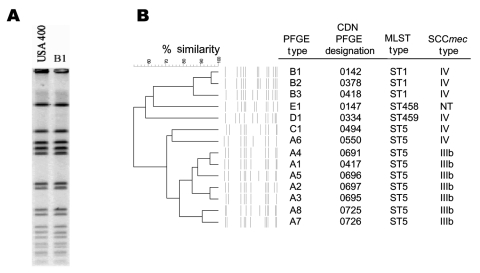
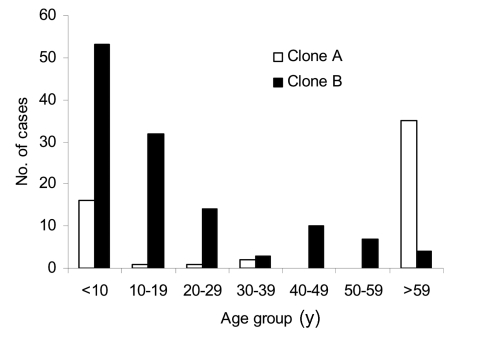
Description:A total of 184 methicillin-resistant Staphylococcus aureus (MRSA) strains were collected from patients who sought treatment primarily for skin and soft tissue infections from January 1, 1999, to March 31, 2002, in east-central Saskatchewan, Canada. Molecular subtyping analysis using pulsed-field gel electrophoresis showed 2 major clusters. Cluster A (n = 55) was composed of a multidrug-resistant MRSA strain associated with a long-term care facility and was similar to the previously reported nosocomial Canadian epidemic strain labeled CMRSA-2. Cluster B (n = 125) was associated with cases identified at community health centers and was indistinguishable from a community-associated (CA)-MRSA strain identified previously in the United States (USA400). Cluster B remained susceptible to a number of classes of antimicrobial agents and harbored the lukF-PV and lukS-PV toxin genes. Over 50% of both clonal groups displayed high-level resistance to mupirocin. This is the first report of the USA400 strain harboring the lukF-PV and lukS-PV toxin genes in Canada.
-
Subjects:
- Adolescent
- Adult
- Aged
- Anti-Bacterial Agents
- Bacterial Proteins
- Bacterial Toxins
- Child
- Communicable Diseases, Emerging
- Community-Acquired Infections
- Exotoxins
- Humans
- Leukocidins
- Methicillin Resistance
- Microbial Sensitivity Tests
- Middle Aged
- Saskatchewan
- Soft Tissue Infections
- Staphylococcal Infections
- Staphylococcal Skin Infections
- Staphylococcus Aureus
-
Source:Emerg Infect Dis. 11(6):844-850.
-
Document Type:
-
Volume:11
-
Issue:6
-
Download URL:
-
File Type:
 [PDF - 207.65 KB]
 -
Collection(s):
-
Main Document Checksum:urn:sha256:79af00d643b2d004ba61868cb61cdd292b44e22349475789177b64ec3543bff8
Supporting Files


File Language:
English
 Was this page helpful?
 Found an issue?



CDC STACKS serves as an archival repository of CDC-published products including
scientific findings, journal articles, guidelines, recommendations, or other public health information authored or
co-authored by CDC or funded partners.
As a repository, CDC STACKS retains documents in their original published format to ensure public access to scientific information.
As a repository, CDC STACKS retains documents in their original published format to ensure public access to scientific information.
You May Also Like
COLLECTION
Emerging Infectious Diseases