



Relative Fitness of Fluoroquinolone-resistant Streptococcus pneumoniae
Supporting Files
Public Domain

-
Jun 2005
Details
-
Alternative Title:Emerg Infect Dis
-
Personal Author:
-
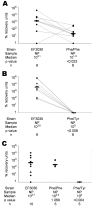
Description:Fluoroquinolone resistance in Streptococcus pneumoniae is primarily mediated by point mutations in the quinolone resistance-determining regions of gyrA and parC. Antimicrobial resistance mutations in housekeeping genes often decrease fitness of microorganisms. To investigate the fitness of quinolone-resistant S. pneumoniae (QRSP), the relative growth efficiencies of 2 isogenic QRSP double mutants were compared with that of their fluoroquinolone-susceptible parent, EF3030, by using murine nasopharyngeal colonization and pneumonia models. Strains containing the GyrA: Ser81Phe, ParC: Ser79Phe double mutations, which are frequently seen in clinical QRSP, competed poorly with EF3030 in competitive colonization or competitive lung infections. However, they efficiently produced lung infection even in the absence of EF3030. The strain containing the GyrA: Ser81Phe, ParC: Ser79Tyr double mutations, which is seen more frequently in laboratory-derived QRSP than in clinical QRSP, demonstrated reduced nasal colonization in competitive or noncompetitive lung infections. However, the strain was equally able to cause competitive or noncompetitive lung infections as well as EF3030.
-
Subjects:
- Research
- Keywords: animal model
- antimicrobial resistance
- fluoroquinolone
- nasopharyngeal carriage
- pneumonia
- Streptococcus pneumoniae
- fitness
- Animals
- Anti-Infective Agents
- Colony Count, Microbial
- DNA Gyrase
- DNA Topoisomerase IV
- Drug Resistance, Bacterial
- Fluoroquinolones
- Humans
- Lung
- Mice
- Mutation
- Nasopharynx
- Pneumonia, Pneumococcal
-
Source:Emerg Infect Dis. 11(6):814-820.
-
Document Type:
-
Volume:11
-
Issue:6
-
Download URL:
-
File Type:
 [PDF - 191.45 KB]
 -
Collection(s):
-
Main Document Checksum:urn:sha256:44aaf28b583ecc596b34f1a53f73147607fd2b9698cbdb756e0b3031b646bec0
Supporting Files


 Was this page helpful?
 Found an issue?






CDC STACKS serves as an archival repository of CDC-published products including
scientific findings, journal articles, guidelines, recommendations, or other public health information authored or
co-authored by CDC or funded partners.
As a repository, CDC STACKS retains documents in their original published format to ensure public access to scientific information.
As a repository, CDC STACKS retains documents in their original published format to ensure public access to scientific information.
You May Also Like
COLLECTION
Emerging Infectious Diseases