



Evaluation of the European League Against Rheumatism/American College of Rheumatology Classification Criteria for Systemic Lupus Erythematosus in a Population Based Registry
Supporting Files

-
5 2023
-
Available in CDC Stacks on May 16, 2024, 12:00 AM
File Language:
English
Details
-
Alternative Title:Arthritis Care Res (Hoboken)
-
Personal Author:Guttmann, Allison ; Denvir, Brendan ; Aringer, Martin ; Buyon, Jill P. ; Belmont, H. Michael ; Sahl, Sara ; Salmon, Jane E. ; Askanase, Anca ; Bathon, Joan M. ; Geraldino-Pardilla, Laura ; Ali, Yousaf ; Ginzler, Ellen M. ; Putterman, Chaim ; Gordon, Caroline ; Helmick, Charles G. ; Parton, Hilary ; Izmirly, Peter M.
-
Description:Objective
Using the Manhattan Lupus Surveillance Program (MLSP), a multi-racial/ethnic population-based registry, we compared three commonly used classification criteria for Systemic Lupus Erythematosus (SLE) to identify unique cases and determine the incidence and prevalence of SLE using the EULAR/ACR criteria.
Methods
SLE cases were defined as fulfilling 1997 ACR, SLICC, or EULAR/ACR classification criteria. We quantified the number of cases uniquely associated with each and the number fulfilling all three. Prevalence and incidence using the EULAR/ACR classification criteria and associated 95% confidence intervals (CI) were calculated.
Results
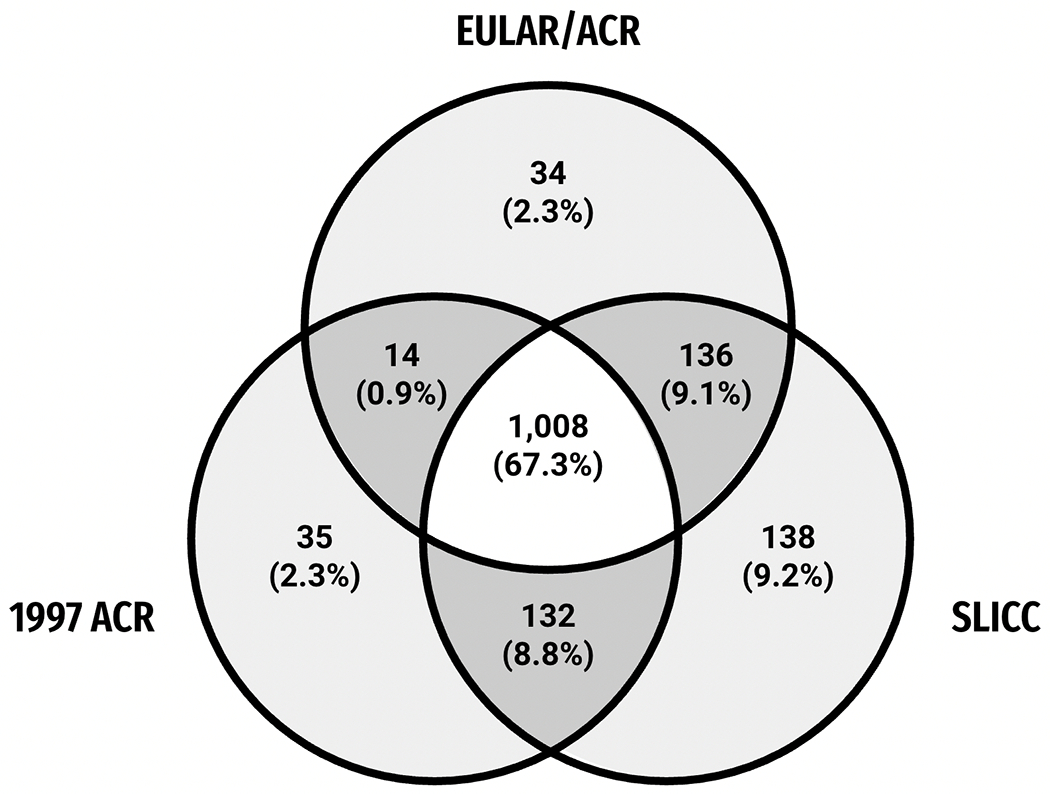
1,497 cases fulfilled at least one of the three classification criteria, with 1,008 (67.3%) meeting all three classifications, 138 (9.2%) fulfilling only SLICC criteria, 35 (2.3%) fulfilling only ACR criteria and 34 (2.3%) uniquely fulfilling EULAR/ACR criteria. Patients solely satisfying EULAR/ACR criteria had fewer than four manifestations. The majority classified only by the ACR criteria did not meet any of the defined immunologic criteria. Patients fulfilling only SLICC criteria did so based on the presence of features unique to this system. Using the EULAR/ACR classification criteria, age-adjusted overall prevalence and incidence rates of SLE in Manhattan were 59.6 (95%CI:55.9-63.4) and 4.9 (95%CI 4.3-5.5) per 100,000 population, with age-adjusted prevalence and incidence rates highest among non-Hispanic Black females.
Conclusion
Applying the three commonly used classification criteria to a population-based registry identified patients with SLE fulfilling only one validated definition. The most recently developed EULAR/ACR classification criteria revealed similar prevalence and incidence estimates to those previously established for the ACR and SLICC classification schemes. -
Subjects:
-
Source:Arthritis Care Res (Hoboken). 75(5):1007-1016
-
Pubmed ID:35638708
-
Pubmed Central ID:PMC11098446
-
Document Type:
-
Funding:
-
Place as Subject:
-
Volume:75
-
Issue:5
-
Download URL:
-
File Type:
 [PDF - 465.32 KB]
 -
Collection(s):
-
Main Document Checksum:urn:sha256:bf3c644fac94a00737e86c36cd50e0dfe7c7301c266b8a3c5e414b0e6064e6de
Supporting Files


File Language:
English
 Was this page helpful?
 Found an issue?


CDC STACKS serves as an archival repository of CDC-published products including
scientific findings, journal articles, guidelines, recommendations, or other public health information authored or
co-authored by CDC or funded partners.
As a repository, CDC STACKS retains documents in their original published format to ensure public access to scientific information.
As a repository, CDC STACKS retains documents in their original published format to ensure public access to scientific information.
You May Also Like
COLLECTION
CDC Public Access