



Multicenter Outbreak of Gram-Negative Bloodstream Infections in Hemodialysis Patients
Supporting Files

-
11 2019 ; 11-2019
-
Available in CDC Stacks on 2024-01-30T00:00:00Z
File Language:
English
Details
-
Alternative Title:Am J Kidney Dis
-
Personal Author:Novosad, Shannon A. ; Lake, Jason ; Nguyen, Duc ; Soda, Elizabeth ; Moulton-Meissner, Heather ; Pho, Mai T. ; Gualandi, Nicole ; Bepo, Lurit ; Stanton, Richard A. ; Daniels, Jonathan B. ; Turabelidze, George ; Van Allen, Kristen ; Arduino, Matthew ; Halpin, Alison Laufer ; Layden, Jennifer ; Patel, Priti R.
-
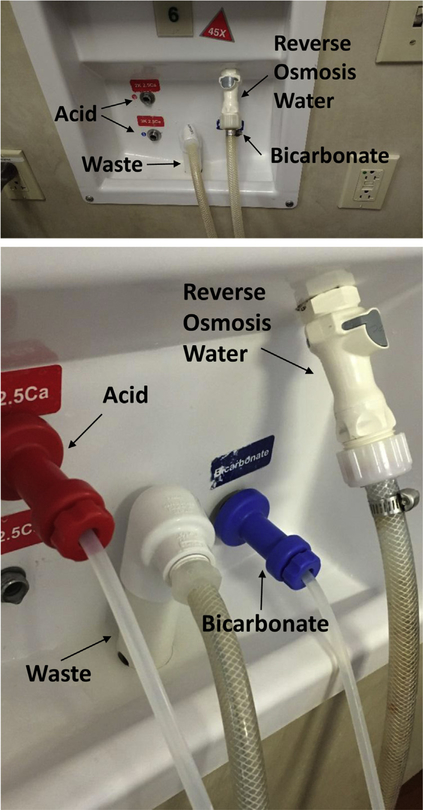
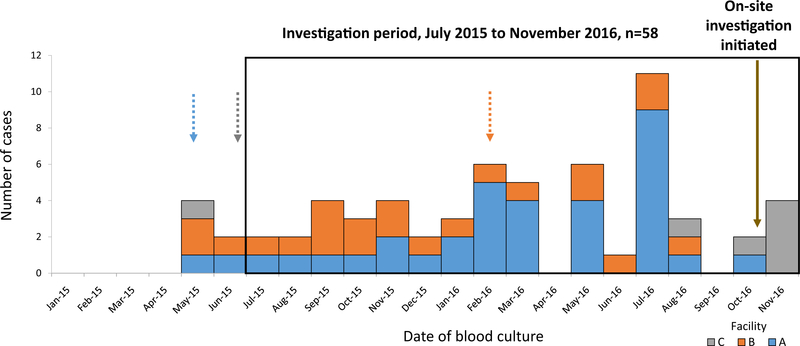
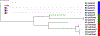
Description:Rationale & Objective ; Contaminated water and other fluids are increasingly recognized to be associated with health care–associated infections. We investigated an outbreak of Gram-negative bloodstream infections at 3 outpatient hemodialysis facilities. ; Study Design ; Matched case-control investigations. ; Setting & Participants ; Patients who received hemodialysis at Facility A, B, or C from July 2015 to November 2016. ; Exposures ; Infection control practices, sources of water, dialyzer reuse, injection medication handling, dialysis circuit priming, water and dialysate test findings, environmental reservoirs such as wall boxes, vascular access care practices, pulsed-field gel electrophoresis, and whole-genome sequencing of bacterial isolates. ; Outcomes ; Cases were defined by a positive blood culture for any Gram-negative bacteria drawn July 1, 2015 to November 30, 2016 from a patient who had received hemodialysis at Facility A, B, or C. ; Analytical Approach ; Exposures in cases and controls were compared using matched univariate conditional logistic regression. ; Results ; 58 cases of Gram-negative bloodstream infection occurred; 48 (83%) required hospitalization. The predominant organisms were Serratia marcescens (n = 21) and Pseudomonas aeruginosa (n = 12). Compared with controls, cases had higher odds of using a central venous catheter for dialysis (matched odds ratio, 54.32; lower bound of the 95% CI, 12.19). Facility staff reported pooling and regurgitation of waste fluid at recessed wall boxes that house connections for dialysate components and the effluent drain within dialysis treatment stations. Environmental samples yielded S marcescens and P aeruginosa from wall boxes. S marcescens isolated from wall boxes and case-patients from the same facilities were closely related by pulsed-field gel electrophoresis and whole-genome sequencing. We identified opportunities for health care workers’ hands to contaminate central venous catheters with contaminated fluid from the wall boxes. ; Limitations ; Limited patient isolates for testing, on-site investigation occurred after peak of infections. ; Conclusions ; This large outbreak was linked to wall boxes, a previously undescribed source of contaminated fluid and biofilms in the immediate patient care environment.
-
Subjects:
-
Source:Am J Kidney Dis. 74(5):610-619
-
Pubmed ID:31375298
-
Pubmed Central ID:PMC10826890
-
Document Type:
-
Funding:
-
Volume:74
-
Issue:5
-
Download URL:
-
File Type:
 [PDF - 710.04 KB]
 -
Collection(s):
-
Main Document Checksum:urn:sha-512:15c2db5caf739ce880588d3484c7f2615ea08dadf146bf4ddd0c12cd4c817ae8de9ea654abb1d82c7c5c75e8a6cb0799383264467918511271ec454cfef1e122
Supporting Files


File Language:
English
 Was this page helpful?
 Found an issue?

CDC STACKS serves as an archival repository of CDC-published products including
scientific findings, journal articles, guidelines, recommendations, or other public health information authored or
co-authored by CDC or funded partners.
As a repository, CDC STACKS retains documents in their original published format to ensure public access to scientific information.
As a repository, CDC STACKS retains documents in their original published format to ensure public access to scientific information.
You May Also Like
COLLECTION
CDC Public Access