



Tuberculosis Elimination in the Netherlands
Supporting Files
Public Domain

-
Apr 2005
Details
-
Alternative Title:Emerg Infect Dis
-
Personal Author:
-
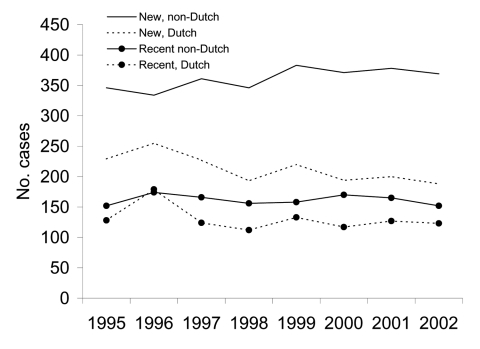
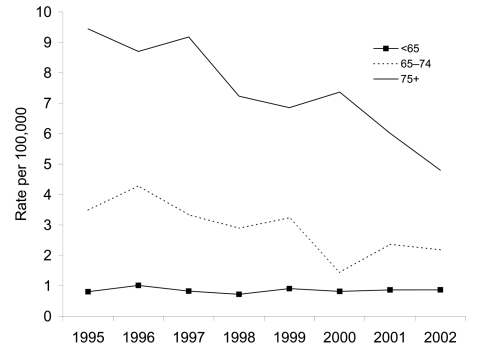
Description:This study assessed progress towards tuberculosis (TB) elimination in the Netherlands by using DNA fingerprinting. Mycobacterium tuberculosis strains were defined as new if the IS6110 restriction fragment length polymorphism pattern had not been observed in any other patient during the previous 2 years. Other cases were defined as clustered and attributed to recent transmission. In the period 1995-2002, the incidence of TB with new strains was stable among non-Dutch residents and declined among the Dutch. However, the decline among the Dutch was restricted to those >or=65 years of age. Moreover, the average number of secondary cases per new strain did not change significantly over time. We conclude that the decline of TB in the Netherlands over the past decade was mainly the result of a cohort effect: older birth cohorts with high infection prevalence were replaced by those with lower infection prevalence. Under current epidemiologic conditions and control efforts, TB may not be eliminated.
-
Subjects:
-
Source:Emerg Infect Dis. 11(4):597-602.
-
Document Type:
-
Volume:11
-
Issue:4
-
Download URL:
-
File Type:
 [PDF - 228.25 KB]
 -
Collection(s):
-
Main Document Checksum:urn:sha256:f452b43ecfe95f77e44b0458f36bdf3c46e7e91a65908d0b25d95f2553dd7dc4
Supporting Files


 Was this page helpful?
 Found an issue?


CDC STACKS serves as an archival repository of CDC-published products including
scientific findings, journal articles, guidelines, recommendations, or other public health information authored or
co-authored by CDC or funded partners.
As a repository, CDC STACKS retains documents in their original published format to ensure public access to scientific information.
As a repository, CDC STACKS retains documents in their original published format to ensure public access to scientific information.
You May Also Like
COLLECTION
Emerging Infectious Diseases