



Piscichuvirus-Associated Severe Meningoencephalomyelitis in Aquatic Turtles, United States, 2009–2021
Supporting Files
Public Domain

-
2 2024
File Language:
English
Details
-
Alternative Title:Emerg Infect Dis
-
Personal Author:Laovechprasit, Weerapong ; Young, Kelsey T. ; Stacy, Brian A. ; Tillis, Steven B. ; Ossiboff, Robert J. ; Vann, Jordan A. ; Subramaniam, Kuttichantran ; Agnew, Dalen W. ; Howerth, Elizabeth W. ; Zhang, Jian ; Whitaker, Shayna ; Walker, Alicia ; Orgill, Andrew M. ; Howell, Lyndsey N. ; Shaver, Donna J. ; Donnelly, Kyle ; Foley, Allen M. ; Stanton, James B.
-
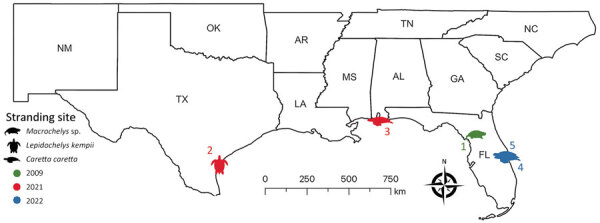
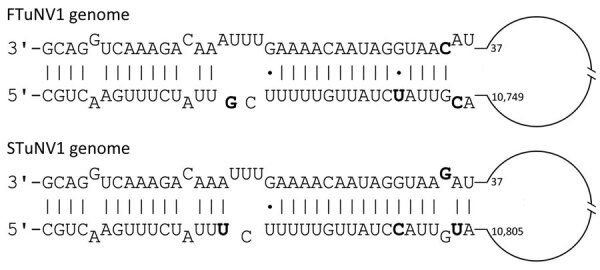
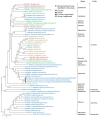
Description:Viruses from a new species of piscichuvirus were strongly associated with severe lymphocytic meningoencephalomyelitis in several free-ranging aquatic turtles from 3 coastal US states during 2009-2021. Sequencing identified 2 variants (freshwater turtle neural virus 1 FTuNV1 and sea turtle neural virus 1 STuNV1) of the new piscichuvirus species in 3 turtles of 3 species. In situ hybridization localized viral mRNA to the inflamed region of the central nervous system in all 3 sequenced isolates and in 2 of 3 additional nonsequenced isolates. All 3 sequenced isolates phylogenetically clustered with other vertebrate chuvirids within the genus Piscichuvirus. FTuNV1 and STuNV1 shared ≈92% pairwise amino acid identity of the large protein, which narrowly places them within the same novel species. The in situ association of the piscichuviruses in 5 of 6 turtles (representing 3 genera) with lymphocytic meningoencephalomyelitis suggests that piscichuviruses are a likely cause of lymphocytic meningoencephalomyelitis in freshwater and marine turtles.
-
Subjects:
-
Keywords:
-
Source:Emerg Infect Dis. 2024; 30(2):280-288
-
Pubmed ID:38270209
-
Pubmed Central ID:PMC10826744
-
Document Type:
-
Place as Subject:
-
Volume:30
-
Issue:2
-
Download URL:
-
File Type:
 [PDF - 2.54 MB]
 -
Collection(s):
-
Main Document Checksum:urn:sha256:80ebf3d9981f8bde86b6713f7043331a3a7b2df3d7381473256c6b017970f09f
Supporting Files


File Language:
English
 Was this page helpful?
 Found an issue?



CDC STACKS serves as an archival repository of CDC-published products including
scientific findings, journal articles, guidelines, recommendations, or other public health information authored or
co-authored by CDC or funded partners.
As a repository, CDC STACKS retains documents in their original published format to ensure public access to scientific information.
As a repository, CDC STACKS retains documents in their original published format to ensure public access to scientific information.
You May Also Like
COLLECTION
Emerging Infectious Diseases