



Childhood Hemolytic Uremic Syndrome, United Kingdom and Ireland
Supporting Files
Public Domain

-
Apr 2005
File Language:
English
Details
-
Alternative Title:Emerg Infect Dis
-
Personal Author:Lynn, Richard M. ; O'Brien, Sarah J. ; Taylor, C. Mark ; Adak, Goutam K. ; Chart, Henrik ; Cheasty, Tom ; Coia, John E. ; Gillespie, Iain A. ; Locking, Mary E. ; Reilly, William J. ; Smith, Henry R. ; Waters, Aoife ; Willshaw, Geraldine A.
-
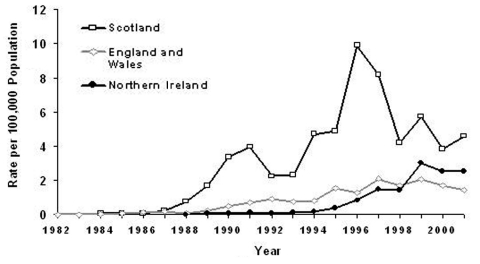
Description:We conducted prospective surveillance of childhood hemolytic uremic syndrome (HUS) from 1997 to 2001 to describe disease incidence and clinical, epidemiologic and microbiologic characteristics. We compared our findings, where possible, with those of a previous study conducted from 1985 to 1988. The average annual incidence of HUS for the United Kingdom and Ireland (0.71/100,000) was unchanged from 1985 to 1988. The overall early mortality had halved, but the reduction in mortality was almost entirely accounted for by improved outcome in patients with diarrhea-associated HUS. The principal infective cause of diarrhea-associated HUS was Shiga toxin-producing Escherichia coli O157 (STEC O157), although in the 1997-2001 survey STEC O157 phage type (PT) 21/28 had replaced STEC O157 PT2 as the predominant PT. The risk of developing diarrhea-associated HUS was significantly higher in children infected with STEC O157 PT 2 and PT 21/28 compared with other PTs. Hypertension as a complication of HUS was greatly reduced in patients with diarrhea-associated HUS.
-
Subjects:
-
Source:Emerg Infect Dis. 11(4):590-596.
-
Document Type:
-
Place as Subject:
-
Volume:11
-
Issue:4
-
Download URL:
-
File Type:
 [PDF - 198.11 KB]
 -
Collection(s):
-
Main Document Checksum:urn:sha256:ba34058678479e092598cf8893acc9070d659835766066eb41924c41b6bb7bb9
Supporting Files


File Language:
English
 Was this page helpful?
 Found an issue?


CDC STACKS serves as an archival repository of CDC-published products including
scientific findings, journal articles, guidelines, recommendations, or other public health information authored or
co-authored by CDC or funded partners.
As a repository, CDC STACKS retains documents in their original published format to ensure public access to scientific information.
As a repository, CDC STACKS retains documents in their original published format to ensure public access to scientific information.
You May Also Like
COLLECTION
Emerging Infectious Diseases