



Genetic Characterization of Hantaviruses Transmitted by the Korean Field Mouse (Apodemus peninsulae), Far East Russia
Supporting Files
Public Domain

-
2002/08/01
-
Series: Emerging Infectious Diseases
File Language:
English
Details
-
Journal Article:Emerging Infectious Diseases
-
Personal Author:Lokugamage, Kumari ; Kariwa, Hiroaki ; Hayasaka, Daisuke ; Cui, Bai Zhong ; Iwasaki, Takuya ; Lokugamage, Nandadeva ; Ivanov, Leonid I. ; Volkov, Vladimir I. ; Demenev, Vladimir A. ; Slonova, Raisa ; Kompanets, Galina ; Kushnaryova, Tatyana ; Kurata, Takeshi ; Maeda, Kenji ; Araki, Koichi ; Mizutani, Tetsuya ; Yoshimatsu, Kumiko ; Arikawa, Jiro ; Takashima, Ikuo
-
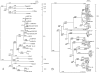
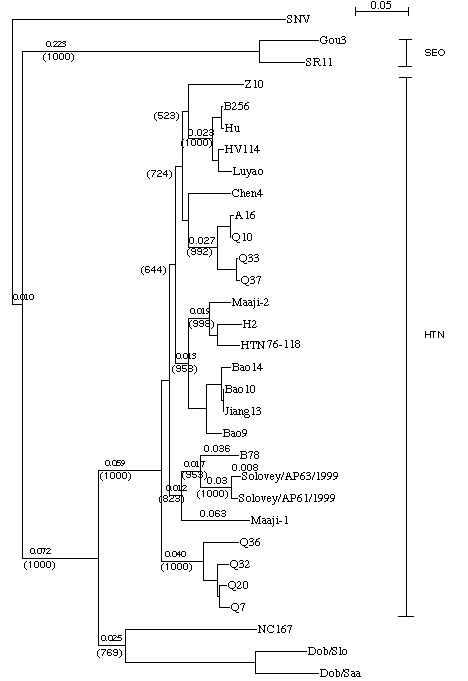
Description:In an epizootiologic survey of 122 rodents captured in Vladivostok, Russia, antibodies positive for hantavirus were found in Apodemus peninsulae (4/70), A. agrarius (1/39), and Clethrionomys rufocanus (1/8). The hantavirus sequences identified in two seropositive A. peninsulae and two patients with hemorrhagic fever with renal syndrome (HFRS) from the Primorye region of Far East Russia were designated as Solovey and Primorye, respectively. The nucleotide sequences of the Solovey, Primorye, and Amur (obtained through GenBank) sequences were closely related (>92% identity). Solovey and Primorye sequences shared 84% nucleotide identity with the prototype Hantaan 76-118. Phylogenetic analysis also indicated a close relationship between Solovey, Primorye, Amur, and other viruses identified in Russia, China, and Korea. Our findings suggest that the Korean field mouse (A. peninsulae) is the reservoir for a hantavirus that causes HFRS over a vast area of east Asia, including Far East Russia.
-
Subjects:
-
Series:
-
DOI:
-
ISSN:1080-6059 (digital) ; 1080-6040 (print)
-
Pubmed ID:12141960
-
Pubmed Central ID:PMC2732528
-
Document Type:
-
Genre:
-
Place as Subject:
-
Rights:Public Domain
-
Topic:
-
Location:
-
Volume:8
-
Issue:8
-
Citation:Emerg Infect Dis. 8(8):768-776.
-
Download URL:
-
File Type:
 [PDF - 380.99 KB]
 -
Collection(s):
-
Main Document Checksum:urn:sha-512:f27eaeed362623552692321168d1551f4ff557ac9350e725dfbd6ce7b91d4d5d9783826b2b1c22cb593d7d620f2458e0c982b498c948ae33399741dff9e66a7e
Supporting Files


File Language:
English
 Was this page helpful?
 Found an issue?






CDC STACKS serves as an archival repository of CDC-published products including
scientific findings, journal articles, guidelines, recommendations, or other public health information authored or
co-authored by CDC or funded partners.
As a repository, CDC STACKS retains documents in their original published format to ensure public access to scientific information.
As a repository, CDC STACKS retains documents in their original published format to ensure public access to scientific information.
You May Also Like
COLLECTION
Emerging Infectious Diseases