



European Bat Lyssavirus Infection in Spanish Bat Populations
Supporting Files
Public Domain

-
Apr 2002
File Language:
English
Details
-
Alternative Title:Emerg Infect Dis
-
Personal Author:
-
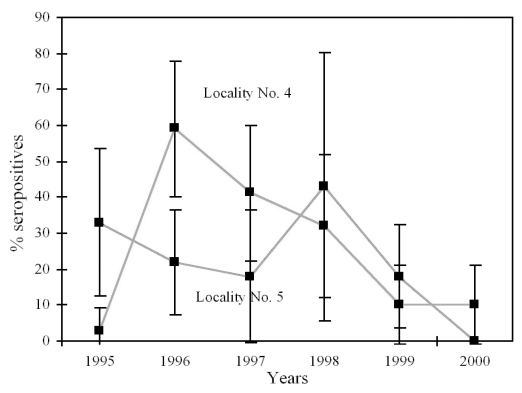
Description:From 1992 to 2000, 976 sera, 27 blood pellets, and 91 brains were obtained from 14 bat species in 37 localities in Spain. Specific anti-European bat lyssavirus 1 (EBL1)-neutralizing antibodies have been detected in Myotis myotis, Miniopterus schreibersii, Tadarida teniotis, and Rhinolophus ferrumequinum in the region of Aragon and the Balearic Islands. Positive results were also obtained by nested reverse transcription-polymerase chain reaction on brain, blood pellet, lung, heart, tongue, and esophagus-larynx-pharynx of M. myotis, Myotis nattereri, R. ferrumequinum, and M. schreibersii. Determination of nucleotide sequence confirmed the presence of EBL1 RNA in the different tissues. In one colony, the prevalence of seropositive bats over time corresponded to an asymmetrical curve, with a sudden initial increase peaking at 60% of the bats, followed by a gradual decline. Banded seropositive bats were recovered during several years, indicating that EBL1 infection in these bats was nonlethal. At least one of this species (M. schreibersii) is migratory and thus could be partially responsible for the dissemination of EBL1 on both shores of the Mediterranean Sea.
-
Subjects:
-
Source:Emerg Infect Dis. 8(4):413-420.
-
Document Type:
-
Place as Subject:
-
Volume:8
-
Issue:4
-
Download URL:
-
File Type:
 [PDF - 723.26 KB]
 -
Collection(s):
-
Main Document Checksum:urn:sha256:8d9d3eabe5471aa9d2121255dc40065da33dda27d1863afded8ebdf4f8b1da67
Supporting Files


File Language:
English
 Was this page helpful?
 Found an issue?




CDC STACKS serves as an archival repository of CDC-published products including
scientific findings, journal articles, guidelines, recommendations, or other public health information authored or
co-authored by CDC or funded partners.
As a repository, CDC STACKS retains documents in their original published format to ensure public access to scientific information.
As a repository, CDC STACKS retains documents in their original published format to ensure public access to scientific information.
You May Also Like
COLLECTION
Emerging Infectious Diseases