


Population immunity to polioviruses in the context of a large-scale wild poliovirus type 1 outbreak in Tajikistan, 2010
Supporting Files

-
10 01 2013
-
File Language:
English
Details
-
Alternative Title:Vaccine
-
Personal Author:
-
Description:Background:
A serosurvey to evaluate population immunity to polioviruses (PVs) in the context of the importation-related wild PV1 outbreak in Tajikistan in 2010 (461 confirmed cases among children and young adults) was conducted.
Methods:
Serum specimens from a nationwide sample of 1–24 year-old persons selected through stratified cluster sampling (n = 2447) were tested for neutralizing antibodies to all three PV types. Samples with titers < 1:8 were considered seronegative. The serosurvey was conducted during the interval after mOPV1 supplementary immunization activities (SIAs) and before tOPV SIAs (targeting ages ≤ 15 years) implemented to control the outbreak. In the absence of pre-outbreak specimens, results for PV3 were used as a proxy for pre-outbreak PV1 immunity patterns.
Results:
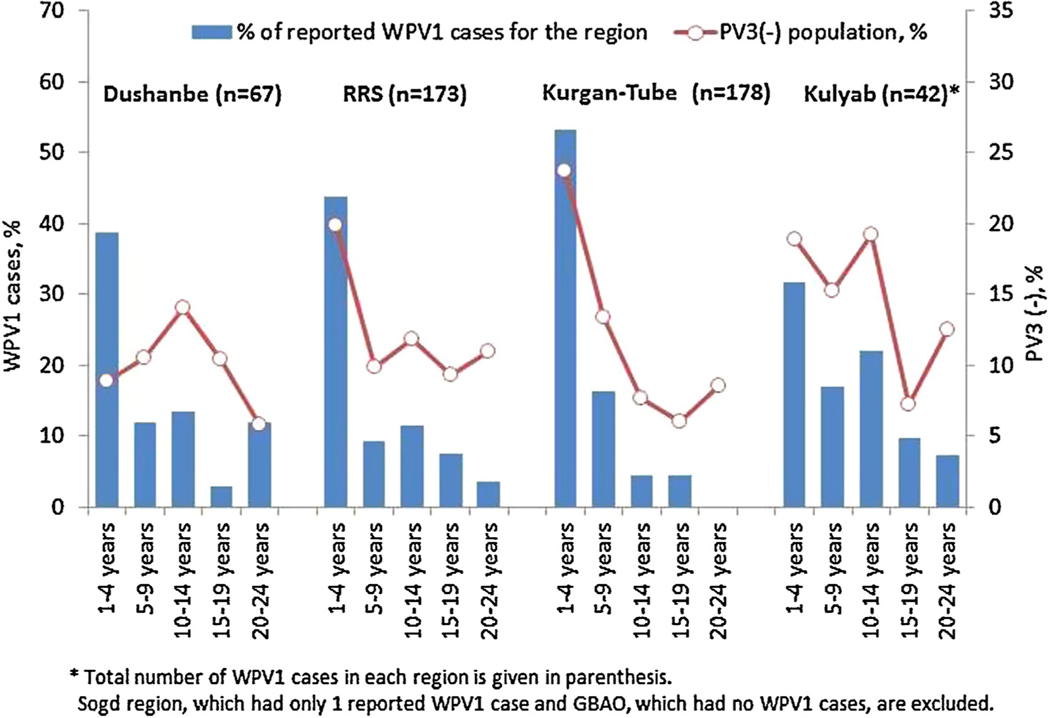
Overall, PV1 seroprevalence was 98.9%, PV2 seroprevalence was 98.8%, and PV3 seroprevalence was 86.9%. PV1 and PV2 seroprevalence exceeded 95% in all age groups and regions. PV3 seroprevalence was <90% in all age groups and regions, except 15–19 year-olds (91.7%) and Dushanbe (90.0%). PV3 seroprevalence was lowest among 1–4 (82.7%) and 5–9 (84.4%) year-olds, particularly among 1–4 year-olds in Kurgan-Tube (76.3%) and RRS (80.0%) regions. Birth cohorts immunized only through routine services (ages, 1–7 years) had lower PV3 seroprevalence than birth cohorts targeted by the SIAs during 1995–2002 (8–19 years): 82.5% versus 89.3%, p < 0.001.
Conclusions:
Suboptimal (<90%) PV3 seroprevalence across wide age range suggests the outbreak resulted from accumulation of susceptibles due to suboptimal coverage over a long time period, particularly in the birth cohorts immunized only through routine services and in areas where the outbreak began (Kurgan-Tube and RRS). High PV1 seroprevalence indicates that mOPV1 SIAs with expanded target age (≤15 years) succeeded in closing the immunity gap and ongoing WPV1 transmission is unlikely. To accelerate outbreak control in areas which have been polio-free for long time, expanding SIA target age should be considered.
-
Subjects:
-
Source:Vaccine. 31(42):4911-4916
-
Pubmed ID:23891502
-
Pubmed Central ID:PMC10465070
-
Document Type:
-
Funding:
-
Volume:31
-
Issue:42
-
Collection(s):
-
Main Document Checksum:urn:sha256:b6cba6fd2b739c288624184485df273887f506b13562c25aa0c9e733626c6523
-
Download URL:
-
File Type:
 [PDF
- 622.01 KB
]
[PDF
- 622.01 KB
]
Supporting Files


File Language:
English
ON THIS PAGE

CDC STACKS serves as an archival repository of CDC-published products including
scientific findings,
journal articles, guidelines, recommendations, or other public health information authored or
co-authored by CDC or funded partners.
As a repository, CDC STACKS retains documents in their original published format to ensure public access to scientific information.
As a repository, CDC STACKS retains documents in their original published format to ensure public access to scientific information.
You May Also Like
COLLECTION
CDC Public Access