


Education and employment as young adults living with spina bifida transition to adulthood in the USA: A study of the National Spina Bifida Patient Registry
Supporting Files

-
6 2023
-

File Language:
English
Details
-
Alternative Title:Dev Med Child Neurol
-
Personal Author:
-
Description:Aim:
To describe the education and employment transition experience of young adults with spina bifida (YASB) and investigate factors associated with employment.
Method:
We queried education and employment data from the US National Spina Bifida Patient Registry from 2009 to 2019. We applied generalized estimating equations models to analyze sociodemographic and disease-related factors associated with employment.
Results:
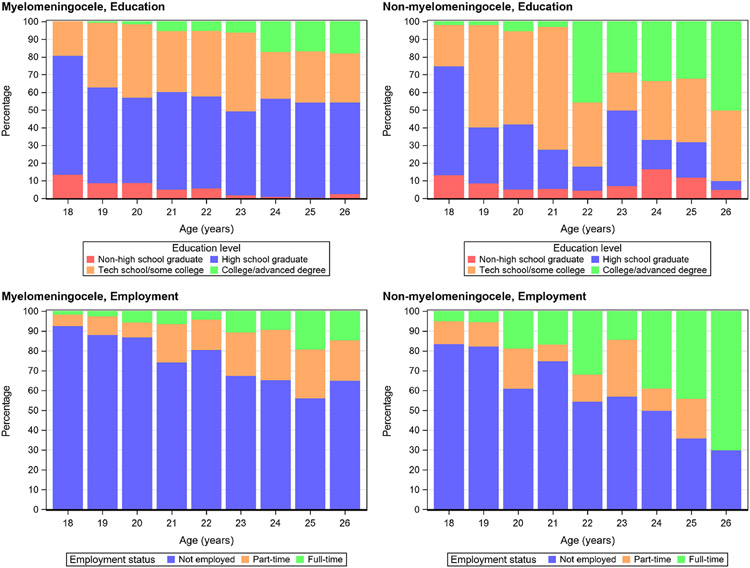
A total of 1909 participants (850 males, 1059 females) aged 18 to 26 years contributed 4379 annual visits. Nearly 84% had myelomeningocele and, at last visit, the median age was 21 years (mean 21 years 5 months, SD 2 years 10 months). A total of 41.8% had at least some post-high school education, and 23.9% were employed. In a multivariable regression model, employment was significantly associated with education level, lower extremity functional level, bowel continence, insurance, and history of non-shunt surgery. This large, national sample of YASB demonstrated low rates of post-secondary education attainment and employment and several potentially modifiable factors associated with employment.
Interpretation:
Specific sociodemographic, medical, and functional factors associated with employment are important for clinicians to consider when facilitating transition for YASB into adulthood. Additional research is needed to understand the impact of cognitive functioning and social determinants of health on transition success in YASB.
-
Subjects:
-
Source:Dev Med Child Neurol. 65(6):821-830
-
Pubmed ID:36385606
-
Pubmed Central ID:PMC10415865
-
Document Type:
-
Funding:U01DD001279/ACL/ACL HHSUnited States/ ; U01 DD001268/DD/NCBDD CDC HHSUnited States/ ; U01 DD001279/DD/NCBDD CDC HHSUnited States/ ; U01DD001093/ACL/ACL HHSUnited States/ ; U01DD001062/ACL/ACL HHSUnited States/ ; U01 DD001057/DD/NCBDD CDC HHSUnited States/ ; U01 DD001275/DD/NCBDD CDC HHSUnited States/ ; U01DD001272/ACL/ACL HHSUnited States/ ; U01 DD001237/DD/NCBDD CDC HHSUnited States/ ; U01DD001057/ACL/ACL HHSUnited States/ ; U01 DD000738/DD/NCBDD CDC HHSUnited States/ ; U01DD001065/ACL/ACL HHSUnited States/ ; U01 DD001280/DD/NCBDD CDC HHSUnited States/ ; U01DD001235/ACL/ACL HHSUnited States/ ; U01 DD001235/DD/NCBDD CDC HHSUnited States/ ; U01DD001268/ACL/ACL HHSUnited States/ ; U01 DD000742/DD/NCBDD CDC HHSUnited States/ ; U01DD001275/ACL/ACL HHSUnited States/ ; U01 DD001082/DD/NCBDD CDC HHSUnited States/ ; U01 DD001093/DD/NCBDD CDC HHSUnited States/ ; U01DD001240/ACL/ACL HHSUnited States/ ; U01 DD001278/DD/NCBDD CDC HHSUnited States/ ; U01DD001270/ACL/ACL HHSUnited States/ ; U01DD001274/ACL/ACL HHSUnited States/ ; U01 DD000740/DD/NCBDD CDC HHSUnited States/ ; U01DD001266/ACL/ACL HHSUnited States/ ; U01 DD000774/DD/NCBDD CDC HHSUnited States/ ; U01 DD001265/DD/NCBDD CDC HHSUnited States/ ; U01 DD001062/DD/NCBDD CDC HHSUnited States/ ; U01 DD001240/DD/NCBDD CDC HHSUnited States/ ; U01 DD001274/DD/NCBDD CDC HHSUnited States/ ; U01DD001280/ACL/ACL HHSUnited States/ ; U01 DD001262/DD/NCBDD CDC HHSUnited States/ ; U01 DD001270/DD/NCBDD CDC HHSUnited States/ ; U01 DD001065/DD/NCBDD CDC HHSUnited States/ ; U01 DD000743/DD/NCBDD CDC HHSUnited States/ ; U01DD001265/ACL/ACL HHSUnited States/ ; U01 DD001266/DD/NCBDD CDC HHSUnited States/ ; U01 DD001272/DD/NCBDD CDC HHSUnited States/ ; U01DD001278/ACL/ACL HHSUnited States/
-
Volume:65
-
Issue:6
-
Collection(s):
-
Main Document Checksum:urn:sha256:b973ef96dbf78b966f09816c4f9b2a1c69eaf7c35aca988c7e0eb670c2880c56
-
Download URL:
-
File Type:
 [PDF
- 592.19 KB
]
[PDF
- 592.19 KB
]


File Language:
English
ON THIS PAGE

CDC STACKS serves as an archival repository of CDC-published products including
scientific findings,
journal articles, guidelines, recommendations, or other public health information authored or
co-authored by CDC or funded partners.
As a repository, CDC STACKS retains documents in their original published format to ensure public access to scientific information.
As a repository, CDC STACKS retains documents in their original published format to ensure public access to scientific information.
You May Also Like
COLLECTION
CDC Public Access