


Estimating the Likely Coverage of Inactivated Poliovirus Vaccine in Routine Immunization: Evidence From Demographic and Health Surveys
Supporting Files

-
11 01 2014
-
File Language:
English
Details
-
Alternative Title:J Infect Dis
-
Personal Author:
-
Description:Background
The Strategic Advisory Group of Experts on Immunization (SAGE) has recommended introduction of at least 1 dose of inactivated poliovirus vaccine (IPV) at ≥14 weeks of age through the routine immunization program in countries currently not using IPV.
Methods
We analyzed all available unrestricted data obtained from the Demographic and Health Surveys since 2005 in sub-Saharan Africa (31 countries) and in South and Southeast Asia (9 countries) to determine coverage of the following injectable vaccines delivered through the routine immunization schedule: diphtheria-tetanus-pertussis vaccine dose 1 (DTP1), DTP2, DTP3, and measles vaccine. Coverage with these vaccines was used as a proxy measure of likely 1- and 2-dose IPV coverage.
Results
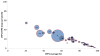
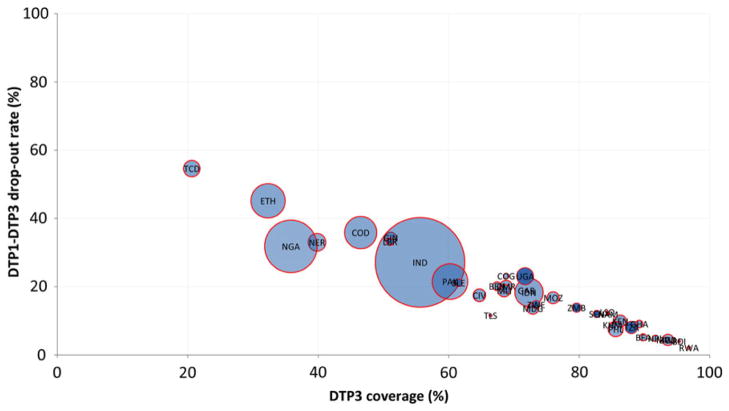
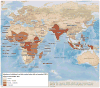
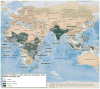
Coverage with 1 dose of IPV is expected to be lowest when offered with DTP3 (median coverage, 73%) and highest when offered with DTP1 (median coverage, 90%). The median DTP1-DTP3 drop-out rate was 14%, which equates to an additional 12 million children not receiving IPV if IPV is offered with DTP3, rather than with DTP1. An increased geographical clustering of children who have not received IPV is expected in sub-Saharan Africa and Asia if IPV is offered with DTP3, rather than with DTP1. Coverage with 2 doses of IPV is expected to be lowest if IPV is administered with DTP3 and measles vaccine (69%) and highest if administered with DTP1 and DTP2 (84%).
Conclusions
Coverage with 1 dose of IPV is expected to be lowest if it is administered at the DTP3 visit. At present, there is insufficient evidence to determine whether the SAGE-recommended IPV schedule for the polio endgame would maximize population immunity to type 2 poliovirus.
-
Subjects:
-
Source:J Infect Dis. 210(Suppl 1):S465-S474
-
Pubmed ID:25316869
-
Pubmed Central ID:PMC10287983
-
Document Type:
-
Funding:
-
Place as Subject:
-
Volume:210
-
Collection(s):
-
Main Document Checksum:urn:sha256:e26604bf79098b3185879a8ad8419289c9afd2695edb5bfc5aa44798afadb0bc
-
Download URL:
-
File Type:
 [PDF
- 1.11 MB
]
[PDF
- 1.11 MB
]
Supporting Files


File Language:
English
ON THIS PAGE



CDC STACKS serves as an archival repository of CDC-published products including
scientific findings,
journal articles, guidelines, recommendations, or other public health information authored or
co-authored by CDC or funded partners.
As a repository, CDC STACKS retains documents in their original published format to ensure public access to scientific information.
As a repository, CDC STACKS retains documents in their original published format to ensure public access to scientific information.
You May Also Like
COLLECTION
CDC Public Access