



Widespread Exposure to Mosquitoborne California Serogroup Viruses in Caribou, Arctic Fox, Red Fox, and Polar Bears, Canada
Supporting Files
Public Domain

-
1 2023
File Language:
English
Details
-
Alternative Title:Emerg Infect Dis
-
Personal Author:Buhler, Kayla J. ; Dibernardo, Antonia ; Pilfold, Nicholas W. ; Harms, N. Jane ; Fenton, Heather ; Carriere, Suzanne ; Kelly, Allicia ; Schwantje, Helen ; Aguilar, Xavier Fernandez ; Leclerc, Lisa-Marie ; Gouin, Geraldine G. ; Lunn, Nicholas J. ; Richardson, Evan S. ; McGeachy, David ; Bouchard, Émilie ; Ortiz, Adrián Hernández ; Samelius, Gustaf ; Lindsay, L. Robbin ; Drebot, Michael A. ; Gaffney, Patricia ; Leighton, Patrick ; Alisauskas, Ray ; Jenkins, Emily
-
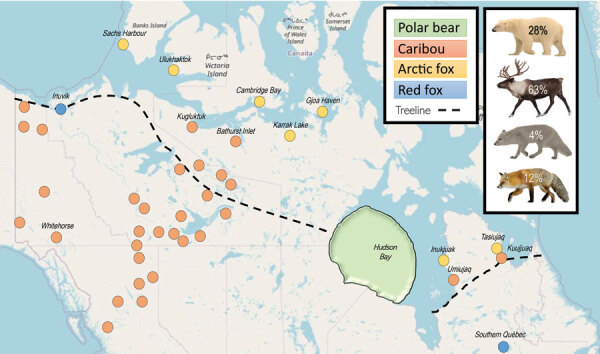
Description:Northern Canada is warming at 3 times the global rate. Thus, changing diversity and distribution of vectors and pathogens is an increasing health concern. California serogroup (CSG) viruses are mosquitoborne arboviruses; wildlife reservoirs in northern ecosystems have not been identified. We detected CSG virus antibodies in 63% (95% CI 58%-67%) of caribou (n = 517), 4% (95% CI 2%-7%) of Arctic foxes (n = 297), 12% (95% CI 6%-21%) of red foxes (n = 77), and 28% (95% CI 24%-33%) of polar bears (n = 377). Sex, age, and summer temperatures were positively associated with polar bear exposure; location, year, and ecotype were associated with caribou exposure. Exposure was highest in boreal caribou and increased from baseline in polar bears after warmer summers. CSG virus exposure of wildlife is linked to climate change in northern Canada and sustained surveillance could be used to measure human health risks.
-
Subjects:
- Research
- Widespread Exposure to Mosquitoborne California Serogroup Viruses in Caribou, Arctic Fox, Red Fox, and Polar Bears, Canada
- arboviruses
- California serogroup viruses
- vector-borne infections
- viruses
- zoonoses
- climate change
- Jamestown Canyon virus
- snowshoe hare virus
- caribou
- Arctic fox
- red fox
- polar bear
- rodents
- Canada
- Animals
- Humans
- Foxes
- Ursidae
- Reindeer
- Ecosystem
- Serogroup
- Encephalitis Virus, California
- Animals, Wild
-
Source:Emerg Infect Dis. 2023; 29(1):54-63
-
Pubmed ID:36573538
-
Pubmed Central ID:PMC9796188
-
Document Type:
-
Volume:29
-
Issue:1
-
Download URL:
-
File Type:
 [PDF - 865.84 KB]
 -
Collection(s):
-
Main Document Checksum:urn:sha256:c2c0ab978e7074fa207ca7abbe41d638f57653f5f7143f0dc32a3896ae0a1951
Supporting Files


File Language:
English
 Was this page helpful?
 Found an issue?

CDC STACKS serves as an archival repository of CDC-published products including
scientific findings, journal articles, guidelines, recommendations, or other public health information authored or
co-authored by CDC or funded partners.
As a repository, CDC STACKS retains documents in their original published format to ensure public access to scientific information.
As a repository, CDC STACKS retains documents in their original published format to ensure public access to scientific information.
You May Also Like
COLLECTION
Emerging Infectious Diseases