



Tracking Emergence and Spread of SARS-CoV-2 Omicron Variant in Large and Small Communities by Wastewater Monitoring in Alberta, Canada
Supporting Files
Public Domain

-
9 2022
File Language:
English
Details
-
Alternative Title:Emerg Infect Dis
-
Personal Author:Hubert, Casey R.J. ; Acosta, Nicole ; Waddell, Barbara J.M. ; Hasing, Maria E. ; Qiu, Yuanyuan ; Fuzzen, Meghan ; Harper, Nathanael B.J. ; Bautista, María A. ; Gao, Tiejun ; Papparis, Chloe ; Van Doorn, Jenn ; Du, Kristine ; Xiang, Kevin ; Chan, Leslie ; Vivas, Laura ; Pradhan, Puja ; McCalder, Janine ; Low, Kashtin ; England, Whitney E. ; Kuzma, Darina ; Conly, John ; Ryan, M. Cathryn ; Achari, Gopal ; Hu, Jia ; Cabaj, Jason L. ; Sikora, Chris ; Svenson, Larry ; Zelyas, Nathan ; Servos, Mark ; Meddings, Jon ; Hrudey, Steve E. ; Frankowski, Kevin ; Parkins, Michael D. ; Pang, Xiaoli (Lilly) ; Lee, Bonita E.
-
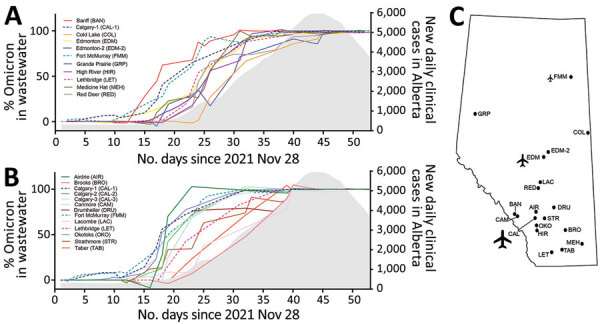
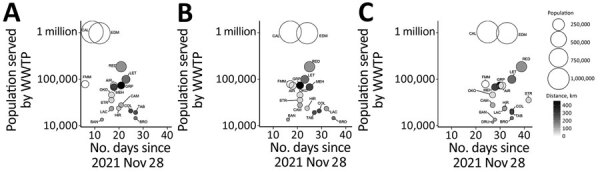
Description:Wastewater monitoring of SARS-CoV-2 enables early detection and monitoring of the COVID-19 disease burden in communities and can track specific variants of concern. We determined proportions of the Omicron and Delta variants across 30 municipalities covering >75% of the province of Alberta (population 4.5 million), Canada, during November 2021-January 2022. Larger cities Calgary and Edmonton exhibited more rapid emergence of Omicron than did smaller and more remote municipalities. Notable exceptions were Banff, a small international resort town, and Fort McMurray, a medium-sized northern community that has many workers who fly in and out regularly. The integrated wastewater signal revealed that the Omicron variant represented close to 100% of SARS-CoV-2 burden by late December, before the peak in newly diagnosed clinical cases throughout Alberta in mid-January. These findings demonstrate that wastewater monitoring offers early and reliable population-level results for establishing the extent and spread of SARS-CoV-2 variants.
-
Subjects:
-
Source:Emerg Infect Dis. 2022; 28(9):1770-1776
-
Pubmed ID:35867051
-
Pubmed Central ID:PMC9423933
-
Document Type:
-
Place as Subject:
-
Volume:28
-
Issue:9
-
Download URL:
-
File Type:
 [PDF - 1.27 MB]
 -
Collection(s):
-
Main Document Checksum:urn:sha256:30842d5158a4d26d3f7cdd9e8bd9a5dcec0fe16e17b766c43163f141f3bb8375
Supporting Files


File Language:
English
 Was this page helpful?
 Found an issue?


CDC STACKS serves as an archival repository of CDC-published products including
scientific findings, journal articles, guidelines, recommendations, or other public health information authored or
co-authored by CDC or funded partners.
As a repository, CDC STACKS retains documents in their original published format to ensure public access to scientific information.
As a repository, CDC STACKS retains documents in their original published format to ensure public access to scientific information.
You May Also Like
COLLECTION
Emerging Infectious Diseases