


Self-reported sleep duration and timing: A methodological review of event definitions, context, and timeframe of related questions
Supporting Files

-
12 2021
-
File Language:
English
Details
-
Alternative Title:Sleep Epidemiol
-
Personal Author:
-
Description:Study Objectives:
Clinical and population health recommendations are derived from studies that include self-report. Differences in question wording and response scales may significantly affect responses. We conducted a methodological review assessing variation in event definition(s), context (i.e., work- versus free-day), and timeframe (e.g., “in the past 4 weeks”) of sleep timing/duration questions.
Methods:
We queried databases of sleep, medicine, epidemiology, and psychology for survey-based studies and/or publications with sleep duration/timing questions. The text of these questions was thematically analyzed.
Results:
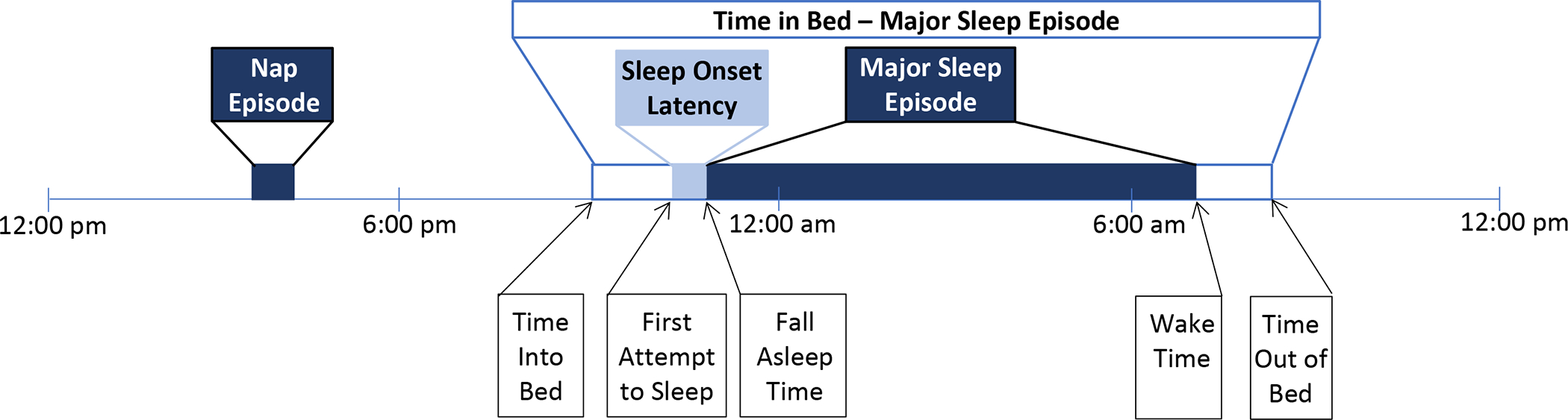
We identified 53 surveys with sample sizes ranging from 93 to 1,185,106. For sleep duration, participants reported nocturnal sleep (24/44), sleep in the past 24-hours (14/44), their major sleep episode (3/44), or answered unaided (3/44). For bedtime, participants reported time into bed (19/47), first attempt to sleep (16/40), or fall-asleep time (12/47). For wake-time, participants reported wake-up time (30/43), the time they “get up” (7/43), or their out-of-bed time (6/43). Context guidance appeared in 18/44 major sleep duration, 35/47 bedtime, and 34/43 wake-time questions. Timeframe was provided in 8/44 major sleep episode duration, 16/47 bedtime, and 10/43 wake-time questions. One question queried the method of awakening (e.g., by alarm clock), 18 questions assessed sleep latency, and 12 measured napping.
Conclusion:
There is variability in the event definition(s), context, and timeframe of questions relating to sleep. This work informs efforts at data harmonization for meta-analyses, provides options for question wording, and identifies questions for future surveys.
-
Keywords:
-
Source:Sleep Epidemiol. 1
-
Pubmed ID:35761957
-
Pubmed Central ID:PMC9233860
-
Document Type:
-
Funding:R01 HL128538/HL/NHLBI NIH HHSUnited States/ ; U54 AG062322/AG/NIA NIH HHSUnited States/ ; K24 HL105664/HL/NHLBI NIH HHSUnited States/ ; K01 HL150339/HL/NHLBI NIH HHSUnited States/ ; R35 HL135818/HL/NHLBI NIH HHSUnited States/ ; 75N92019C00011/HL/NHLBI NIH HHSUnited States/ ; R01 OH011773/OH/NIOSH CDC HHSUnited States/ ; P01 AG009975/AG/NIA NIH HHSUnited States/
-
Volume:1
-
Collection(s):
-
Main Document Checksum:urn:sha-512:ee901894a736acbd9924004e9cc172a04ac13f62f4f21fe4585595d74df679949f4f6239909282d001c6652576457dc2ba53b5c8b13fcef70e9971b40e4825ff
-
Download URL:
-
File Type:
 [PDF
- 340.18 KB
]
[PDF
- 340.18 KB
]
Supporting Files


File Language:
English
ON THIS PAGE

CDC STACKS serves as an archival repository of CDC-published products including
scientific findings,
journal articles, guidelines, recommendations, or other public health information authored or
co-authored by CDC or funded partners.
As a repository, CDC STACKS retains documents in their original published format to ensure public access to scientific information.
As a repository, CDC STACKS retains documents in their original published format to ensure public access to scientific information.
You May Also Like
COLLECTION
CDC Public Access