



Fatigability of the Lumbopelvic Stabilizing Muscles in Women 8 and 26 Weeks Postpartum
Supporting Files

-
2018 ; Sep-Dec 2018
-
Available in CDC Stacks on September 01, 2019, 12:00 AM
File Language:
English
Details
-
Alternative Title:J Womens Health Phys Therap
-
Personal Author:
-
Description:Background:
Pregnancy and childbirth are associated with lumbopelvic pain and instability. Fatigability of the lumbopelvic stabilizing muscles after childbirth is unknown, and no clinical tests exist to assess this important metric of muscle function.
Objectives:
To compare fatigability of the lumbopelvic stabilizing muscles in postpartum and nulligravid (control) women using the Active Straight Leg Raise (ASLR) Fatigue Task, and to determine if fatigability is associated with inter-recti distance (IRD), physical function, and pain/disability.
Study design:
Longitudinal case-control study
Methods:
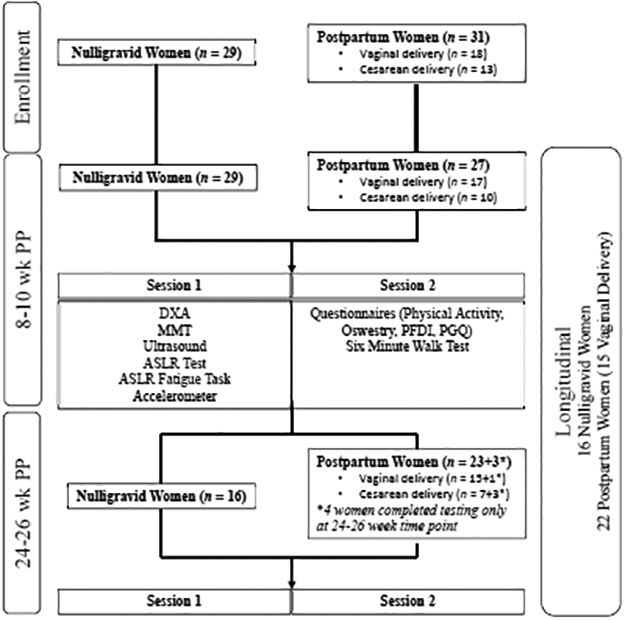
Twenty-nine nulligravid (25.4 ± 9.1 years) and 31 postpartum women (31.4 ± 5.2 years; vaginal delivery n=18) were tested at two time points, 16 weeks apart (postpartum women tested at 8–10 and 24–26 weeks postpartum). Muscular function was assessed with manual muscle testing (MMT), the ASLR Test, and a new ASLR Fatigue Task. Other measures included IRD, rectus abdominis thickness, physical activity, and six-minute walk distance.
Results:
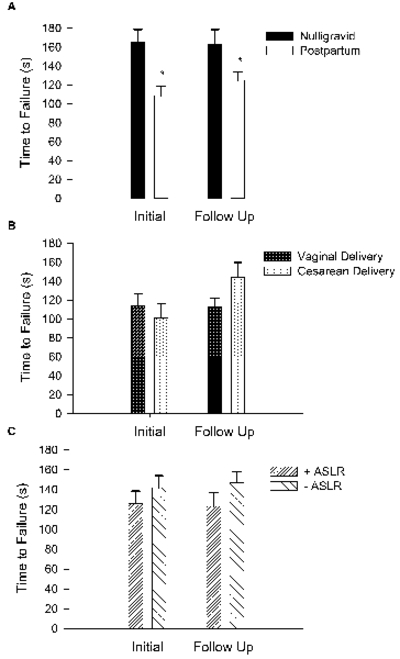
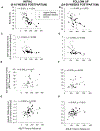
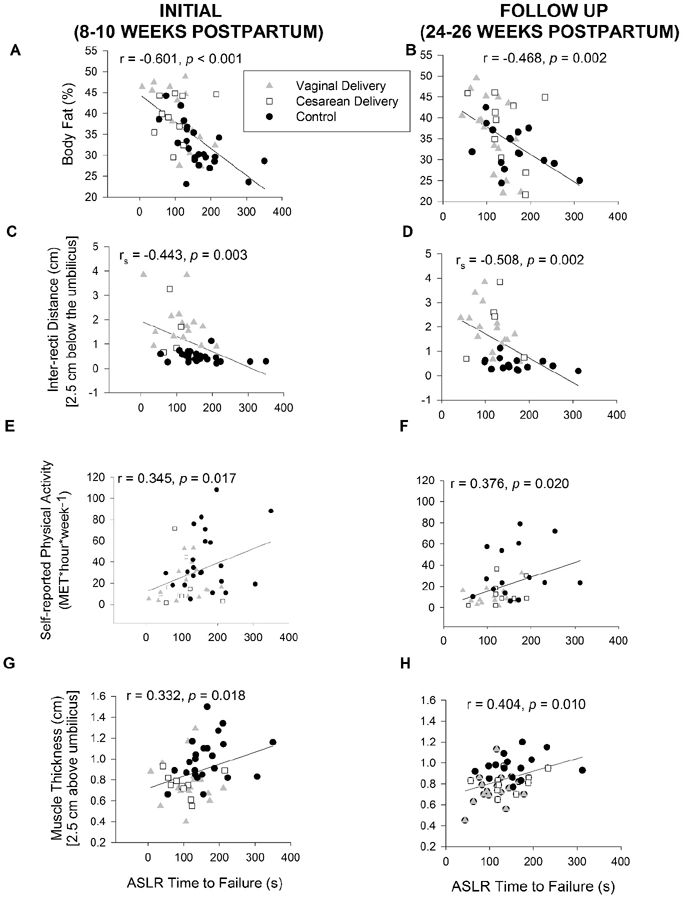
Postpartum women were 23% more fatigable (p=0.028) and were weaker (MMT) (p<0.001) than controls up to 26 weeks postpartum. The ASLR fatigue task (time-to-failure) was associated with smaller IRD, greater rectus abdominis thickness, higher physical activity levels, greater MMT strength, and further distance walked in six minutes (p<0.05).
Conclusion:
Postpartum women (up to 6 months) had greater fatigability of the lumbopelvic stabilizing muscles and lower physical function than nulligravid women, suggesting core muscle function and fatigability should be assessed after pregnancy and childbirth. The ASLR Fatigue Task could be a clinically useful tool to determine fatigability of the lumbopelvic stabilizing muscles in women postpartum. -
Keywords:
-
Source:J Womens Health Phys Therap. 42(3):128-138
-
Pubmed ID:30740039
-
Pubmed Central ID:PMC6366649
-
Document Type:
-
Funding:
-
Volume:42
-
Issue:3
-
Download URL:
-
File Type:
 [PDF - 242.03 KB]
 -
Collection(s):
-
Main Document Checksum:urn:sha256:d8277c8dc25c1b3d96b4ddb94172d1cd4c0aa545f6670a0b5086a9677e5ee7d4
Supporting Files


File Language:
English
 Was this page helpful?
 Found an issue?

CDC STACKS serves as an archival repository of CDC-published products including
scientific findings, journal articles, guidelines, recommendations, or other public health information authored or
co-authored by CDC or funded partners.
As a repository, CDC STACKS retains documents in their original published format to ensure public access to scientific information.
As a repository, CDC STACKS retains documents in their original published format to ensure public access to scientific information.
You May Also Like
COLLECTION
CDC Public Access