



Plasmodium falciparum pfhrp2 and pfhrp3 Gene Deletions from Persons with Symptomatic Malaria Infection in Ethiopia, Kenya, Madagascar, and Rwanda
Supporting Files
Public Domain

-
2022/03/01
File Language:
English
Details
-
Alternative Title:Emerg Infect Dis
-
Personal Author:Rogier, Eric ; McCaffery, Jessica N. ; Nace, Doug ; Svigel, Samaly Souza ; Assefa, Ashenafi ; Hwang, Jimee ; Kariuki, Simon ; Samuels, Aaron M. ; Westercamp, Nelli ; Ratsimbasoa, Arsène ; Randrianarivelojosia, Milijaona ; Uwimana, Aline ; Udhayakumar, Venkatachalam ; Halsey, Eric S.
-
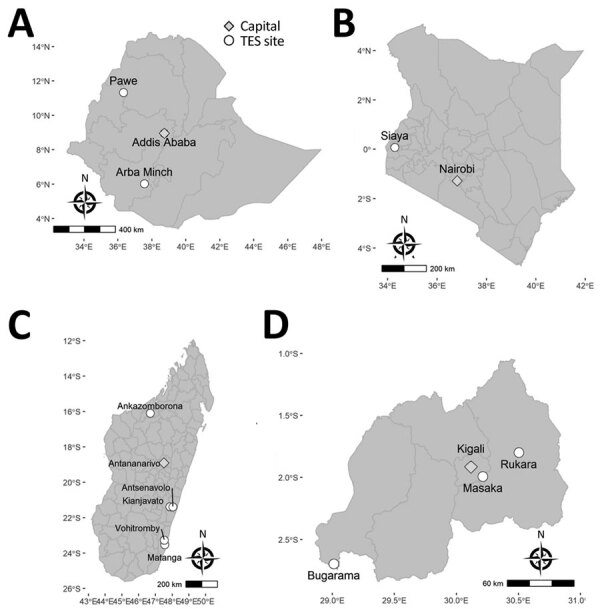
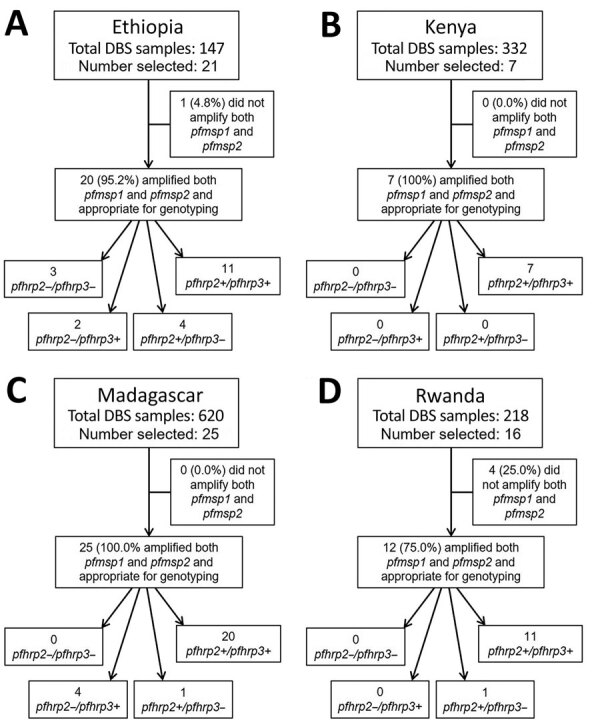
Description:Histidine-rich protein 2 (HRP2)-based rapid diagnostic tests detect Plasmodium falciparum malaria and are used throughout sub-Saharan Africa. However, deletions in the pfhrp2 and related pfhrp3 (pfhrp2/3) genes threaten use of these tests. Therapeutic efficacy studies (TESs) enroll persons with symptomatic P. falciparum infection. We screened TES samples collected during 2016-2018 in Ethiopia, Kenya, Rwanda, and Madagascar for HRP2/3, pan-Plasmodium lactate dehydrogenase, and pan-Plasmodium aldolase antigen levels and selected samples with low levels of HRP2/3 for pfhrp2/3 genotyping. We observed deletion of pfhrp3 in samples from all countries except Kenya. Single-gene deletions in pfhrp2 were observed in 1.4% (95% CI 0.2%-4.8%) of Ethiopia samples and in 0.6% (95% CI 0.2%-1.6%) of Madagascar samples, and dual pfhrp2/3 deletions were noted in 2.0% (95% CI 0.4%-5.9%) of Ethiopia samples. Although this study was not powered for precise prevalence estimates, evaluating TES samples revealed a low prevalence of pfhrp2/3 deletions in most sites.
-
Subjects:
-
Source:Emerg Infect Dis. 2022; 28(3):608-616
-
Pubmed ID:35201739
-
Pubmed Central ID:PMC8888236
-
Document Type:
-
Genre:
-
Place as Subject:
-
Volume:28
-
Issue:3
-
Download URL:
-
File Type:
 [PDF - 1.57 MB]
 -
Collection(s):
-
Main Document Checksum:urn:sha-512:dff6fc8d887d53141f5c4571ed7c43665c1f445edb3cb2298c83704103d3eb33a5c5845c8d2784271f08ea33221cc63c8015cb43fa409a8b97248ec8b1f2f80e
Supporting Files


File Language:
English
 Was this page helpful?
 Found an issue?



CDC STACKS serves as an archival repository of CDC-published products including
scientific findings, journal articles, guidelines, recommendations, or other public health information authored or
co-authored by CDC or funded partners.
As a repository, CDC STACKS retains documents in their original published format to ensure public access to scientific information.
As a repository, CDC STACKS retains documents in their original published format to ensure public access to scientific information.
You May Also Like
COLLECTION
Emerging Infectious Diseases