


Successful Use of Near Point-of-Care Early Infant Diagnosis in NAMPHIA to Improve Turnaround Times in a National Household Survey
Supporting Files

-
8 01 2021
-
File Language:
English
Details
-
Alternative Title:J Acquir Immune Defic Syndr
-
Personal Author:Domaoal, Robert A. ; Sleeman, Katrina ; Sawadogo, Souleymane ; Dzinamarira, Tafadzwa ; Frans, Ndahafa ; Shatumbu, Saara P. ; Kakoma, Ligamena N. ; Shuumbwa, Terthu K. ; Cox, Mackenzie Hurlston ; Stephens, Sally ; Nisbet, Lydia ; Metz, Melissa ; Saito, Suzue ; Williams, Daniel B. ; Voetsch, Andrew C. ; Patel, Hetal ; Parekh, Bharat ; Duong, Yen T.
-
Description:Background:
In the Population-based HIV Impact Assessment (PHIA) surveys, early infant diagnosis (EID) was provided to infants <18 months without a prior diagnosis. For the Namibia PHIA (NAMPHIA), the GeneXpert platform was assessed for the feasibility of near POC EID testing compared to the Roche COBAS AmpliPrep/COBAS TaqMan (CAP/CTM) platform and to implement quality assurance measures for rapid turnaround time to improve EID results reporting.
Methods:
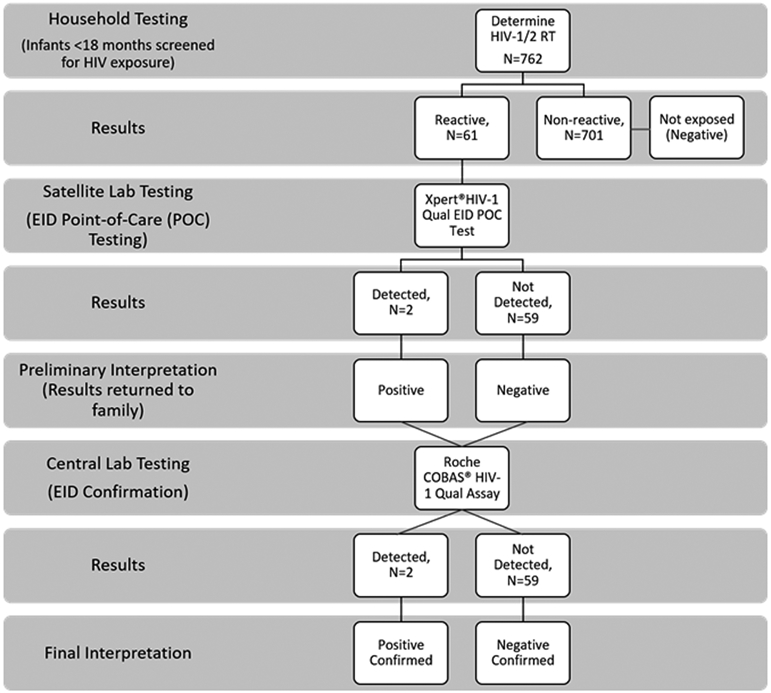
NAMPHIA participants were screened for HIV exposure using Determine HIV-1/2 rapid test; samples reactive on Determine received EID testing on the GeneXpert instrument and Xpert® HIV-1 Qual assay using whole blood. Results were confirmed at the Namibia Institute of Pathology using dried blood spots on the Roche CAP/CTM platform per national guidelines.
Results:
Of the 762 screened infants, 61 (8.0%) were Determine-reactive and considered HIV-exposed. Of the 61 exposed infants, 2 were found to be HIV-infected while 59 were negative on both GeneXpert and Roche platforms, achieving 100% concordance. Average turnaround time was 3.4 days for the Xpert HIV-1 Qual assay, and average time from collection to testing was 1.0 days for GeneXpert compared to 10.7 days for Roche. No samples failed using GeneXpert while 1 failed using Roche and was repeated.
Conclusion:
Quality POC EID testing is feasible in a national survey through extensive training and external quality assurance measures. The use of decentralized POC EID for national testing would provide rapid diagnosis and improve turnaround times which may prevent loss-to-follow-up, ensure linkage to care and improve clinical outcomes for infants.
-
Subjects:
-
Source:J Acquir Immune Defic Syndr. 87(Suppl 1):S67-S72
-
Pubmed ID:34166314
-
Pubmed Central ID:PMC8754064
-
Document Type:
-
Funding:
-
Volume:87
-
Collection(s):
-
Main Document Checksum:urn:sha256:34518eb7e94b5c5aafa6a46e8cf63ee1b124f157a52acc98c0d7e827879717d9
-
Download URL:
-
File Type:
 [PDF
- 133.00 KB
]
[PDF
- 133.00 KB
]
Supporting Files


File Language:
English
ON THIS PAGE

CDC STACKS serves as an archival repository of CDC-published products including
scientific findings,
journal articles, guidelines, recommendations, or other public health information authored or
co-authored by CDC or funded partners.
As a repository, CDC STACKS retains documents in their original published format to ensure public access to scientific information.
As a repository, CDC STACKS retains documents in their original published format to ensure public access to scientific information.
You May Also Like
COLLECTION
CDC Public Access