


Depression and anxiety in a manganese-exposed community
Supporting Files

-
7 2021
-
File Language:
English
Details
-
Alternative Title:Neurotoxicology
-
Personal Author:
-
Description:Objective:
To characterize the association between residential environmental manganese (Mn) exposure and depression and anxiety, given prior associations among occupationally-exposed workers.
Methods:
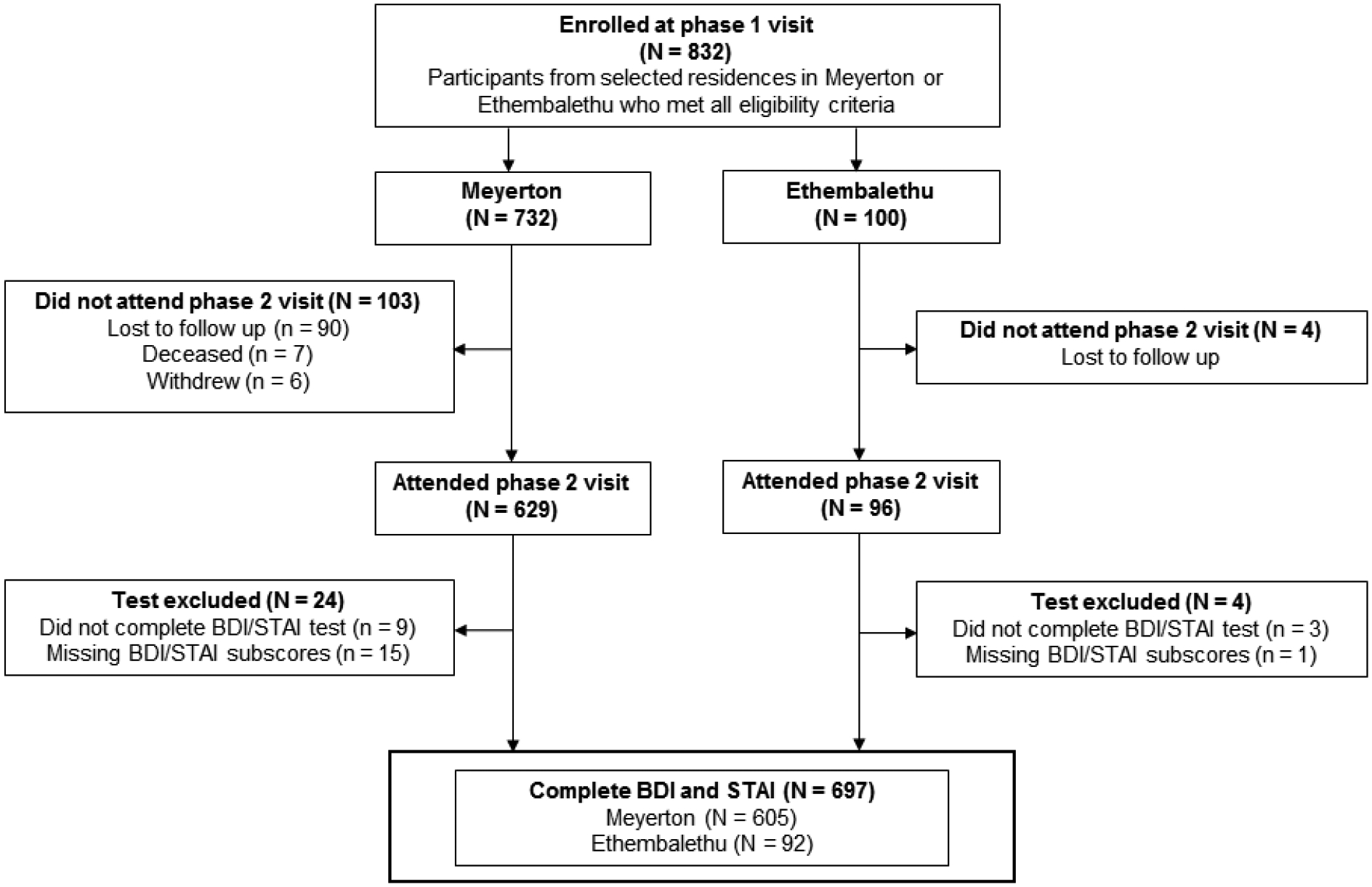
We administered the Beck Depression Inventory (BDI) and the State-Trait Anxiety Inventory (STAI) to 697 study participants in their preferred languages. These participants represented a population-based sample of residents aged ≥40 from two predominantly Black African communities in Gauteng province, South Africa: 605 in Meyerton, adjacent to a large Mn smelter, and 92 in Ethembalethu, a comparable non-exposed community. We investigated the associations between community (Meyerton vs. Ethembalethu) and severity of depression and anxiety, using linear regression, adjusting for age and sex. To document community-level differences in Mn exposure, we measured airborne PM2.5-Mn.
Results:
Meyerton residents had BDI scores 5.63 points (95% CI 3.07, 8.20) higher than Ethembalethu residents, with all questions contributing to this significant difference. STAI-state scores were marginally higher in Meyerton than Ethembalethu residents [2.12 (95% CI −0.17, 4.41)], whereas STAI-trait scores were more similar between the communities [1.26 (95% CI −0.82, 3.35)]. Mean PM2.5-Mn concentration was 203 ng/m3 at a long-term fixed site in Meyerton and 10 ng/m3 in Ethembalethu.
Conclusion:
Residence near Mn emission sources may be associated with greater depression symptomatology, and possibly current, but not lifetime, anxiety.
-
Subjects:
-
Source:Neurotoxicology. 85:222-233
-
Pubmed ID:34087333
-
Pubmed Central ID:PMC8635218
-
Document Type:
-
Funding:R01 DK064832/DK/NIDDK NIH HHSUnited States/ ; R01 ES026246/ES/NIEHS NIH HHSUnited States/ ; R01 NS109487/NS/NINDS NIH HHSUnited States/ ; K24 ES017765/ES/NIEHS NIH HHSUnited States/ ; P42 ES023716/ES/NIEHS NIH HHSUnited States/ ; R01 ES026187/ES/NIEHS NIH HHSUnited States/ ; P30 NS098577/NS/NINDS NIH HHSUnited States/ ; R01 ES027696/ES/NIEHS NIH HHSUnited States/ ; R01 ES029524/ES/NIEHS NIH HHSUnited States/ ; R01 ES026891/ES/NIEHS NIH HHSUnited States/ ; R01 ES029509/ES/NIEHS NIH HHSUnited States/ ; R01 HD098255/HD/NICHD NIH HHSUnited States/ ; R01 OH011661/OH/NIOSH CDC HHSUnited States/ ; P01 AG055367/AG/NIA NIH HHSUnited States/ ; R01 ES025991/ES/NIEHS NIH HHSUnited States/ ; R01 ES029846/ES/NIEHS NIH HHSUnited States/ ; R01 HD070855/HD/NICHD NIH HHSUnited States/ ; R25 ES025503/ES/NIEHS NIH HHSUnited States/ ; K01 ES028295/ES/NIEHS NIH HHSUnited States/ ; R01 ES030937/ES/NIEHS NIH HHSUnited States/
-
Place as Subject:
-
Volume:85
-
Collection(s):
-
Main Document Checksum:urn:sha256:07167e72e3d4fef9681ddd7a58653eea6648a1c1ca3ac235bdfe4020da7c8b83
-
Download URL:
-
File Type:
 [PDF
- 534.38 KB
]
[PDF
- 534.38 KB
]
Supporting Files


File Language:
English
ON THIS PAGE

CDC STACKS serves as an archival repository of CDC-published products including
scientific findings,
journal articles, guidelines, recommendations, or other public health information authored or
co-authored by CDC or funded partners.
As a repository, CDC STACKS retains documents in their original published format to ensure public access to scientific information.
As a repository, CDC STACKS retains documents in their original published format to ensure public access to scientific information.
You May Also Like
COLLECTION
CDC Public Access