



Association of Poor Subjective Sleep Quality With Risk for Death by Suicide During a 10-Year Period
Supporting Files

-
10 2014 ; 10-2014
-
Available in CDC Stacks on 2015-10-01T00:00:00Z
File Language:
English
Details
-
Alternative Title:JAMA Psychiatry
-
Personal Author:
-
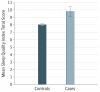
Description:IMPORTANCE ; Older adults have high rates of sleep disturbance, die by suicide at disproportionately higher rates compared with other age groups, and tend to visit their physician in the weeks preceding suicide death. To our knowledge, to date, no study has examined disturbed sleep as an independent risk factor for late-life suicide. ; OBJECTIVE ; To examine the relative independent risk for suicide associated with poor subjective sleep quality in a population-based study of older adults during a 10-year observation period. ; DESIGN, SETTING, AND PARTICIPANTS ; A longitudinal case-control cohort study of late-life suicide among a multisite, population-based community sample of older adults participating in the Established Populations for Epidemiologic Studies of the Elderly. Of 14 456 community older adults sampled, 400 control subjects were matched (on age, sex, and study site) to 20 suicide decedents. ; MAIN OUTCOMES AND MEASURES ; Primary measures included the Sleep Quality Index, the Center for Epidemiologic Studies–Depression Scale, and vital statistics. ; RESULTS ; Hierarchical logistic regressions revealed that poor sleep quality at baseline was significantly associated with increased risk for suicide (odds ratio OR, 1.39; 95% CI, 1.14-1.69; P < .001) by 10 follow-up years. In addition, 2 sleep items were individually associated with elevated risk for suicide at 10-year follow-up: difficulty falling asleep (OR, 2.24; 95% CI, 1.27-3.93; P < .01) and nonrestorative sleep (OR, 2.17; 95% CI, 1.28-3.67; P < .01). Controlling for depressive symptoms, baseline self-reported sleep quality was associated with increased risk for death by suicide (OR, 1.30; 95% CI, 1.04-1.63; P < .05). ; CONCLUSIONS AND RELEVANCE ; Our results indicate that poor subjective sleep quality is associated with increased risk for death by suicide 10 years later, even after adjustment for depressive symptoms. Disturbed sleep appears to confer considerable risk, independent of depressed mood, for the most severe suicidal behaviors and may warrant inclusion in suicide risk assessment frameworks to enhance detection of risk and intervention opportunity in late life.
-
Keywords:
-
Source:JAMA Psychiatry. 2014; 71(10):1129-1137
-
Pubmed ID:25133759
-
Pubmed Central ID:PMC4283786
-
Document Type:
-
Funding:
-
Volume:71
-
Issue:10
-
Download URL:
-
File Type:
 [PDF - 240.63 KB]
 -
Collection(s):
-
Main Document Checksum:urn:sha256:6cf7ba34816341134ce951db5e29cb1cff4d921fdec04ee9a00fbb1fd5007244
Supporting Files


File Language:
English
 Was this page helpful?
 Found an issue?



CDC STACKS serves as an archival repository of CDC-published products including
scientific findings, journal articles, guidelines, recommendations, or other public health information authored or
co-authored by CDC or funded partners.
As a repository, CDC STACKS retains documents in their original published format to ensure public access to scientific information.
As a repository, CDC STACKS retains documents in their original published format to ensure public access to scientific information.
You May Also Like
COLLECTION
CDC Public Access