



Glycemic Control is Associated with Dyslipidemia Over Time in Youth with Type 2 Diabetes: the SEARCH for Diabetes in Youth Study
Supporting Files

-
11 2021
-
Available in CDC Stacks on 2022-11-01T00:00:00Z
File Language:
English
Details
-
Alternative Title:Pediatr Diabetes
-
Personal Author:Brady, Ryan P ; Shah, Amy S ; Jensen, Elizabeth T ; Stafford, Jeanette M ; D’Agostino, Ralph B ; Dolan, Lawrence M ; Knight, Lisa ; Imperatore, Giuseppina ; Turley, Christine B ; Liese, Angela D. ; Urbina, Elaine M ; Lawrence, Jean M ; Pihoker, Catherine ; Marcovina, Santica ; Dabelea, Dana
-
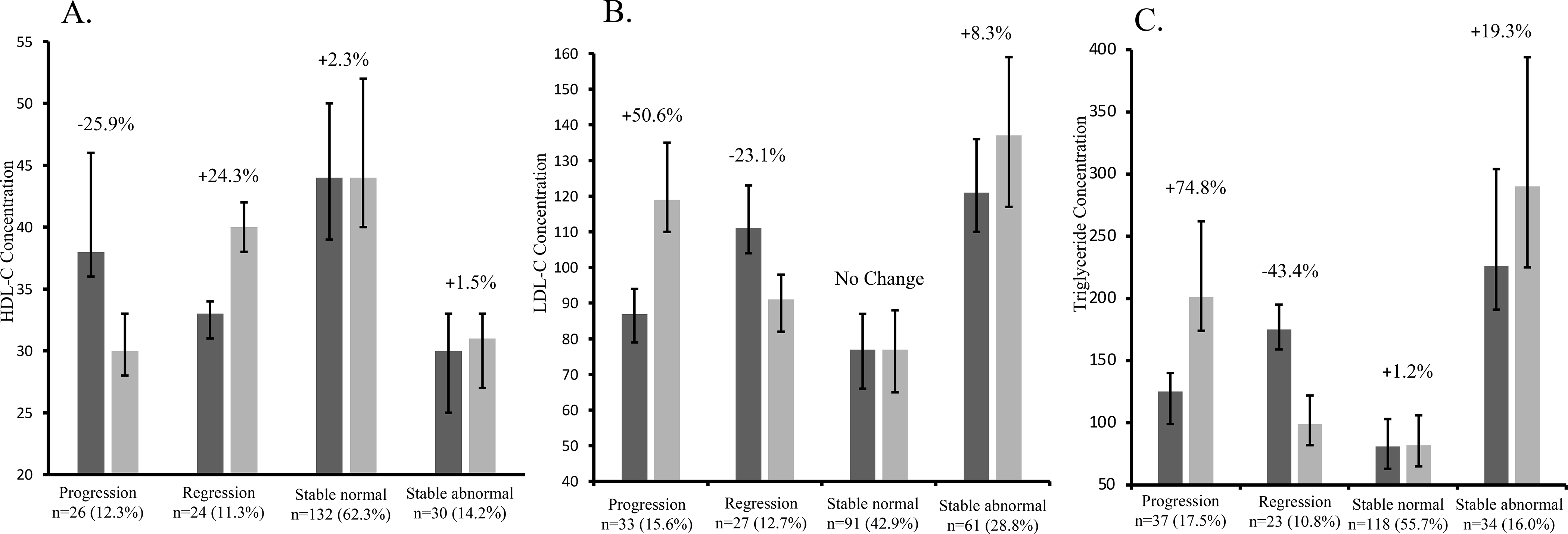
Description:Background: ; Dyslipidemia has been documented in youth with type 2 diabetes. There is a paucity of studies examining dyslipidemia over time in youth with type 2 diabetes and associated risk factors. ; Objectives: ; To evaluate lipids at baseline and follow-up and associated risk factors in youth with type 2 diabetes. ; Methods: ; We studied 212 youth with type 2 diabetes at baseline and after an average of 7 years of follow-up in the SEARCH for Diabetes in Youth Study. Abnormal lipids were defined as HDL-C <35, LDL-C >100, or triglycerides >150 (all mg/dL). We evaluated participants for progression to abnormal lipids (normal lipids at baseline, abnormal at follow-up), regression (abnormal lipids at baseline, normal at follow-up), stable normal and stable abnormal lipids over time for HDL-C, LDL-C and triglycerides. Associations between HbA1c and adiposity over time (area under the curve, AUC) with progression and stable abnormal lipids were evaluated. ; Results: ; HDL-C progressed, regressed, was stable normal, and stable abnormal in 12.3%, 11.3%, 62.3%, and 14.2% of participants, respectively. Corresponding LDL-C percentages were 15.6%, 12.7%, 42.9% and 28.8% and triglycerides were 17.5%, 10.8%, 55.7% and 16.0%. Each 1% increase in HbA1c AUC was associated with a 13% higher risk of progression and stable abnormal triglycerides and a 20% higher risk of progression and stable abnormal LDL-C. Higher adiposity AUC was marginally (p=0.049) associated with abnormal HDL-C. ; Conclusions. ; Progression and stable abnormal LDL-C and triglycerides occur in youth with type 2 diabetes and are associated with higher HbA1c.
-
Subjects:
-
Source:Pediatr Diabetes. 22(7):951-959
-
Pubmed ID:34363298
-
Pubmed Central ID:PMC8530941
-
Document Type:
-
Funding:UC4 DK108173/DK/NIDDK NIH HHSUnited States/ ; U18 DP006131/DP/NCCDPHP CDC HHSUnited States/ ; U18 DP006134/DP/NCCDPHP CDC HHSUnited States/ ; U18 DP006138/DP/NCCDPHP CDC HHSUnited States/ ; U18 DP006139/DP/NCCDPHP CDC HHSUnited States/ ; R01 DK127208/DK/NIDDK NIH HHSUnited States/ ; U18 DP006136/DP/NCCDPHP CDC HHSUnited States/ ; U18 DP006133/DP/NCCDPHP CDC HHSUnited States/ ; U01 DP000246/DP/NCCDPHP CDC HHSUnited States/ ; U18 DP002714/DP/NCCDPHP CDC HHSUnited States/ ; U01 DP000247/DP/NCCDPHP CDC HHSUnited States/ ; U01 DP000248/DP/NCCDPHP CDC HHSUnited States/ ; U18 DP002709/DP/NCCDPHP CDC HHSUnited States/ ; U01 DP000254/DP/NCCDPHP CDC HHSUnited States/ ; U18 DP002708/DP/NCCDPHP CDC HHSUnited States/ ; U01 DP000244/DP/NCCDPHP CDC HHSUnited States/ ; U18 DP002710/DP/NCCDPHP CDC HHSUnited States/ ; U01 DP000250/DP/NCCDPHP CDC HHSUnited States/
-
Volume:22
-
Issue:7
-
Download URL:
-
File Type:
 [PDF - 251.49 KB]
 -
Collection(s):
-
Main Document Checksum:urn:sha256:ff3460439582414ab62fb3ebaf51c9f2f615f03329d57800ccfb3905bf59a424
Supporting Files


File Language:
English
 Was this page helpful?
 Found an issue?

CDC STACKS serves as an archival repository of CDC-published products including
scientific findings, journal articles, guidelines, recommendations, or other public health information authored or
co-authored by CDC or funded partners.
As a repository, CDC STACKS retains documents in their original published format to ensure public access to scientific information.
As a repository, CDC STACKS retains documents in their original published format to ensure public access to scientific information.
You May Also Like
COLLECTION
CDC Public Access