



Child and Adolescent Maltreatment Patterns and Risk of Eating Disorder Behaviors Developing in Young Adulthood
Supporting Files
Peer Reviewed

-
2021/10/01
-
Available in CDC Stacks on 2022-10-01T00:00:00Z
File Language:
English
Details
-
Journal Article:Child Abuse & Neglect
-
Personal Author:
-
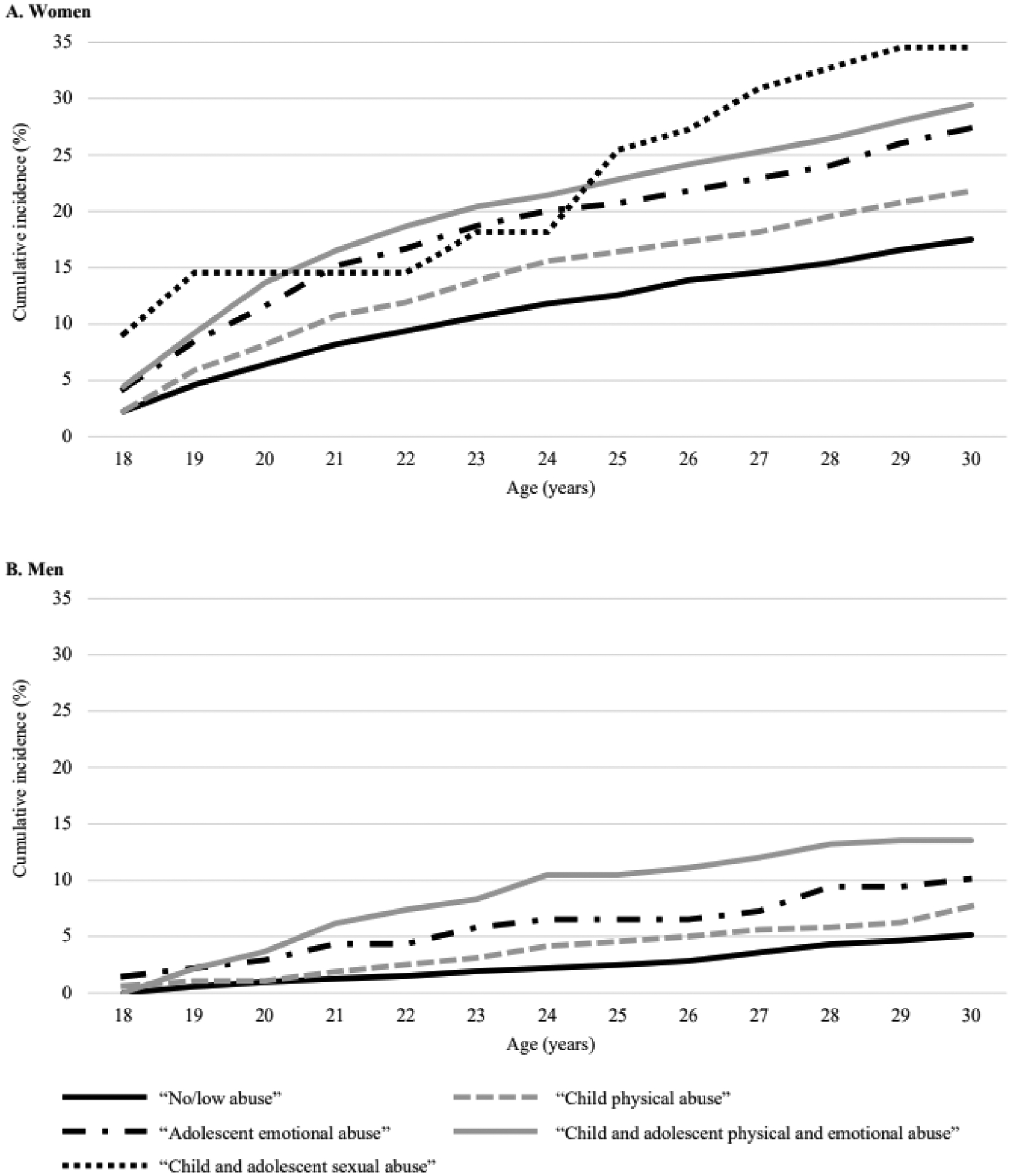
Description:Background: Child maltreatment may be an important risk factor for eating disorder (ED) behaviors. However, most previous research has been limited to clinical, female, and cross-sectional samples, and has not adequately accounted for complex abuse patterns. Objective: To determine whether women and men with distinct patterns of child and adolescent maltreatment have higher risks of developing ED behaviors in young adulthood than individuals with a low probability of maltreatment. Participants and setting: Data came from 7010 U.S. women and men (95% White) in the Growing Up Today Study, a prospective, community-based cohort study (14 waves between 1996 and 2016). Methods: We used a previously created maltreatment variable that was empirically derived using latent class analysis. Maltreatment groups were characterized as: "no/low abuse," "child physical abuse," "adolescent emotional abuse," "child and adolescent physical and emotional abuse," and "child and adolescent sexual abuse." We estimated risk ratios for ED behaviors developing in young adulthood using the modified Poisson approach with generalized estimating equations. We stratified models by sex. Results: Groups characterized by maltreatment had elevated risks of incident ED behaviors compared with the "no/low abuse" group among both women and men. For women, risks tended to be strongest among the "child and adolescent sexual abuse" group. For men, risks tended to be strongest among the "child and adolescent physical and emotional abuse" group. Risks were particularly strong for purging behaviors. Conclusion: Risk of incident ED behaviors in young adulthood varied by distinct maltreatment groups. Detecting maltreatment early may help prevent EDs and subsequent maltreatment. Description provided by NIOSH
-
Subjects:
-
Keywords:
-
Source:Child Abuse Negl 2021 Oct; 120:105225
-
ISSN:0145-2134
-
Pubmed ID:34352683
-
Pubmed Central ID:PMC8493560
-
Document Type:
-
Funding:R01 OH009803/OH/NIOSH CDC HHSUnited States/ ; R01 HD066963/HD/NICHD NIH HHSUnited States/ ; R01 HD049889/HD/NICHD NIH HHSUnited States/ ; P30 DK046200/DK/NIDDK NIH HHSUnited States/ ; K24 HL068041/HL/NHLBI NIH HHSUnited States/ ; R01 DK059570/DK/NIDDK NIH HHSUnited States/ ; R01 DA033974/DA/NIDA NIH HHSUnited States/ ; R01 MH087786/MH/NIMH NIH HHSUnited States/
-
Genre:
-
Place as Subject:
-
CIO:
-
Topic:
-
Location:
-
Pages in Document:15 pdf pages
-
Volume:120
-
NIOSHTIC Number:nn:20064795
-
Contact Point Address:Hannah N. Ziobrowski, Department of Health Care Policy, Harvard Medical School, 180 Longwood Avenue, Boston, MA 02115, USA
-
Email:ziobrowski@hcp.med.harvard.edu
-
Federal Fiscal Year:2022
-
Performing Organization:Brigham and Women's Hospital, Inc., Boston, Massachusetts
-
Peer Reviewed:True
-
Download URL:
-
File Type:
 [PDF - 260.36 KB]
 -
Collection(s):
-
Main Document Checksum:urn:sha-512:f2e37e86c68f6e86cb8a9a44b15cb5d86816d4a75556f53e02b7c3962fcfeae2d163b3a4170a3dadd559ae8c30b074bb1e28989a6b3c530c3c1288ed21e1382d
Supporting Files


File Language:
English
 Was this page helpful?
 Found an issue?

CDC STACKS serves as an archival repository of CDC-published products including
scientific findings, journal articles, guidelines, recommendations, or other public health information authored or
co-authored by CDC or funded partners.
As a repository, CDC STACKS retains documents in their original published format to ensure public access to scientific information.
As a repository, CDC STACKS retains documents in their original published format to ensure public access to scientific information.
You May Also Like