



Perfluoroalkyl and Polyfluoroalkyl Substances and Body Size and Composition Trajectories in Midlife Women: The Study of Women’s Health Across the Nation 1999–2018
Supporting Files

-
9 2021
-
File Language:
English
Details
-
Alternative Title:Int J Obes (Lond)
-
Personal Author:
-
Description:Background/Objectives:
Perfluoroalkyl and polyfluoroalkyl substances (PFAS) have been suggested as obesogens but epidemiologic evidence is limited. We examined associations of serum PFAS concentrations with longitudinal trajectories of weight, waist circumference (WC), fat mass and proportion fat in midlife women.
Subjects/Methods:
This study included 1,381 midlife women, with a total of 15,000 repeated measures from the multi-racial/ethnic Study of Women’s Health Across the Nation between 1999 and 2018. The average follow-up was 14.9 (range: 0–18.6) years. Body size (objectively measured weight and WC) and body composition from dual-energy X-ray absorptiometry were assessed at near-annual visits. Linear mixed models with piecewise linear splines were utilized to model non-linear trajectories of body size and composition.
Results:
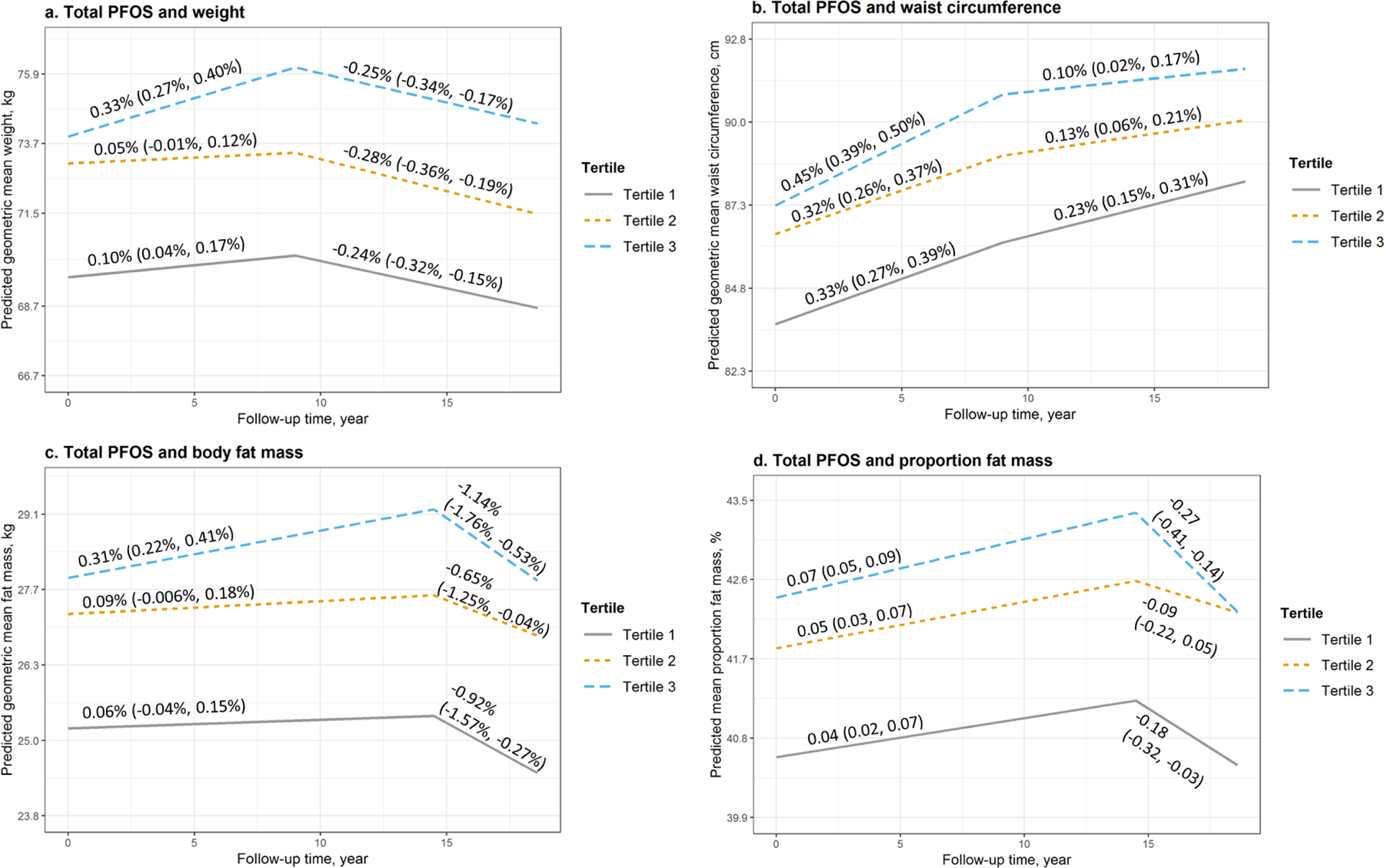
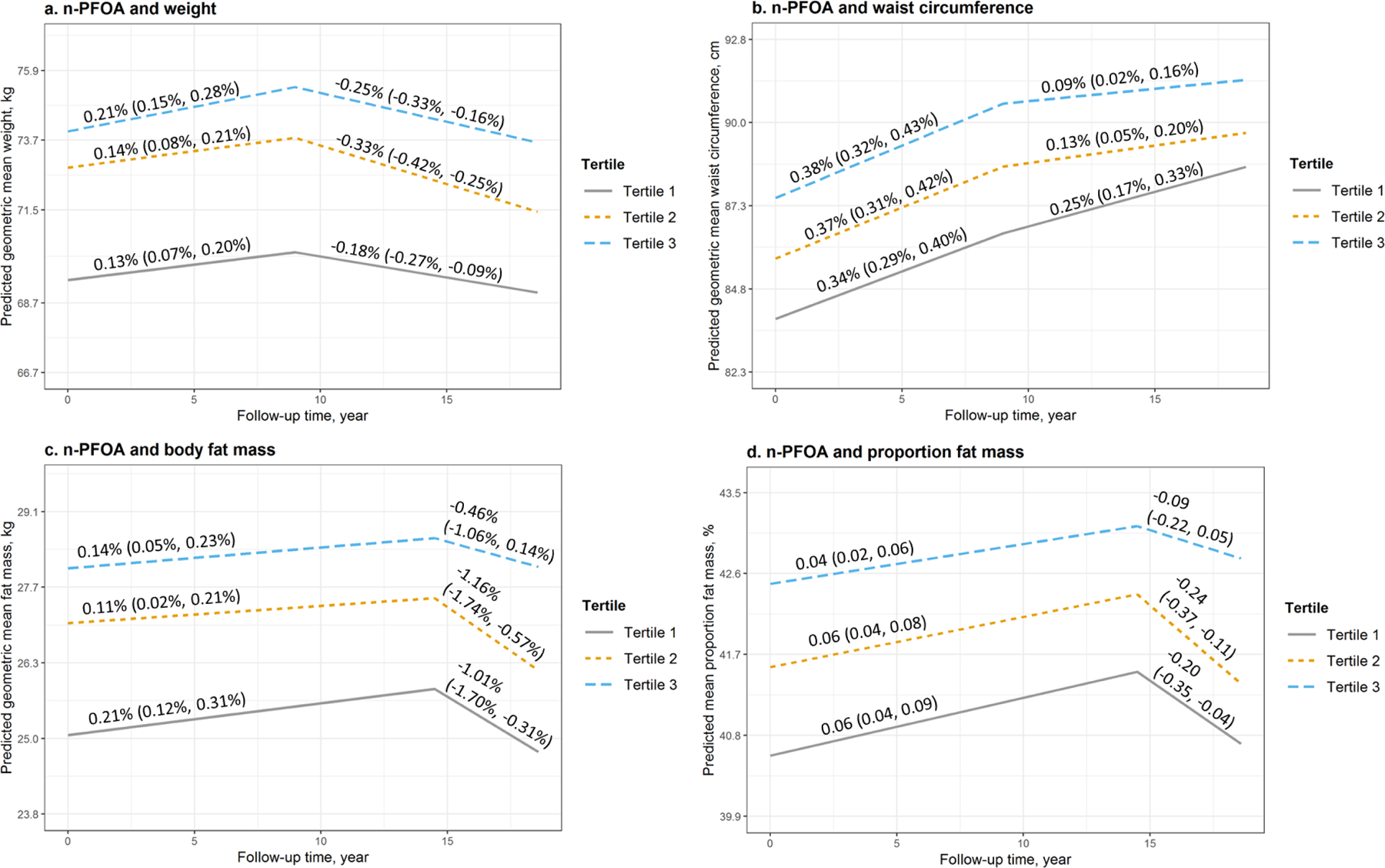
After multivariable adjustment, PFAS concentrations were positively associated with weight, WC, fat mass, and proportion fat at baseline and during follow-up. Comparing the highest to the lowest tertiles of PFAS concentrations, adjusted geometric mean weight was 73.9 kg vs. 69.6 kg for PFOS (P<0.0001), and 74.0 vs. 69.4 kg for linear PFOA (P<0.0001) at baseline. Women with the highest tertile of PFOS had an annual increase rate of 0.33% (95% CI: 0.27%, 0.40%) in weight, compared to the lowest tertile with 0.10% (95% CI: 0.04%, 0.17%) (P<0.0001). PFOS was also significantly related to higher increase rates in WC (difference=0.12% per year, P=0.002) and fat mass (difference=0.25% per year, P=0.0002). EtFOSAA and MeFOSAA showed similar effects to PFOS. Although PFHxS was not related to body size or fat at baseline, PFHxS was significantly associated with accelerated increases in weight (P<0.0001), WC (P=0.003), fat mass (P<0.0001), and proportion fat (P=0.0009). No significant results were found for PFNA.
Conclusions:
Certain PFAS were positively associated with greater body size and body fat, and higher rates of change over time. PFAS may be an underappreciated contributing factor to obesity risk.
-
Subjects:
-
Source:Int J Obes (Lond). 45(9):1937-1948
-
Pubmed ID:33986457
-
Pubmed Central ID:PMC8384652
-
Document Type:
-
Funding:T42 OH008455/OH/NIOSH CDC HHSUnited States/ ; U01 AG012554/AG/NIA NIH HHSUnited States/ ; T42OH008455/ACL/ACL HHSUnited States/ ; P30 ES017885/ES/NIEHS NIH HHSUnited States/ ; U01 AG012505/AG/NIA NIH HHSUnited States/ ; U01 AG012535/AG/NIA NIH HHSUnited States/ ; U01 AG012553/AG/NIA NIH HHSUnited States/ ; U01 NR004061/NR/NINR NIH HHSUnited States/ ; U01 AG012539/AG/NIA NIH HHSUnited States/ ; R01 ES026578/ES/NIEHS NIH HHSUnited States/ ; U01 AG012546/AG/NIA NIH HHSUnited States/ ; U19 AG063720/AG/NIA NIH HHSUnited States/ ; U01 AG012495/AG/NIA NIH HHSUnited States/ ; U01 AG012531/AG/NIA NIH HHSUnited States/ ; R01 ES026964/ES/NIEHS NIH HHSUnited States/ ; U01 AG017719/AG/NIA NIH HHSUnited States/
-
Volume:45
-
Issue:9
-
Collection(s):
-
Main Document Checksum:urn:sha256:24e5ede6e0ed4f7dfab491b83a16cfcdf93adb91d0fb7ba03c0362e3ebaa3f66
-
Download URL:
-
File Type:
 [PDF
- 845.82 KB
]
[PDF
- 845.82 KB
]
Supporting Files


File Language:
English
 Was this page helpful?
 Found an issue?
CDC STACKS serves as an archival repository of CDC-published products including
scientific findings,
journal articles, guidelines, recommendations, or other public health information authored or
co-authored by CDC or funded partners.
As a repository, CDC STACKS retains documents in their original published format to ensure public access to scientific information.
As a repository, CDC STACKS retains documents in their original published format to ensure public access to scientific information.
You May Also Like
COLLECTION
CDC Public Access