



Survival of infants born with esophageal atresia among 24 international birth defects surveillance programs
Supporting Files

-
Jul 15 2021
-
Available in CDC Stacks on January 15, 2021, 12:00 AM
File Language:
English
Details
-
Alternative Title:Birth Defects Res
-
Personal Author:Bell, Jane C. ; Baynam, Gareth ; Bergman, Jorieke E. H. ; Bermejo-Sánchez, Eva ; Botto, Lorenzo D. ; Canfield, Mark A. ; Dastgiri, Saeed ; Gatt, Miriam ; Groisman, Boris ; Hurtado-Villa, Paula ; Kallen, Karin ; Khoshnood, Babak ; Konrad, Victoria ; Landau, Danielle ; Lopez-Camelo, Jorge S. ; Martinez, Laura ; Morgan, Margery ; Mutchinick, Osvaldo M. ; Nance, Amy E. ; Nembhard, Wendy ; Pierini, Anna ; Rissmann, Anke ; Shan, Xiaoyi ; Sipek, Antonin ; Szabova, Elena ; Tagliabue, Giovanna ; Yevtushok, Lyubov S. ; Zarante, Ignacio ; Nassar, Natasha
-
Description:Background:
Esophageal atresia (EA) affects around 2.3–2.6 per 10,000 births world-wide. Infants born with this condition require surgical correction soon after birth. Most survival studies of infants with EA are locally or regionally based. We aimed to describe survival across multiple world regions.
Methods:
We included infants diagnosed with EA between 1980 and 2015 from 24 birth defects surveillance programs that are members of the International Clearinghouse for Birth Defects Surveillance and Research. We calculated survival as the proportion of liveborn infants alive at 1 month, 1- and 5-years, among all infants with EA, those with isolated EA, those with EA and additional anomalies or EA and a chromosomal anomaly or genetic syndrome. We also investigated trends in survival over the decades, 1980s–2010s.
Results:
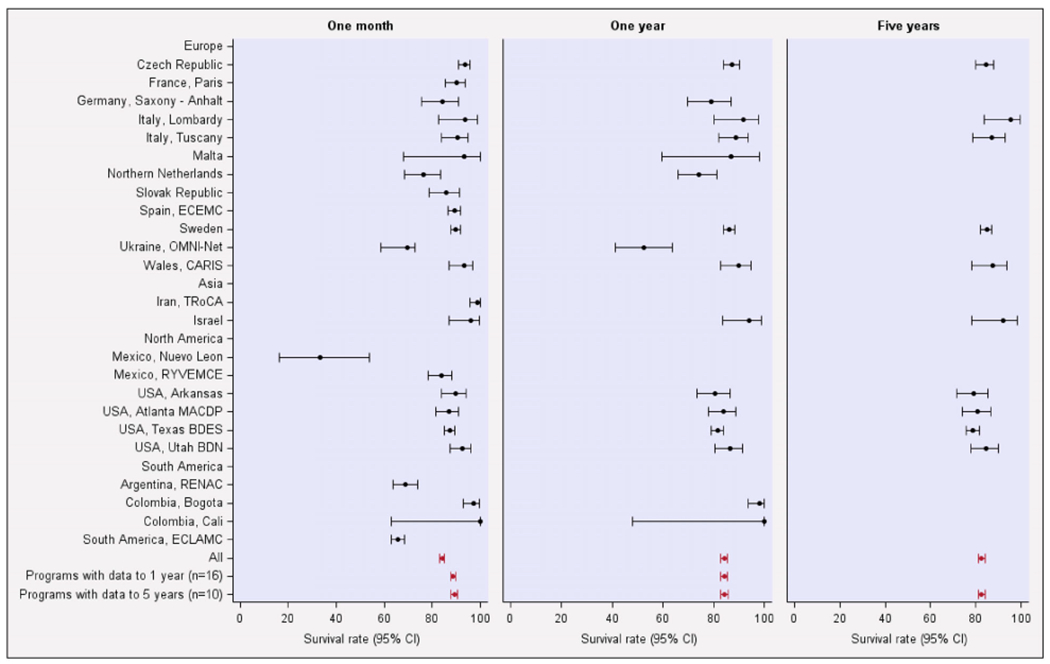
We included 6,466 liveborn infants with EA. Survival was 89.4% (95% CI 88.1–90.5) at 1-month, 84.5% (95% CI 83.0–85.9) at 1-year and 82.7% (95% CI 81.2–84.2) at 5-years. One-month survival for infants with isolated EA (97.1%) was higher than for infants with additional anomalies (89.7%) or infants with chromosomal or genetic syndrome diagnoses (57.3%) with little change at 1- and 5-years. Survival at 1 month improved from the 1980s to the 2010s, by 6.5% for infants with isolated EA and by 21.5% for infants with EA and additional anomalies.
Conclusions:
Almost all infants with isolated EA survived to 5 years. Mortality was higher for infants with EA and an additional anomaly, including chromosomal or genetic syndromes. Survival improved from the 1980s, particularly for those with additional anomalies. -
Subjects:
-
Source:Birth Defects Res. 113(12):945-957
-
Pubmed ID:33734618
-
Pubmed Central ID:PMC8273078
-
Document Type:
-
Funding:HRSA: Maternal Child Health Block Grant/ ; Instituto de Salud Carlos III (Ministry of Science and Innovation); and Fundación 1000 sobre Defectos Congénitos. Spain/ ; CC999999/ImCDC/Intramural CDC HHSUnited States/ ; State of Arkansas/ ; Maltese Government/ ; AZV 17-29622A/Ministry of Health of the Czech Republic/ ; Direzione Diritti di cittadinanza e coesione sociale-Regione Toscana/ ; Dutch Ministry of Welfare, Health and Sports/
-
Volume:113
-
Issue:12
-
Download URL:
-
File Type:
 [PDF - 194.69 KB]
 -
Collection(s):
-
Main Document Checksum:urn:sha256:0ecb2f920988ce423b7c339dd58fbacf2af8872111f9c7561a896748a292c4df
Supporting Files


File Language:
English
 Was this page helpful?
 Found an issue?

CDC STACKS serves as an archival repository of CDC-published products including
scientific findings, journal articles, guidelines, recommendations, or other public health information authored or
co-authored by CDC or funded partners.
As a repository, CDC STACKS retains documents in their original published format to ensure public access to scientific information.
As a repository, CDC STACKS retains documents in their original published format to ensure public access to scientific information.
You May Also Like
COLLECTION
CDC Public Access