



Trends and Outcomes of Fresh and Frozen Donor Oocyte Cycles in the United States
Supporting Files

-
2024/11/01
-
Available in CDC Stacks on November 14, 2024, 12:00 AM
File Language:
English
Details
-
Alternative Title:Fertil Steril
-
Personal Author:
-
Description:Objective:
To examine trends, characteristics, and outcomes of donor oocyte embryo transfer cycles by original oocyte and resultant embryo state and determine whether oocyte state (fresh or frozen) is differentially associated with clinical pregnancy, live birth, and term, normal birthweight neonates among singleton live births.
Design:
Retrospective cohort study
Subjects:
Patients undergoing donor oocyte embryo transfer cycles in the United States reporting to National Assisted Reproductive Technology Surveillance System (NASS) from 2013-2020
Exposure:
Original donor oocyte and resultant embryo state (fresh or frozen)
Main Outcome Measures:
Annual numbers and proportions of total donor oocyte embryo transfer cycles stratified by oocyte and embryo state and single embryo transfer cycles resulting in live birth of term (≥37 weeks gestation), normal birthweight (≥2500g) singletons during 2013-2020. Rates of live birth and term, normal birthweight neonates among singleton live births for 2018-2020 are also reported. Relative risks (RR) examine associations between donor oocyte state and live birth and term, normal birthweight neonates among singleton live births resulting from donor oocyte embryo transfer cycles.
Results:
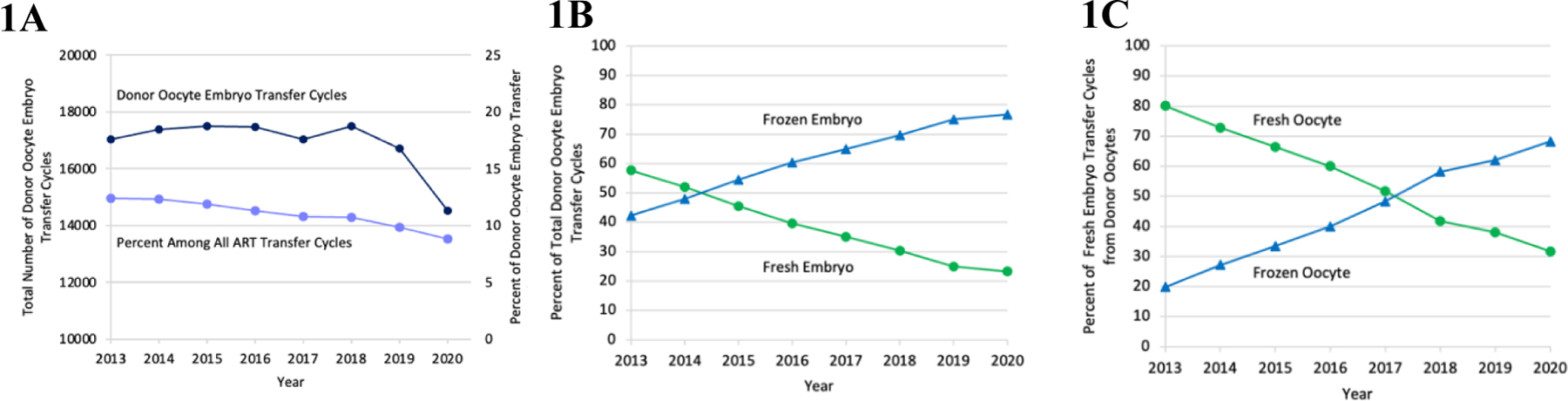
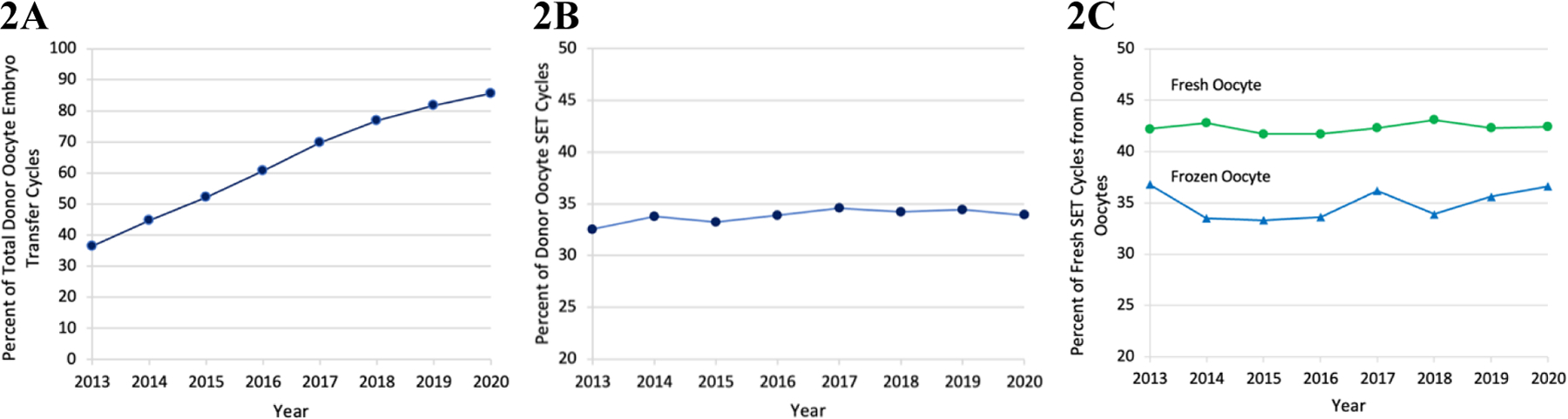
From 2013-2020, there were 135,085 donor oocyte embryo transfer cycles, of which the proportions increased for frozen embryos (42.3% to 76.6%), fresh embryos using frozen donor oocytes (19.9% to 68.3%) and single embryo transfer (SET) (36.4% to 85.5%). During 2018-2020, there were 48,679 donor oocyte embryo transfer cycles. Rates of live birth were lower with frozen compared to fresh donor oocytes for both fresh (46.2%, 55.9%; aRR 0.83 95% CI 0.79-0.87) and frozen (41.3%, 45.8%; aRR 0.94 95% CI 0.91-0.98) embryo transfer cycles. Among singleton live births, rates of delivering a term, normal birthweight neonate were similar for frozen compared to fresh donor oocyte transfer cycles among fresh (77.3, 77.2%; aRR 1.01 95% CI 0.98-1.03) and frozen (75.6, 75.1%; aRR 1.02 95% CI 0.99-1.04) embryos.
Conclusion:
In this national study of donor oocyte embryo transfer cycles, frozen embryo transfers, fresh embryo transfers using frozen oocytes, and SET increased. Although frozen compared to fresh oocytes were associated with a slightly reduced rate of live birth, rates of term, normal birthweight neonates among singleton live births were comparable between donor oocyte states. -
Subjects:
-
Keywords:
-
Source:Fertil Steril. 122(5):844-855
-
Pubmed ID:38986758
-
Pubmed Central ID:PMC11560672
-
Document Type:
-
Funding:
-
Genre:
-
Volume:122
-
Issue:5
-
Download URL:
-
File Type:
 [PDF - 570.03 KB]
 -
Collection(s):
-
Main Document Checksum:urn:sha-512:8d427faa98f7660bfe120f9ec1b5354ee6c08aff2a4291849b9daae4266e37508ed92f761b4b1d975aca494966613cef0a672c2bf4e11f349e05fd7b44b22b46
Supporting Files


File Language:
English
 Was this page helpful?
 Found an issue?



CDC STACKS serves as an archival repository of CDC-published products including
scientific findings, journal articles, guidelines, recommendations, or other public health information authored or
co-authored by CDC or funded partners.
As a repository, CDC STACKS retains documents in their original published format to ensure public access to scientific information.
As a repository, CDC STACKS retains documents in their original published format to ensure public access to scientific information.
You May Also Like
COLLECTION
CDC Public Access