


White matter microstructure in the young adult brain varies with neighborhood disadvantage in adolescence
Supporting Files

-
7 01 2021
-
File Language:
English
Details
-
Alternative Title:Neuroscience
-
Personal Author:
-
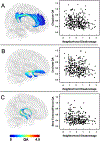
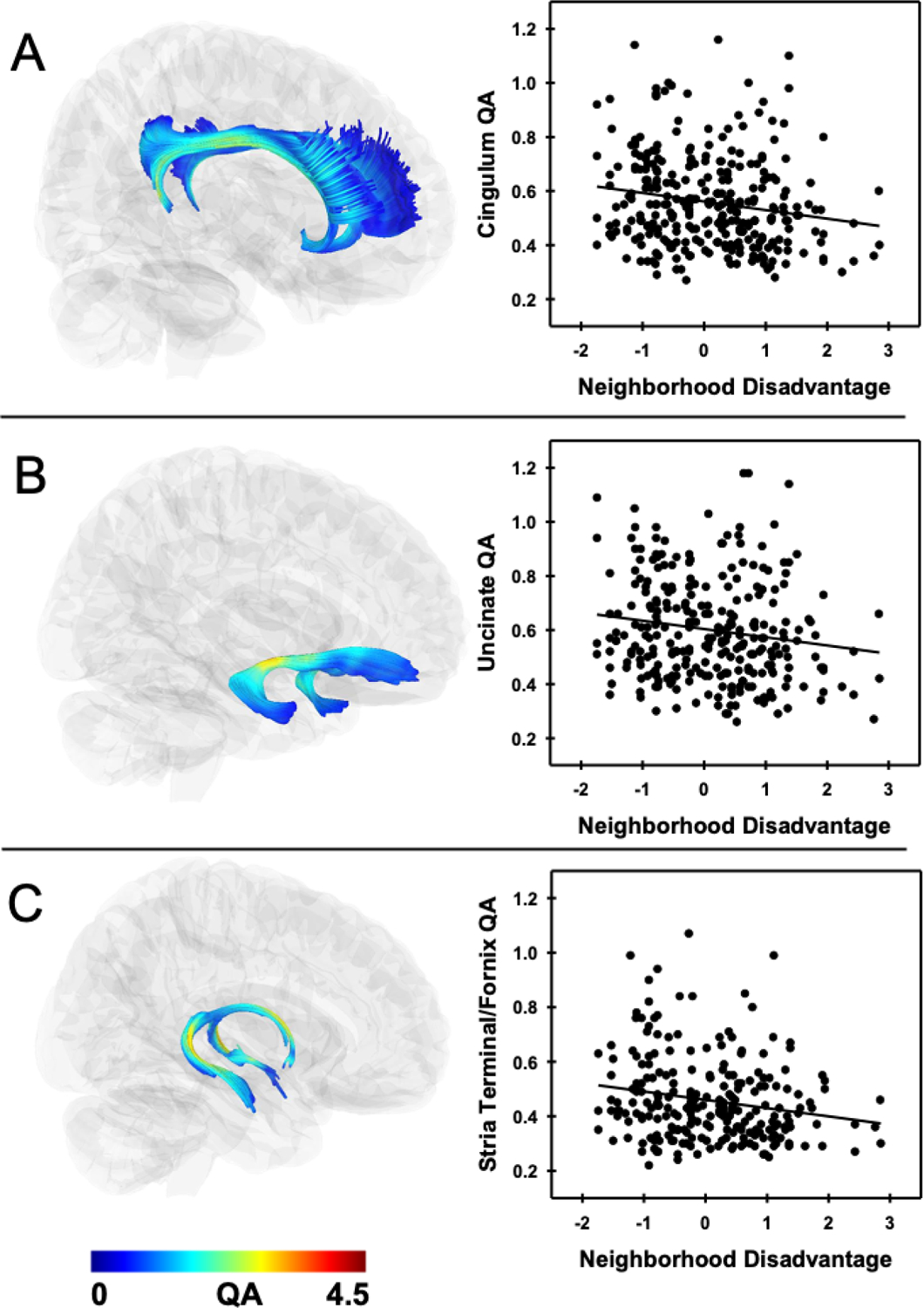
Description:Neighborhood disadvantage and community violence are common in poor, urban communities and are risk factors for emotional dysfunction. Emotional processes are supported by neural circuitry that includes the prefrontal cortex (PFC), hippocampus, amygdala, and hypothalamus. These brain regions are connected by white matter pathways that include the cingulum bundle, uncinate fasciculus, stria terminalis, and fornix. Emotional function varies with the microstructure of these white matter pathways. However, it is not clear whether the microstructure of these pathways varies with risk factors for emotional dysfunction (e.g., neighborhood disadvantage and violence exposure). Therefore, determining the relationships between neighborhood disadvantage, violence exposure, and white matter microstructure may offer insight into the neural mechanisms by which adverse life experiences alter developing neural systems. The current study investigated the association that exposure to neighborhood disadvantage and violence have with the quantitative anisotropy (QA), a measure of the amount of directional water diffusion, of the cingulum bundle, uncinate fasciculus, stria terminalis, and fornix. Neighborhood disadvantage (M| = 11.20) and violence exposure (M| = 11.20; M| = 13.05; M| = 16.20; M| = 19.25) were assessed during adolescence and participants returned for magnetic resonance imaging as young adults (N = 303; M| = 20.25, SD = 1.55), during which diffusion weighted brain images were collected. The QA of the cingulum bundle, uncinate fasciculus, and stria terminalis/fornix varied negatively with neighborhood disadvantage such that the QA of these white matter tracts decreased as neighborhood disadvantage increased. Violence exposure was not related to QA in any tract (i.e., cingulum bundle, uncinate fasciculus, and stria terminalis/fornix) after correction for multiple comparisons. These results suggest that an adolescent's neighborhood may play an important role in the microstructure (i.e., QA) of white matter pathways that connect brain regions that support emotional function.
-
Subjects:
-
Source:Neuroscience. 466:162-172
-
Pubmed ID:34004262
-
Pubmed Central ID:PMC8217337
-
Document Type:
-
Funding:U19 DP002664/DP/NCCDPHP CDC HHSUnited States/ ; U48 DP000046/DP/NCCDPHP CDC HHSUnited States/ ; U19 DP002663/DP/NCCDPHP CDC HHSUnited States/ ; U48 DP000056/DP/NCCDPHP CDC HHSUnited States/ ; R01 MH098348/MH/NIMH NIH HHSUnited States/ ; U19 DP002665/DP/NCCDPHP CDC HHSUnited States/ ; F31 AA027137/AA/NIAAA NIH HHSUnited States/ ; T32 NS061788/NS/NINDS NIH HHSUnited States/ ; U48 DP000057/DP/NCCDPHP CDC HHSUnited States/
-
Volume:466
-
Collection(s):
-
Main Document Checksum:urn:sha256:253a5f5b91546846d46d62f1c509b1cbdbc72de2cd64651eb6e3293bb30471e6
-
Download URL:
-
File Type:
 [PDF
- 552.71 KB
]
[PDF
- 552.71 KB
]
Supporting Files


File Language:
English
ON THIS PAGE

CDC STACKS serves as an archival repository of CDC-published products including
scientific findings,
journal articles, guidelines, recommendations, or other public health information authored or
co-authored by CDC or funded partners.
As a repository, CDC STACKS retains documents in their original published format to ensure public access to scientific information.
As a repository, CDC STACKS retains documents in their original published format to ensure public access to scientific information.
You May Also Like
COLLECTION
CDC Public Access