


Associations of Perfluoroalkyl and Polyfluoroalkyl Substances (PFAS) and PFAS Mixtures with Adipokines in Midlife Women
Supporting Files

-
6-2021
-
File Language:
English
Details
-
Alternative Title:Int J Hyg Environ Health
-
Personal Author:
-
Description:Background:
Perfluoroalkyl and polyfluoroalkyl substances (PFAS) exposure have been associated with obesity and related comorbidities, possibly through disrupting signaling pathways of adipokines. Both leptin and adiponectin can modulate metabolic processes. However, the effects of PFAS on adipokines are not well understood.
Objective:
We determined if serum PFAS concentrations were associated with adipokine profiles in midlife women.
Methods:
We examined 1,245 women aged 45–56 years from the Study of Women’s Health Across the Nation. Concentrations of 11 PFAS were quantified in baseline serum samples collected in 1999–2000. Linear and branched perfluorooctane sulfonic acid isomers (n-PFOS and Sm-PFOS) and their sum (PFOS), linear perfluorooctanoic acid (n-PFOA), perfluorononanoic acid (PFNA), perfluorohexane sulfonic acid (PFHxS), 2-(N-methyl-perfluorooctane sulfonamido) acetic acid (MeFOSAA), and 2-(N-ethyl-perfluorooctane sulfonamido) acetic acid (EtFOSAA) with detection frequencies >60% were included in the analysis. Adipokines including leptin, soluble leptin receptor (sOB-R), free leptin index (FLI, the ratio of leptin to sOB-R), total and high molecular weight (HMW) adiponectin were assessed in 2002–2003. We utilized multivariable linear regressions and Bayesian kernel machine regression (BKMR) to assess individual and overall joint effects of PFAS on adipokines with adjustment for age, race/ethnicity, study site, education, smoking status, physical activity, menopausal status, and waist circumference.
Results:
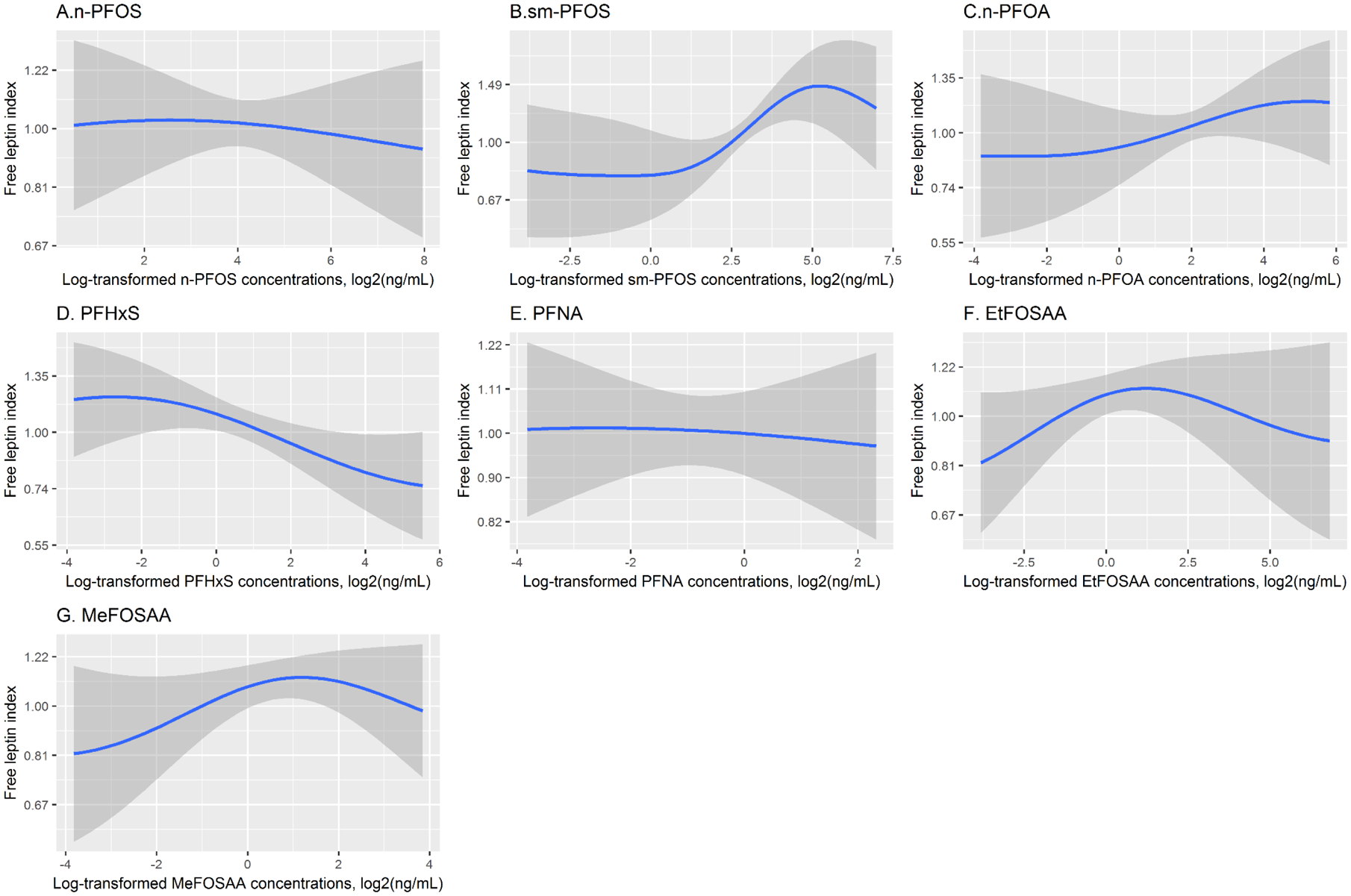
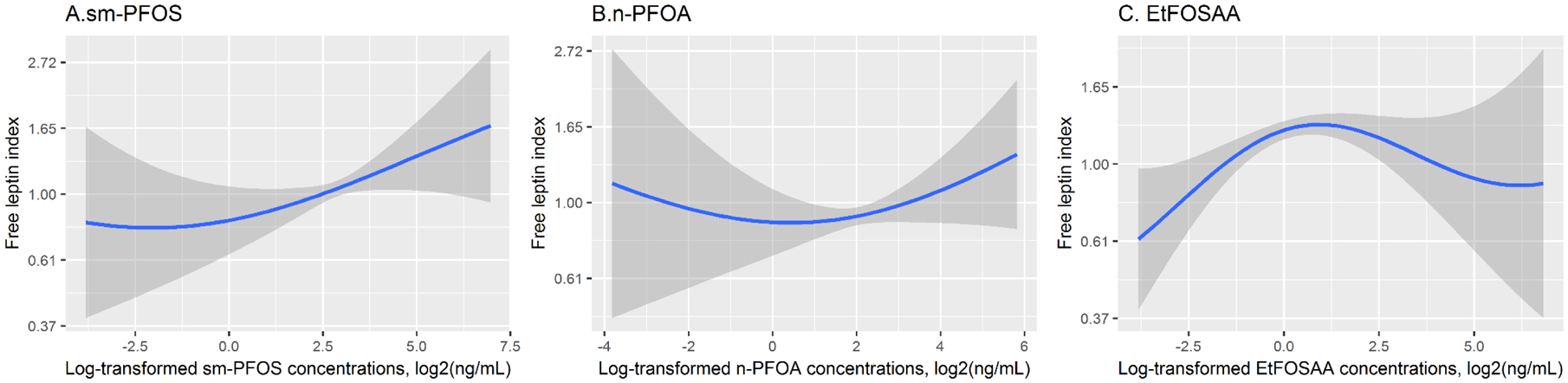
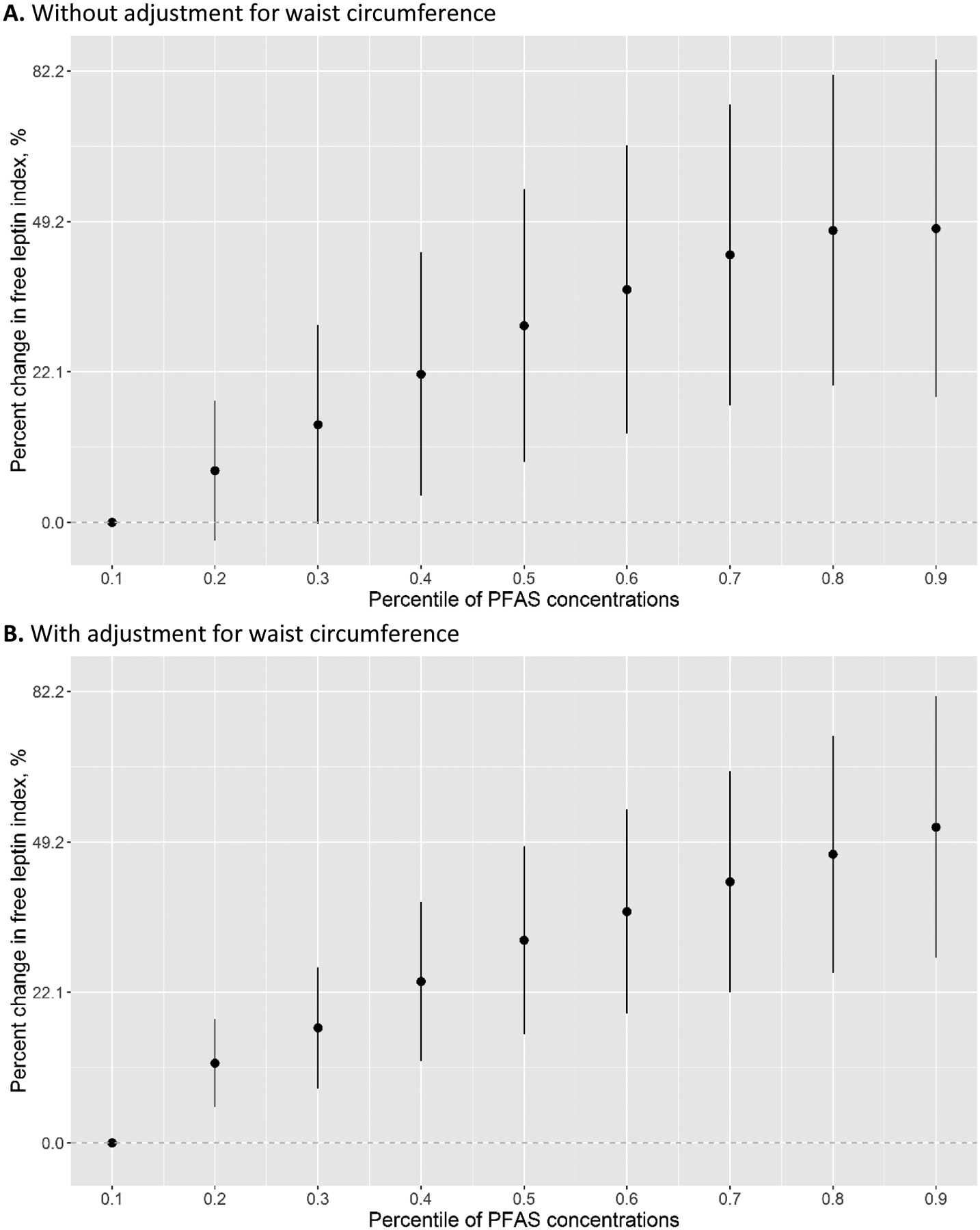
A doubling of PFAS concentrations was associated with 7.8% (95% CI: 2.5%, 13.4%) higher FLI for PFOS, 9.4% (95% CI: 3.7%, 15.3%) for n-PFOA, 5.5% (95% CI: 2.2%, 9.0%) for EtFOSAA and 7.4% (95% CI: 2.8%, 12.2%) for MeFOSAA. Similar associations were found for leptin. Only EtFOSAA was associated with lower sOB-R concentrations (1.4% lower, 95% CI: −2.7%, −0.1%). Results remained in women with overweight or obesity but not those with normal weight or underweight. No statistically significant associations were observed with total or HMW adiponectin, except for PFNA with total and HMW adiponectin observed in women with normal weight or underweight. In BKMR analysis, women with PFAS concentrations at the median and the 90th percentile had 30.9% (95% CI: 15.6%, 48.3%) and 52.1% (95% CI: 27.9%, 81.0%) higher FLI, respectively, compared with those with concentrations fixed at the 10th percentile.
Conclusion:
Some PFAS may alter circulating levels of leptin. Understanding associations between PFAS and adipokines may help elucidate whether PFAS can influence obesity and metabolic disease.
-
Subjects:
-
Source:Int J Hyg Environ Health. 235:113777
-
Pubmed ID:34090141
-
Pubmed Central ID:PMC8207532
-
Document Type:
-
Funding:T42 OH008455/OH/NIOSH CDC HHSUnited States/ ; P30 DK092926/DK/NIDDK NIH HHSUnited States/ ; U01 AG012554/AG/NIA NIH HHSUnited States/ ; P30 AG024824/AG/NIA NIH HHSUnited States/ ; T42OH008455/ACL/ACL HHSUnited States/ ; P30 ES017885/ES/NIEHS NIH HHSUnited States/ ; U01 AG012535/AG/NIA NIH HHSUnited States/ ; U01 AG012553/AG/NIA NIH HHSUnited States/ ; U01 NR004061/NR/NINR NIH HHSUnited States/ ; U01 AG012539/AG/NIA NIH HHSUnited States/ ; R01 ES026578/ES/NIEHS NIH HHSUnited States/ ; U01 AG012546/AG/NIA NIH HHSUnited States/ ; U19 AG063720/AG/NIA NIH HHSUnited States/ ; U01 AG012495/AG/NIA NIH HHSUnited States/ ; P30 DK020572/DK/NIDDK NIH HHSUnited States/ ; U01 AG012505/AG/NIA NIH HHSUnited States/ ; U01 AG012531/AG/NIA NIH HHSUnited States/ ; R01 ES026964/ES/NIEHS NIH HHSUnited States/ ; U01 AG017719/AG/NIA NIH HHSUnited States/
-
Volume:235
-
Collection(s):
-
Main Document Checksum:urn:sha256:12b741ce5e784c3a297645217f58e9ff254160c5fcbe4adaa536dc6b38fda5e7
-
Download URL:
-
File Type:
 [PDF
- 850.78 KB
]
[PDF
- 850.78 KB
]
Supporting Files


File Language:
English
ON THIS PAGE



CDC STACKS serves as an archival repository of CDC-published products including
scientific findings,
journal articles, guidelines, recommendations, or other public health information authored or
co-authored by CDC or funded partners.
As a repository, CDC STACKS retains documents in their original published format to ensure public access to scientific information.
As a repository, CDC STACKS retains documents in their original published format to ensure public access to scientific information.
You May Also Like
COLLECTION
CDC Public Access