



Redox Epiphospholipidome in Programmed Cell Death Signaling: Catalytic Mechanisms and Regulation
Supporting Files
Peer Reviewed

-
2021/02/19
File Language:
English
Details
-
Journal Article:Frontiers in Endocrinology
-
Personal Author:Amoscato, Andrew A. ; Anthonymuthu, Tamil S. ; Bayir, Hülya ; Beezhold, Donald H. ; Cinemre, Fatma B. ; Epperly, Michael W. ; Greenberger, Joel S. ; Kagan, Valerian E. ; Kapralov, Alexander A. ; Lamade, Andrew ; Mallampalli, Rama K. ; Shrivastava, Indira H. ; Shvedova, Anna A. ; Srivastava, Apurva K. ; Tyurin, Vladimir A. ; Tyurina, Yulia Y. ; Vlasova, Irina I.
-
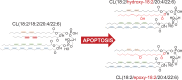
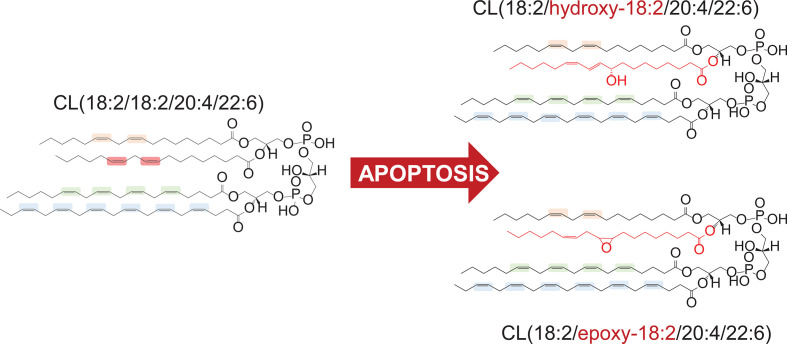
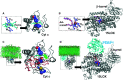
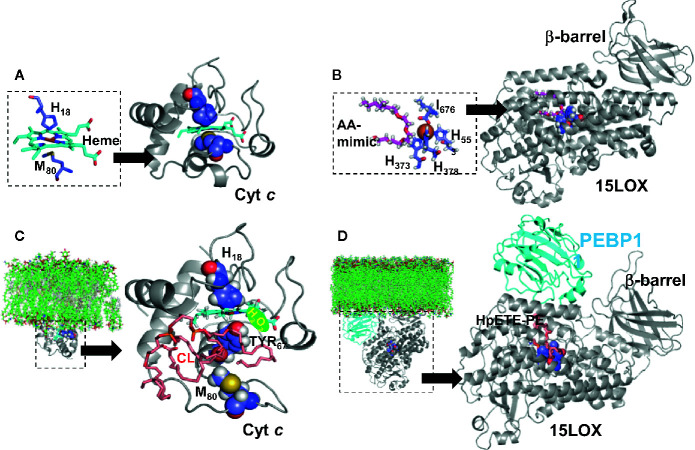
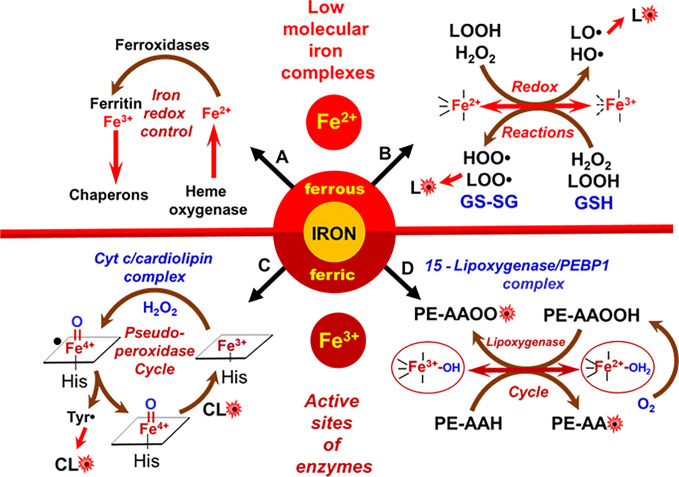
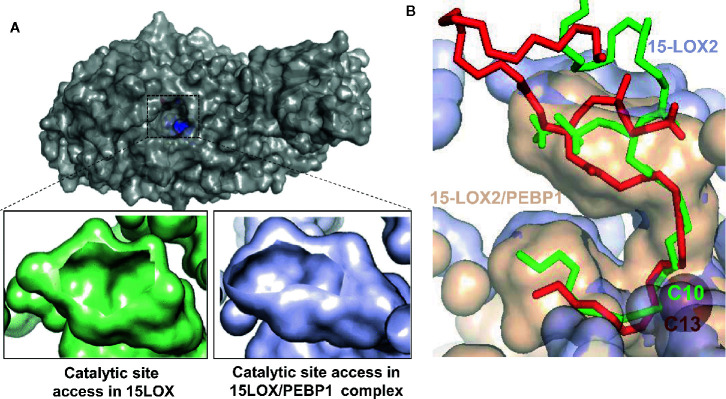
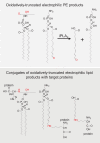
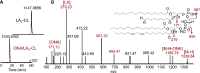
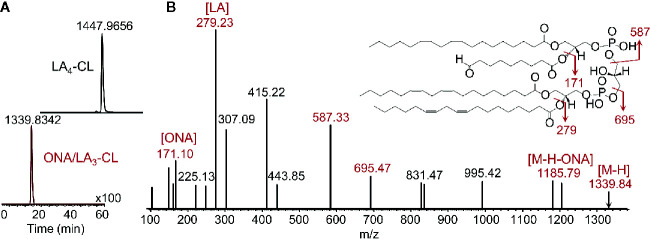
Description:A huge diversification of phospholipids, forming the aqueous interfaces of all biomembranes, cannot be accommodated within a simple concept of their role as membrane building blocks. Indeed, a number of signaling functions of (phospho)lipid molecules has been discovered. Among these signaling lipids, a particular group of oxygenated polyunsaturated fatty acids (PUFA), so called lipid mediators, has been thoroughly investigated over several decades. This group includes oxygenated octadecanoids, eicosanoids, and docosanoids and includes several hundreds of individual species. Oxygenation of PUFA can occur when they are esterified into major classes of phospholipids. Initially, these events have been associated with non-specific oxidative injury of biomembranes. An alternative concept is that these post-synthetically oxidatively modified phospholipids and their adducts with proteins are a part of a redox epiphospholipidome that represents a rich and versatile language for intra- and inter-cellular communications. The redox epiphospholipidome may include hundreds of thousands of individual molecular species acting as meaningful biological signals. This review describes the signaling role of oxygenated phospholipids in programs of regulated cell death. Although phospholipid peroxidation has been associated with almost all known cell death programs, we chose to discuss enzymatic pathways activated during apoptosis and ferroptosis and leading to peroxidation of two phospholipid classes, cardiolipins (CLs) and phosphatidylethanolamines (PEs). This is based on the available LC-MS identification and quantitative information on the respective peroxidation products of CLs and PEs. We focused on molecular mechanisms through which two proteins, a mitochondrial hemoprotein cytochrome c (cyt c), and non-heme Fe lipoxygenase (LOX), change their catalytic properties to fulfill new functions of generating oxygenated CL and PE species. Given the high selectivity and specificity of CL and PE peroxidation we argue that enzymatic reactions catalyzed by cy t c/CL complexes and 15-lipoxygenase/ phosphatidylethanolamine binding protein 1 (15LOX/PEBP1) complexes dominate, at least during the initiation stage of peroxidation, in apoptosis and ferroptosis. We contrast cell-autonomous nature of CLox signaling in apoptosis correlating with its anti-inflammatory functions vs. non-cell-autonomous ferroptotic signaling facilitating pro-inflammatory (necroinflammatory) responses. Finally, we propose that small molecule mechanism-based regulators of enzymatic phospholipid peroxidation may lead to highly specific antiapoptotic and anti-ferroptotic therapeutic modalities. Description provided by NIOSH
-
Subjects:
-
Keywords:
-
Source:Front Endocrinol 2021 Feb; 11:628079
-
ISSN:1664-2392
-
Pubmed ID:33679610
-
Pubmed Central ID:PMC7933662
-
Document Type:
-
Funding:R01 CA165065/CA/NCI NIH HHS/United States ; HHSN261200800001E/CA/NCI NIH HHS/United States ; U19 AI068021/AI/NIAID NIH HHS/United States ; U01 AI156924/AI/NIAID NIH HHS/United States ; R01 NS076511/NS/NINDS NIH HHS/United States ; U01 AI156923/AI/NIAID NIH HHS/United States ; R01 AI145406/AI/NIAID NIH HHS/United States ; R01 NS061817/NS/NINDS NIH HHS/United States ; R01 CA243142/CA/NCI NIH HHS/United States ; P01 HL114453/HL/NHLBI NIH HHS/United States
-
Genre:
-
Place as Subject:
-
CIO:
-
Division:
-
Topic:
-
Location:
-
Pages in Document:20 pdf pages
-
Volume:11
-
NIOSHTIC Number:nn:20062248
-
Contact Point Address:Valerian E. Kagan, Center for Free Radical and Antioxidant Health, Department of Environmental and Occupational Health, University of Pittsburgh, Pittsburgh, PA
-
Email:kagan@pitt.edu
-
Federal Fiscal Year:2021
-
NORA Priority Area:
-
Peer Reviewed:True
-
Download URL:
-
File Type:
 [PDF - 1.98 MB]
 -
Collection(s):
-
Main Document Checksum:urn:sha-512:a86365c7ecce1e2933729d7b310cf831d811a009533f64d0f7da836184b48ba25e27a9a7064e5eae00c9b8947dd530a8ff9d90a1add74eaa480366c30f0cb62d
Supporting Files


File Language:
English
 Was this page helpful?
 Found an issue?




CDC STACKS serves as an archival repository of CDC-published products including
scientific findings, journal articles, guidelines, recommendations, or other public health information authored or
co-authored by CDC or funded partners.
As a repository, CDC STACKS retains documents in their original published format to ensure public access to scientific information.
As a repository, CDC STACKS retains documents in their original published format to ensure public access to scientific information.
You May Also Like