


The Impact of Liver Transplantation on Hepatocellular Carcinoma Mortality in the United States
Supporting Files

-
March 2021
-
File Language:
English
Details
-
Alternative Title:Cancer Epidemiol Biomarkers Prev
-
Personal Author:
-
Description:Background:
Hepatocellular carcinoma (HCC) carries a poor prognosis. Liver transplantation (LT) is potentially curative for localized HCC. We evaluated the impact of LT on US general population HCC-specific mortality rates.
Methods:
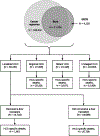
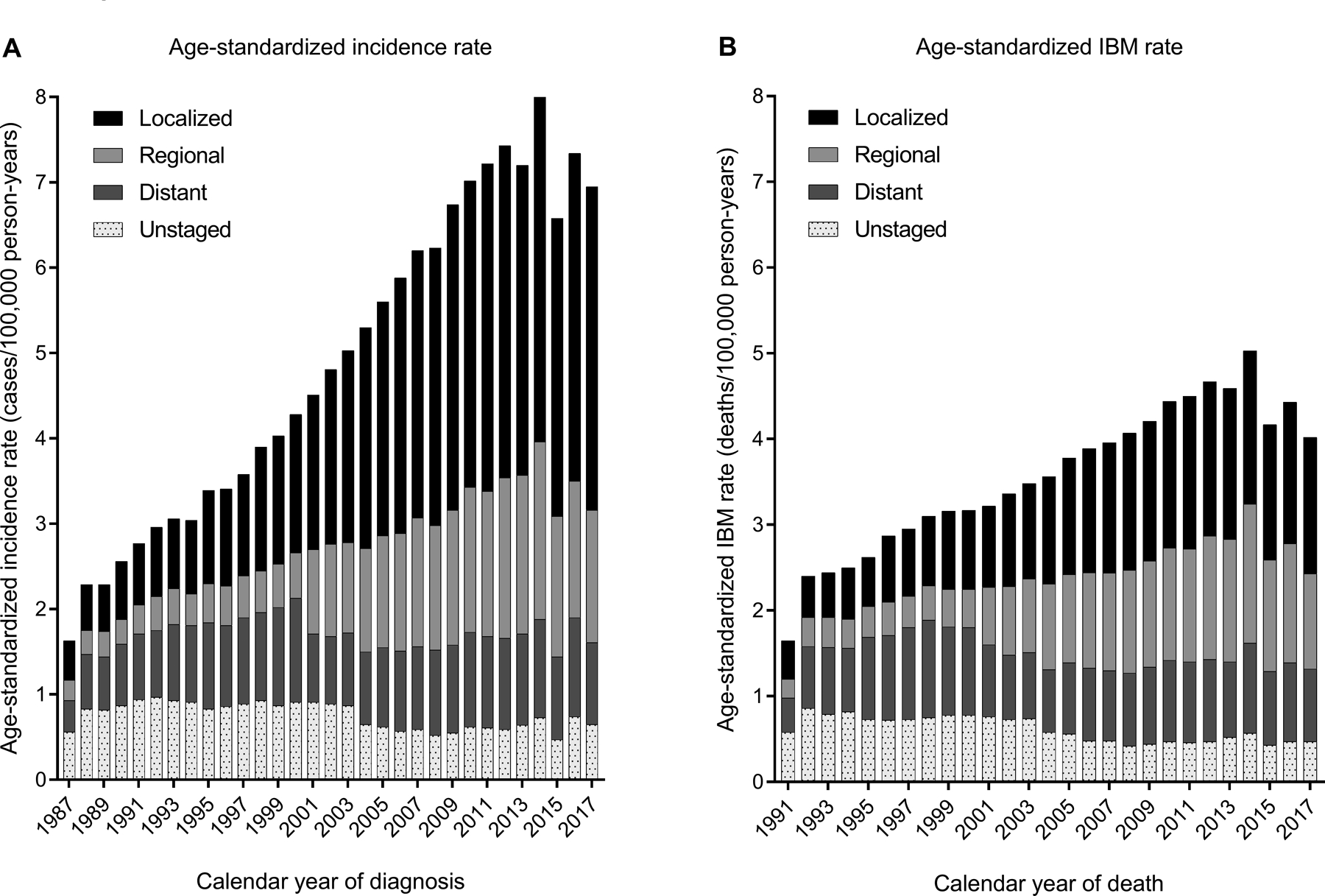
The Transplant Cancer Match Study links the US transplant registry with 17 cancer registries. We calculated age-standardized incidence (1987–2017) and incidence-based mortality (IBM) rates (1991–2017) for adult HCCs. We partitioned population-level IBM rates by cancer stage and calculated counterfactual IBM rates assuming transplanted cases had not received a transplant.
Results:
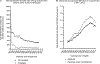
Among 129,487 HCC cases, 45.9% had localized cancer. HCC incidence increased on average 4.0% annually (95%CI=3.6%−4.5%). IBM also increased for HCC overall (2.9% annually; 95%CI=1.7%−4.2%) and specifically for localized stage HCC (4.8% annually; 95%CI=4.0%−5.5%). The proportion of HCC-related transplants jumped sharply from 6.7% (2001) to 18.0% (2002), and further increased to 40.0% (2017). HCC-specific mortality declined among both non-transplanted and transplanted cases over time. In the absence of transplants, IBM for localized HCC would have increased at 5.3% instead of 4.8% annually.
Conclusions:
LT has provided survival benefit to patients with localized HCC. However, diagnosis of many cases at advanced stages, limited availability of donor livers, and improved mortality for non-transplanted patients have limited the impact of transplantation on general population HCC-specific mortality rates.
Impact:
Though LT rates continue to rise, better screening and treatment modalities are needed to halt the rising HCC mortality rates in the US.
-
Subjects:
-
Source:Cancer Epidemiol Biomarkers Prev. 30(3):513-520
-
Pubmed ID:33199438
-
Pubmed Central ID:PMC8052263
-
Document Type:
-
Funding:N01PC35143/CA/NCI NIH HHSUnited States/ ; HHSN261201800005C/CA/NCI NIH HHSUnited States/ ; U58 DP003883/DP/NCCDPHP CDC HHSUnited States/ ; U58 DP003875/DP/NCCDPHP CDC HHSUnited States/ ; HHSN261201000036C/CA/NCI NIH HHSUnited States/ ; U58 DP000807/DP/NCCDPHP CDC HHSUnited States/ ; Z99 CA999999/ImNIH/Intramural NIH HHSUnited States/ ; U58 DP000848/DP/NCCDPHP CDC HHSUnited States/ ; HHSN261201800002C/CA/NCI NIH HHSUnited States/ ; U58 DP000824/DP/NCCDPHP CDC HHSUnited States/ ; HHSN261201300021C/CA/NCI NIH HHSUnited States/ ; HHSN261201000035I/CA/NCI NIH HHSUnited States/ ; HHSN261201000035C/PC/NCI NIH HHSUnited States/ ; HHSN261201000034C/CA/NCI NIH HHSUnited States/
-
Volume:30
-
Issue:3
-
Collection(s):
-
Main Document Checksum:urn:sha256:f19831080d3573aad631f7c786db7fbc7972258d0b594bed705c8ae22e7c4e2a
-
Download URL:
-
File Type:
 [PDF
- 818.83 KB
]
[PDF
- 818.83 KB
]
Supporting Files


File Language:
English
ON THIS PAGE






CDC STACKS serves as an archival repository of CDC-published products including
scientific findings,
journal articles, guidelines, recommendations, or other public health information authored or
co-authored by CDC or funded partners.
As a repository, CDC STACKS retains documents in their original published format to ensure public access to scientific information.
As a repository, CDC STACKS retains documents in their original published format to ensure public access to scientific information.
You May Also Like
COLLECTION
CDC Public Access