



Duchenne and Becker Muscular Dystrophies Prevalence in MD STARnet surveillance sites: An Examination of Racial and Ethnic Differences
Supporting Files

-
2021 ; 2021
-
Available in CDC Stacks on 2022-01-21T00:00:00Z
File Language:
English
Details
-
Alternative Title:Neuroepidemiology
-
Personal Author:
-
Corporate Authors:
-
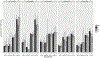
Description:Introduction: ; Previous studies indicated variability in the prevalence of Duchenne and Becker muscular dystrophies (DBMD) by racial/ethnic groups. The Centers for Disease Control and Prevention’s (CDC) Muscular Dystrophy Surveillance, Tracking, and Research network (MD STARnet) conducts muscular dystrophy surveillance in multiple geographic areas of the United States and continues to enroll new cases. This provides an opportunity to continue investigating differences in DBMD prevalence by race and ethnicity, and to compare the impact of using varying approaches for estimating prevalence. ; Objective: ; To estimate overall and race/ethnicity-specific prevalence of DBMD among males aged 5 to 9 years and compare the performance of three prevalence estimation methods. ; Methods: ; The overall and race/ethnicity-specific 5-year period prevalence rates were estimated with MD STARnet data using three methods. Method 1 used the median of 5 yearly prevalence and Methods 2 and 3 calculated prevalence directly with different birth cohorts. To compare prevalence between racial/ethnic groups, Poisson modelling was used to estimate prevalence ratios (PRs) with non-Hispanic (NH) whites as the referent group. Comparison between methods was also conducted. ; Results: ; In the final population-based sample of 1,164 DBMD males, the overall 5-year prevalence for DBMD among 5 to 9 years of age ranged from 1.92-2.48 per 10,000 males; 0.74-1.26 for NH blacks, 1.78-2.26 for NH whites, 2.24-4.02 for Hispanics and 0.61-1.83 for NH American Indian or Alaska Native and Native Hawaiian or Pacific Islander (AIAN/API). The PRs for NH blacks/NH whites, Hispanics/NH whites and NH AIAN/API/NH whites were 0.46 (95%CI: 0.36,0.59), 1.37 (1.17,1.61), and 0.61 (0.40,0.93), respectively. ; Conclusions: ; In males aged 5 to 9 years, compared to the prevalence of DBMD in NH whites, prevalence in NH blacks and NH AIAN/API was lower and higher in Hispanics. All methods produced similar prevalence estimates; however, Method 1 produced narrower confidence intervals and Method 2 produced fewer zero prevalence estimates than the other two methods.
-
Subjects:
-
Keywords:
-
Source:Neuroepidemiology. 55(1):47-55
-
Pubmed ID:33477152
-
Pubmed Central ID:PMC8045764
-
Document Type:
-
Funding:U01DD001054/ACL/ACL HHSUnited States/ ; U01DD001245/ACL/ACL HHSUnited States/ ; U01 DD000187/DD/NCBDD CDC HHSUnited States/ ; U01DD001120/ACL/ACL HHSUnited States/ ; U01 DD001123/DD/NCBDD CDC HHSUnited States/ ; U01 DD001247/DD/NCBDD CDC HHSUnited States/ ; U01DD001119/ACL/ACL HHSUnited States/ ; U01DD001108/ACL/ACL HHSUnited States/ ; U01 DD001120/DD/NCBDD CDC HHSUnited States/ ; CC999999/ImCDC/Intramural CDC HHSUnited States/ ; U01DD001126/ACL/ACL HHSUnited States/ ; U01DD001244/ACL/ACL HHSUnited States/ ; U01 DD000191/DD/NCBDD CDC HHSUnited States/ ; U01 DD000190/DD/NCBDD CDC HHSUnited States/ ; U01 DD001244/DD/NCBDD CDC HHSUnited States/ ; U01DD001117/ACL/ACL HHSUnited States/ ; U01 DD001117/DD/NCBDD CDC HHSUnited States/ ; U01 DD001126/DD/NCBDD CDC HHSUnited States/ ; U01DD001116/ACL/ACL HHSUnited States/ ; U01 DD001245/DD/NCBDD CDC HHSUnited States/ ; U01DD001123/ACL/ACL HHSUnited States/ ; U01 DD000189/DD/NCBDD CDC HHSUnited States/ ; U01 DD001116/DD/NCBDD CDC HHSUnited States/ ; U01 DD001119/DD/NCBDD CDC HHSUnited States/ ; U01 DD001108/DD/NCBDD CDC HHSUnited States/ ; U01 DD001248/DD/NCBDD CDC HHSUnited States/ ; U01 DD001054/DD/NCBDD CDC HHSUnited States/
-
Volume:55
-
Issue:1
-
Download URL:
-
File Type:
 [PDF - 165.10 KB]
 -
Collection(s):
-
Main Document Checksum:urn:sha-512:7abfcd7952e04f3533d3b1d0d29a2819169e81c4a72bc5ea40f869bfc94b8e311e789affbd1f336a5b6c199ac3899742cb802b6129f64ac25f0895437d1edaae
Supporting Files


File Language:
English
 Was this page helpful?
 Found an issue?


CDC STACKS serves as an archival repository of CDC-published products including
scientific findings, journal articles, guidelines, recommendations, or other public health information authored or
co-authored by CDC or funded partners.
As a repository, CDC STACKS retains documents in their original published format to ensure public access to scientific information.
As a repository, CDC STACKS retains documents in their original published format to ensure public access to scientific information.
You May Also Like
COLLECTION
CDC Public Access