


Reemergence of Human Monkeypox and Declining Population Immunity in the Context of Urbanization, Nigeria, 2017–2020
Supporting Files
Public Domain

-
April 2021
File Language:
English
Details
-
Alternative Title:Emerg Infect Dis
-
Personal Author:
-
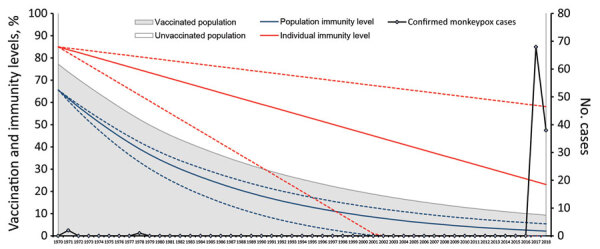
Description:A monkeypox outbreak in Nigeria during 2017-2020 provides an illustrative case study for emerging zoonoses. We built a statistical model to simulate declining immunity from monkeypox at 2 levels: At the individual level, we used a constant rate of decline in immunity of 1.29% per year as smallpox vaccination rates fell. At the population level, the cohort of vaccinated residents decreased over time because of deaths and births. By 2016, only 10.1% of the total population in Nigeria was vaccinated against smallpox; the serologic immunity level was 25.7% among vaccinated persons and 2.6% in the overall population. The substantial resurgence of monkeypox in Nigeria in 2017 appears to have been driven by a combination of population growth, accumulation of unvaccinated cohorts, and decline in smallpox vaccine immunity. The expanding unvaccinated population means that entire households, not just children, are now more susceptible to monkeypox, increasing risk of human-to-human transmission.
-
Subjects:
-
Source:Emerg Infect Dis. 27(4):1007-1014
-
Pubmed ID:33756100
-
Pubmed Central ID:PMC8007331
-
Document Type:
-
Place as Subject:
-
Volume:27
-
Issue:4
-
Collection(s):
-
Main Document Checksum:urn:sha256:3f7d41dd7e46532150636dfd81856f41d3eaa8a155329a278150ee3f3c465dfc
-
Download URL:
-
File Type:
 [PDF
- 1.53 MB
]
[PDF
- 1.53 MB
]
Supporting Files


File Language:
English
ON THIS PAGE


CDC STACKS serves as an archival repository of CDC-published products including
scientific findings,
journal articles, guidelines, recommendations, or other public health information authored or
co-authored by CDC or funded partners.
As a repository, CDC STACKS retains documents in their original published format to ensure public access to scientific information.
As a repository, CDC STACKS retains documents in their original published format to ensure public access to scientific information.
You May Also Like
COLLECTION
Emerging Infectious Diseases