



Platelet reactivity in response to aspirin and ticagrelor in African-Americans and European-Americans
Supporting Files

-
2 2021
-
File Language:
English
Details
-
Alternative Title:J Thromb Thrombolysis
-
Personal Author:
-
Description:Background:
Platelet gene polymorphisms are associated with variable on-treatment platelet reactivity and vary by race. Whether differences in platelet reactivity and aspirin or ticagrelor exist between African-American and European-Americans remains poorly understood.
Methods:
Biological samples from three prior prospective antiplatelet challenge studies at the Duke Clinical Research Unit were used to compare platelet reactivity between African-American and European-American subjects. Platelet reactivity at baseline, on-aspirin, on-ticagrelor, and the treatment effect of aspirin or ticagrelor were compared between groups using an adjusted mixed effects model.
Results:
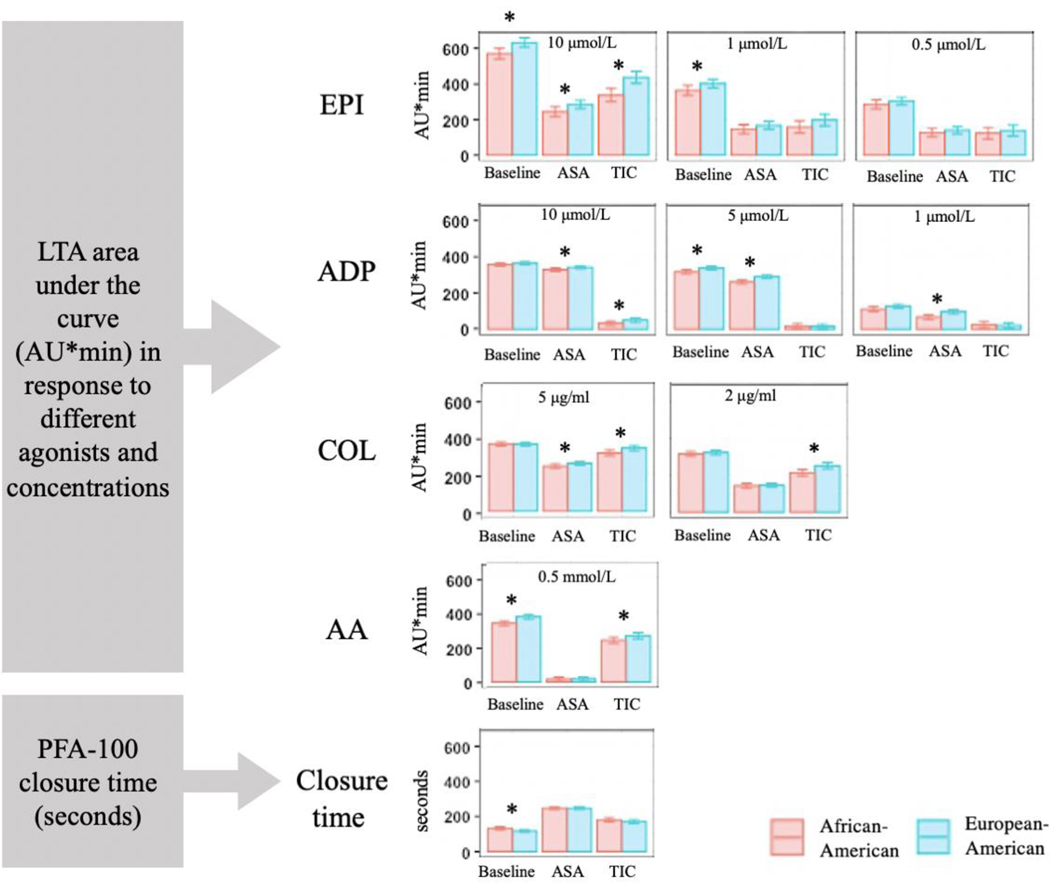
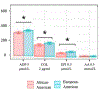
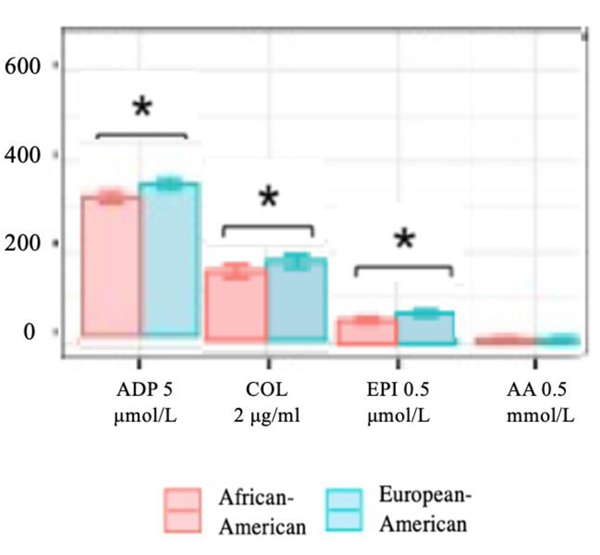
Compared with European-Americans (n=282; 50% female; mean±standard deviation age, 50±16), African-Americans (n=209; 67% female; age 48±12) had lower baseline platelet reactivity with platelet function analyzer-100 (PFA-100) (p<0.01) and with light transmission aggregometry (LTA) in response to arachidonic acid (AA), adenosine diphosphate (ADP), and epinephrine agonists (p<0.05). African-Americans had lower platelet reactivity on aspirin in response to ADP, epinephrine, and collagen (p<0.05) and on ticagrelor in response to AA, ADP, and collagen (p<0.05). The treatment effect of aspirin was greater in European-Americans with an AA agonist (p=0.002). Between-race differences with in vitro aspirin mirrored those seen in vivo. The treatment effect of ticagrelor was greater in European-Americans in response to ADP (p<0.05) but with collagen, the treatment effect was greater for African-Americans (p<0.05).
Conclusions:
Platelet reactivity was overall lower in African-Americans off-treatment, on aspirin, and on ticagrelor. European-Americans experienced greater platelet suppression on aspirin and on ticagrelor. The aspirin response difference in vivo and in vitro suggests a mechanism intrinsic to the platelet. Whether the absolute level of platelet reactivity or the degree of platelet suppression after treatment is more important for clinical outcomes is uncertain.
-
Subjects:
-
Source:J Thromb Thrombolysis. 51(2):249-259
-
Pubmed ID:33159252
-
Pubmed Central ID:PMC7889728
-
Document Type:
-
Funding:2012/0003R/Duke-National University Singapore/ ; 5RC1GM091083/National Institutes of General Medical Sciences/ ; R01 HL118049/HL/NHLBI NIH HHSUnited States/ ; U01 DD000014/DD/NCBDD CDC HHSUnited States/ ; 5U01DD000014/CC/CDC HHSUnited States/ ; RC1 GM091083/GM/NIGMS NIH HHSUnited States/ ; UL1 RR024128/RR/NCRR NIH HHSUnited States/ ; R01HL118049/Foundation for the National Institutes of Health/ ; 5UL1RR024128/RR/NCRR NIH HHSUnited States/
-
Volume:51
-
Issue:2
-
Collection(s):
-
Main Document Checksum:urn:sha256:e6943f920c3c07eb84ae33a967893ff6ff2f692277f0efd48c82607d19293c88
-
Download URL:
-
File Type:
 [PDF
- 924.93 KB
]
[PDF
- 924.93 KB
]
Supporting Files


File Language:
English
 Was this page helpful?
 Found an issue?

CDC STACKS serves as an archival repository of CDC-published products including
scientific findings,
journal articles, guidelines, recommendations, or other public health information authored or
co-authored by CDC or funded partners.
As a repository, CDC STACKS retains documents in their original published format to ensure public access to scientific information.
As a repository, CDC STACKS retains documents in their original published format to ensure public access to scientific information.
You May Also Like
COLLECTION
CDC Public Access