


Inflammation and acute traffic-related air pollution exposures among a cohort of youth with type 1 diabetes
Supporting Files

-
11 2019
-
File Language:
English
Details
-
Alternative Title:Environ Int
-
Personal Author:
-
Description:Background
Evidence remains equivocal regarding the association of inflammation, a precursor to cardiovascular disease, and acute exposures to ambient air pollution from traffic-related particulate matter. Though youth with type 1 diabetes are at higher risk for cardiovascular disease, the relationship of inflammation and ambient air pollution exposures in this population has received little attention.
Objectives
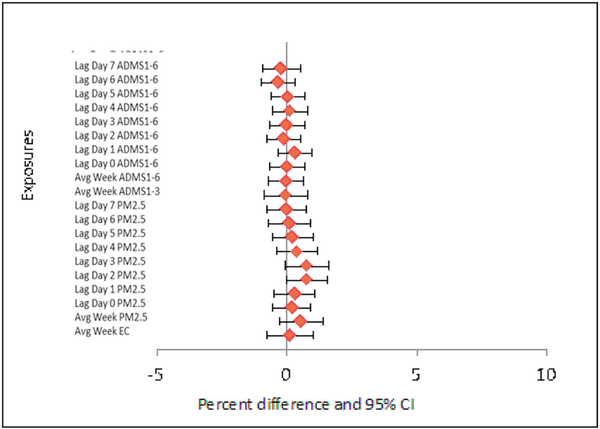
Using five geographically diverse US sites from the racially- and ethnically-diverse SEARCH for Diabetes in Youth Cohort, we examined the relationship of acute exposures to PM2.5 mass, Atmospheric Dispersion Modeling System (ADMS)-Roads traffic-related PM concentrations near roadways, and elemental carbon (EC) with biomarkers of inflammation including interleukin-6 (IL-6), c-reactive protein (hs-CRP) and fibrinogen.
Methods
Baseline questionnaires and blood were obtained at a study visit. Using a spatio-temporal modeling approach, pollutant exposures for 7 days prior to blood draw were assigned to residential addresses. Linear mixed models for each outcome and exposure were adjusted for demographic and lifestyle factors identified a priori.
Results
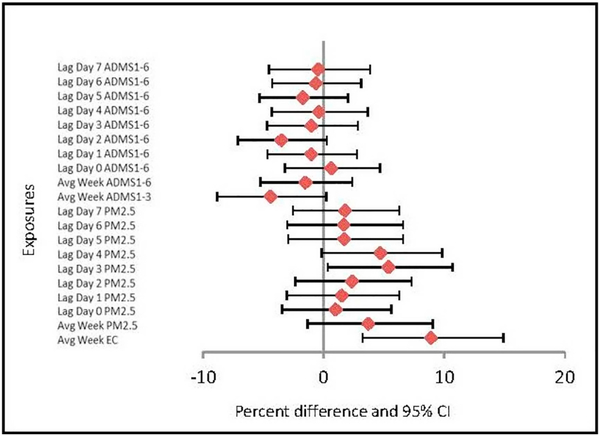
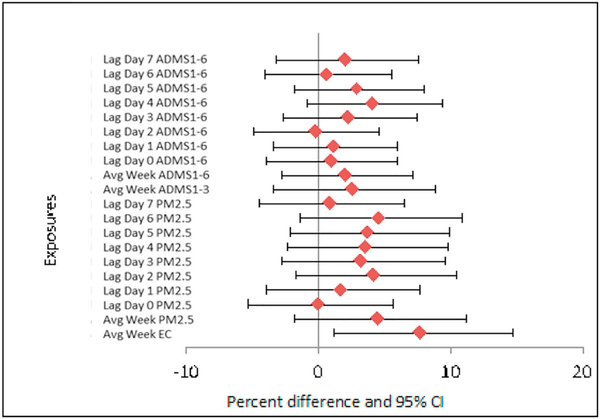
Among the 2566 participants with complete data, fully-adjusted models showed positive associations of EC average week exposures with IL-6 and hs-CRP, and PM2.5 mass exposures on lag day 3 with IL-6 levels. Comparing the 25th and 75th percentiles of average week EC exposures resulted in 8.3% higher IL-6 (95%CI: 2.7%,14.3%) and 9.8% higher hs-CRP (95%CI: 2.4%,17.7%). We observed some evidence of effect modification for the relationships of PM2.5 mass exposures with hs-CRP by gender and with IL-6 by race/ethnicity.
Conclusions
Indicators of inflammation were associated with estimated traffic-related air pollutant exposures in this study population of youth with type 1 diabetes. Thus youth with type 1 diabetes may be at increased risk of air pollution-related inflammation. These findings and the racial/ethnic and gender differences observed deserve further exploration.
-
Subjects:
-
Source:Environ Int. 132:105064
-
Pubmed ID:31419765
-
Pubmed Central ID:PMC7717111
-
Document Type:
-
Funding:P30 DK057516/DK/NIDDK NIH HHSUnited States/ ; U01 DP000247/DP/NCCDPHP CDC HHSUnited States/ ; U18 DP002710/DP/NCCDPHP CDC HHSUnited States/ ; U18DP006138/ACL/ACL HHSUnited States/ ; UL1 TR000154/TR/NCATS NIH HHSUnited States/ ; U18 DP002714/DP/NCCDPHP CDC HHSUnited States/ ; U01 DP000248/DP/NCCDPHP CDC HHSUnited States/ ; U01 DP000244/DP/NCCDPHP CDC HHSUnited States/ ; UL1 TR000062/TR/NCATS NIH HHSUnited States/ ; U18DP006134/ACL/ACL HHSUnited States/ ; U18 DP002709/DP/NCCDPHP CDC HHSUnited States/ ; U18DP006131/ACL/ACL HHSUnited States/ ; UL1 TR000077/TR/NCATS NIH HHSUnited States/ ; HIR 10-001/HX/HSRD VAUnited States/ ; U18DP006139/ACL/ACL HHSUnited States/ ; UC4 DK108173/DK/NIDDK NIH HHSUnited States/ ; R01 ES019168/ES/NIEHS NIH HHSUnited States/ ; UL1 TR000423/TR/NCATS NIH HHSUnited States/ ; U18DP006136/ACL/ACL HHSUnited States/ ; U01 DP000250/DP/NCCDPHP CDC HHSUnited States/ ; U01 DP000246/DP/NCCDPHP CDC HHSUnited States/ ; U01 DP000254/DP/NCCDPHP CDC HHSUnited States/ ; U18DP006133/ACL/ACL HHSUnited States/ ; U18 DP002708/DP/NCCDPHP CDC HHSUnited States/
-
Volume:132
-
Collection(s):
-
Main Document Checksum:urn:sha256:5d806ca723b2cef39fa368be192652f7ee161e93e81ec0ea371412ade6908a9d
-
Download URL:
-
File Type:
 [PDF
- 649.37 KB
]
[PDF
- 649.37 KB
]
Supporting Files


File Language:
English
ON THIS PAGE


CDC STACKS serves as an archival repository of CDC-published products including
scientific findings,
journal articles, guidelines, recommendations, or other public health information authored or
co-authored by CDC or funded partners.
As a repository, CDC STACKS retains documents in their original published format to ensure public access to scientific information.
As a repository, CDC STACKS retains documents in their original published format to ensure public access to scientific information.
You May Also Like
COLLECTION
CDC Public Access