


Outbreak of Haff Disease along the Yangtze River, Anhui Province, China, 2016
Supporting Files
Public Domain

-
Dec 2020
-
File Language:
English
Details
-
Alternative Title:Emerg Infect Dis
-
Personal Author:Ma, Huilai ; Wu, Jiabing ; Qin, Wei ; Lin, Chao ; Li, Dan ; Zha, Bing ; Chen, Qi ; Ma, Yan ; Zhou, Tichao ; Li, Shicong ; Gong, Lei ; Ma, Wanwan ; Ge, Dafang ; Cheng, Zhouxiang ; Chen, Jian ; Li, Qun
-
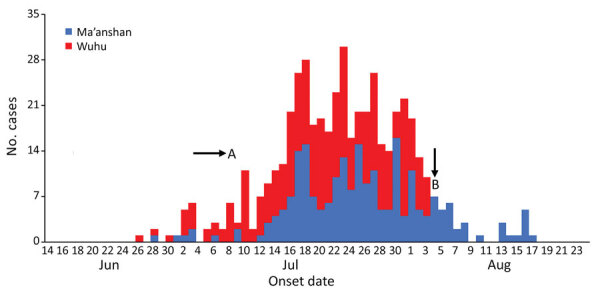
Description:We investigated a large outbreak of Haff disease that occurred along the Yangtze River in Anhui Province, China, in 2016. Of the 672 cases identified during the outbreak, 83.3% (560/672) occurred in Wuhu and Ma'anshan. Patients experienced myalgia (100%) and muscle weakness (54.7%). The mean value of myoglobin was 330 + 121.2 ng/mL and of serum creatine kinase 5,439.2 + 4,765.1 U/L. Eating crayfish was the only common exposure among all cases; 96.8% (240/248) of implicated crayfish were caught on the shores of the Yangtze River or its connected ditches. Mean incubation period was 6.2 + 3.8 hours. This case-control study demonstrated that eating the liver of crayfish and eating a large quantity of crayfish were associated with an increased risk for Haff disease. The seasonal increases in crayfish population along the Yangtze River might explain the seasonal outbreaks of Haff disease.
-
Subjects:
-
Source:Emerg Infect Dis. 26(12):2916-2921
-
Pubmed ID:33219647
-
Pubmed Central ID:PMC7706968
-
Document Type:
-
Place as Subject:
-
Volume:26
-
Issue:12
-
Collection(s):
-
Main Document Checksum:urn:sha256:6f0b147c60a2510dfad3b80ffc1a08b1707fe8a1225456478c536bcbe6dc13ac
-
Download URL:
-
File Type:
 [PDF
- 698.91 KB
]
[PDF
- 698.91 KB
]
Supporting Files


File Language:
English
ON THIS PAGE

CDC STACKS serves as an archival repository of CDC-published products including
scientific findings,
journal articles, guidelines, recommendations, or other public health information authored or
co-authored by CDC or funded partners.
As a repository, CDC STACKS retains documents in their original published format to ensure public access to scientific information.
As a repository, CDC STACKS retains documents in their original published format to ensure public access to scientific information.
You May Also Like
COLLECTION
Emerging Infectious Diseases