



Discriminatory Capacity of Anthropometric Indices for Cardiovascular Disease in Adults: A Systematic Review and Meta-Analysis
Supporting Files
Public Domain

-
October 22 2020
File Language:
English
Details
-
Journal Article:Preventing Chronic Disease (PCD)
-
Personal Author:
-
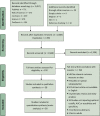
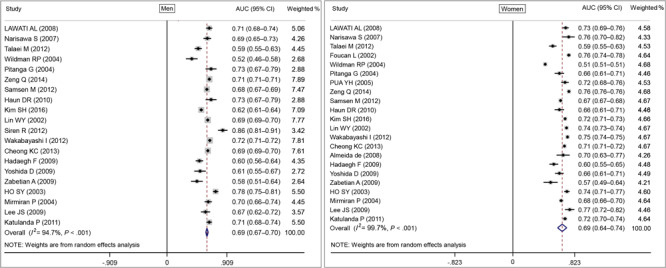
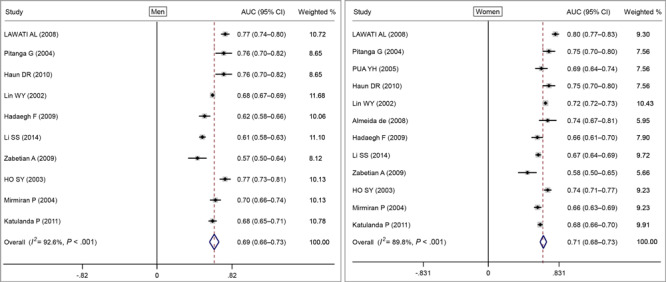
Description:Introduction ; Obesity is one of the main risk factors for cardiovascular disease (CVD) and cardiometabolic disease (CMD). Many studies have developed cutoff points of anthropometric indices for predicting these diseases. The aim of this systematic review was to differentiate the screening potential of body mass index (BMI), waist circumference (WC), and waist-to-hip ratio (WHR) for adult CVD risk. ; Methods ; We used relevant key words to search electronic databases to identify studies published up to 2019 that used receiver operating characteristic (ROC) curves for assessing the cut-off points of anthropometric indices. We used a random-effects model to pool study results and assessed between-study heterogeneity by using the I2 statistic and Cochran’s Q test. ; Results ; This meta-analysis included 38 cross-sectional and 2 cohort studies with 105 to 137,256 participants aged 18 or older. The pooled area under the ROC curve (AUC) value for BMI was 0.66 (95% CI, 0.63–0.69) in both men and women. The pooled AUC values for WC were 0.69 (95% CI, 0.67–0.70) in men and 0.69 (95% CI, 0.64–0.74) in women, and the pooled AUC values for WHR were 0.69 (95% CI, 0.66–0.73) in men and 0.71 (95% CI, 0.68–0.73) in women. ; Conclusion ; Our findings indicated a slight difference between AUC values of these anthropometric indices. However, indices of abdominal obesity, especially WHR, can better predict CVD occurrence.
-
Subjects:
-
Source:Prev Chronic Dis. 2020; 17
-
ISSN:1545-1151
-
Pubmed ID:33092686
-
Pubmed Central ID:PMC7587303
-
Document Type:
-
Volume:17
-
Download URL:
-
File Type:
 [PDF - 860.08 KB]
 -
Collection(s):
-
Main Document Checksum:urn:sha-512:d0295dc900e4c1bb4f99997c0753f25a00582259a377e726817e3eb4ddf78dabb01f07eb3f9e79ef18566a0dc91b4a035c6fdddada5a6a939475495e129d29fa
Supporting Files


File Language:
English
 Was this page helpful?
 Found an issue?





CDC STACKS serves as an archival repository of CDC-published products including
scientific findings, journal articles, guidelines, recommendations, or other public health information authored or
co-authored by CDC or funded partners.
As a repository, CDC STACKS retains documents in their original published format to ensure public access to scientific information.
As a repository, CDC STACKS retains documents in their original published format to ensure public access to scientific information.
You May Also Like
COLLECTION
Preventing Chronic Disease