


Urinary Metal Mixtures and Longitudinal Changes in Glucose Homeostasis: The Study of Women’s Health Across the Nation (SWAN)
Supporting Files

-
12 2020
-
File Language:
English
Details
-
Alternative Title:Environ Int
-
Personal Author:
-
Description:Background:
Epidemiologic studies on associations between metals and insulin resistance and β-cell dysfunction have been cross-sectional and focused on individual metals.
Objective:
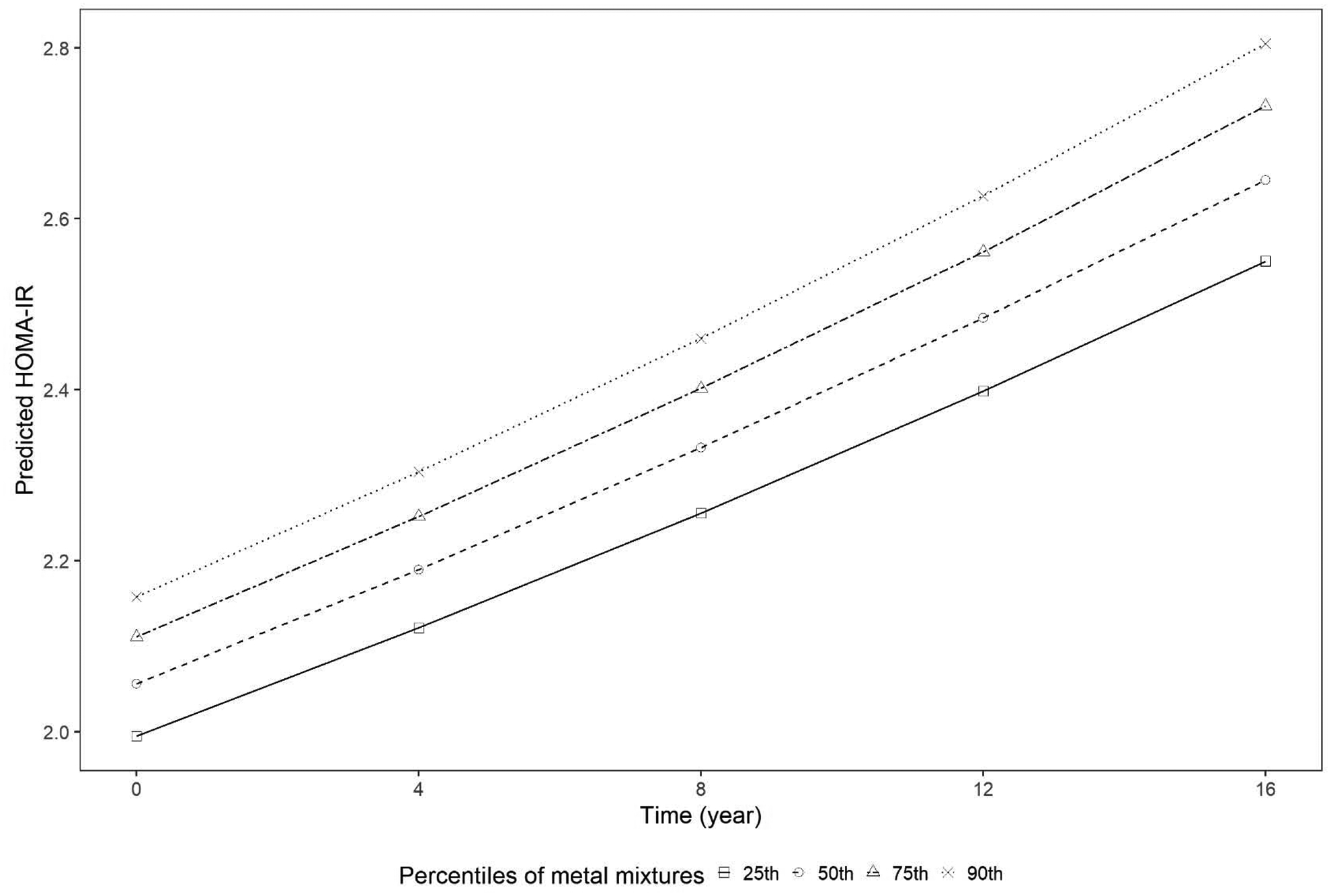
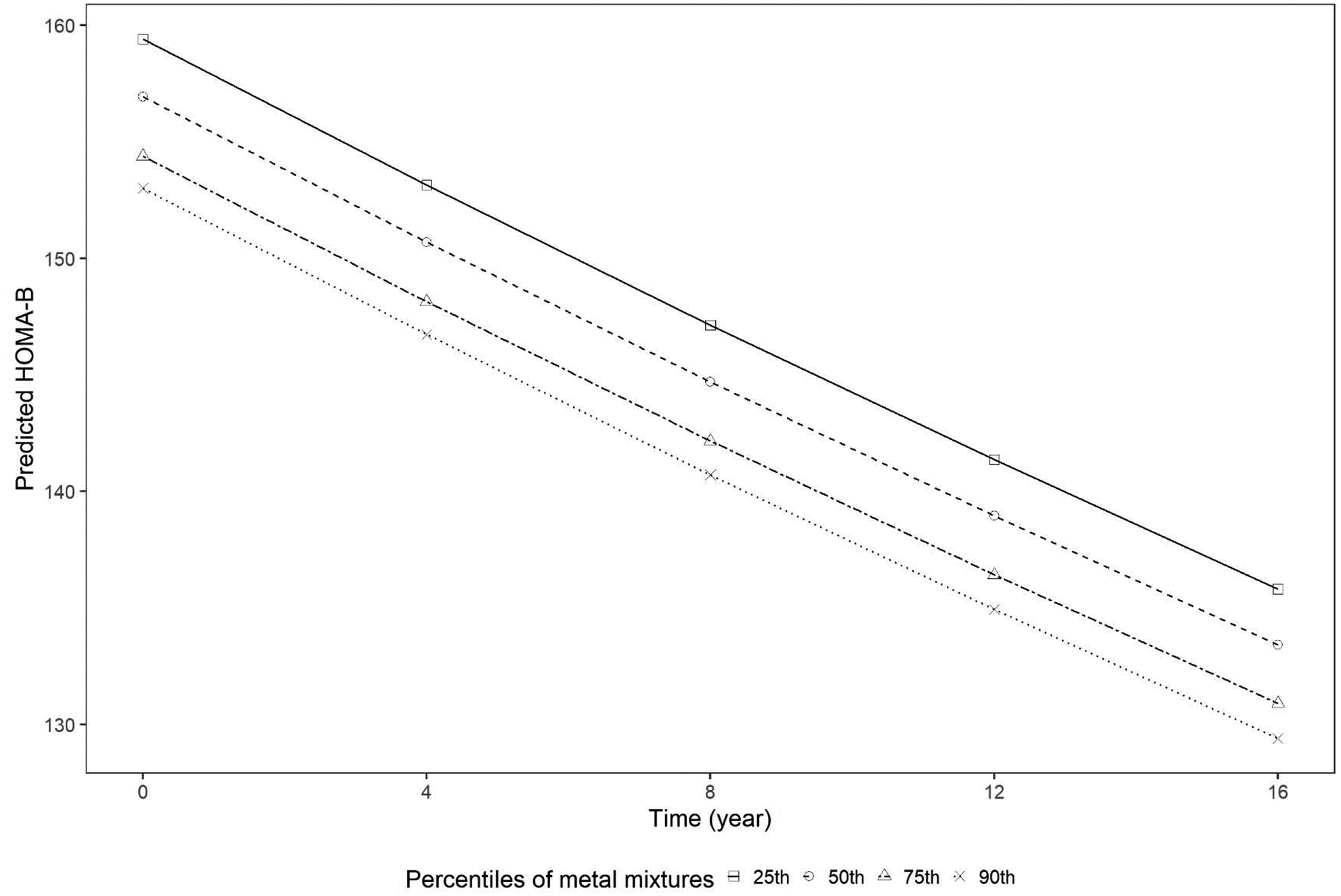
We assessed the association of exposure to metal mixtures, based on assessment of 15 urinary metals, with both baseline levels and longitudinal changes in homeostatic model assessments for insulin resistance (HOMA-IR) and β-cell function (HOMA-β).
Methods:
We examined 1,262 women, aged 45–56 years at baseline (1999–2000), who were followed through 2015–2016, from the Study of Women’s Health Across the Nation. Urinary concentrations of 15 metals (arsenic, barium, cadmium, cobalt, cesium, copper, mercury, manganese, molybdenum, nickel, lead, antimony, tin, thallium, and zinc) were determined at baseline. HOMA-IR and HOMA-β were repeatedly measured over 16 years of follow-up. A two-stage modeling was used to account for correlations in dependent and independent variables: In stage-1, linear mixed effects models were used to estimate the participant-specific baseline HOMA levels from random intercepts and participant-specific rates of changes from random slopes. In stage-2, adaptive elastic-net (AENET) models were fit to identify components of metal mixtures associated with participant-specific baseline levels and rates of changes in HOMA-IR and HOMA-β, respectively. An environmental risk score (ERS) was used to integrate metal mixture effects from AENET results.
Results:
In multivariable adjusted AENET models, urinary zinc was associated with higher HOMA-IR at baseline, whereas molybdenum was associated with lower HOMA-IR at baseline. The estimated changes in baseline HOMA-IR for one standard deviation increase in log-transformed urinary metal concentrations were 5.76% (3.05%, 8.55%) for zinc and −3.25% (−5.45%, −1.00%) for molybdenum, respectively. Urinary zinc was also associated with lower HOMA- β at baseline. Arsenic was associated with a slightly faster rate of decline in HOMA-β in the AENET model evaluating associations between metals and rate of changes. Significant associations of ERS with both HOMA-IR and HOMA-β at baseline were observed. ERS for the rate of changes was not calculated and examined in relation to rates of changes in HOMA-IR and HOMA-β because only a single metal was selected by AENET.
Conclusion:
Exposure to metal mixtures may be exerting effects on insulin resistance and β-cell dysfunction, which might be mechanisms by which metal exposures lead to elevated diabetes risks.
-
Subjects:
-
Source:Environ Int. 145:106109
-
Pubmed ID:32927284
-
Pubmed Central ID:PMC7577932
-
Document Type:
-
Funding:T42 OH008455/OH/NIOSH CDC HHSUnited States/ ; U01 AG012554/AG/NIA NIH HHSUnited States/ ; UL1 RR024131/RR/NCRR NIH HHSUnited States/ ; T42OH008455/ACL/ACL HHSUnited States/ ; P30 ES017885/ES/NIEHS NIH HHSUnited States/ ; U01 AG012535/AG/NIA NIH HHSUnited States/ ; U01 AG012553/AG/NIA NIH HHSUnited States/ ; U01 NR004061/NR/NINR NIH HHSUnited States/ ; U01 AG012539/AG/NIA NIH HHSUnited States/ ; R01 ES026578/ES/NIEHS NIH HHSUnited States/ ; U01 AG012546/AG/NIA NIH HHSUnited States/ ; U19 AG063720/AG/NIA NIH HHSUnited States/ ; U01 AG012495/AG/NIA NIH HHSUnited States/ ; P30 DK020572/DK/NIDDK NIH HHSUnited States/ ; U01 AG012505/AG/NIA NIH HHSUnited States/ ; U01 AG012531/AG/NIA NIH HHSUnited States/ ; R01 ES026964/ES/NIEHS NIH HHSUnited States/ ; U01 AG017719/AG/NIA NIH HHSUnited States/
-
Volume:145
-
Collection(s):
-
Main Document Checksum:urn:sha256:1eb93ff4e057f8e9742a2c607fa738ce3b70acc61278e252925b3d625576e311
-
Download URL:
-
File Type:
 [PDF
- 607.74 KB
]
[PDF
- 607.74 KB
]
Supporting Files


File Language:
English
ON THIS PAGE

CDC STACKS serves as an archival repository of CDC-published products including
scientific findings,
journal articles, guidelines, recommendations, or other public health information authored or
co-authored by CDC or funded partners.
As a repository, CDC STACKS retains documents in their original published format to ensure public access to scientific information.
As a repository, CDC STACKS retains documents in their original published format to ensure public access to scientific information.
You May Also Like
COLLECTION
CDC Public Access