


Anti-Müllerian hormone levels in nurses working night shifts
Supporting Files

-
April 04 2019
-
File Language:
English
Details
-
Alternative Title:Arch Environ Occup Health
-
Personal Author:
-
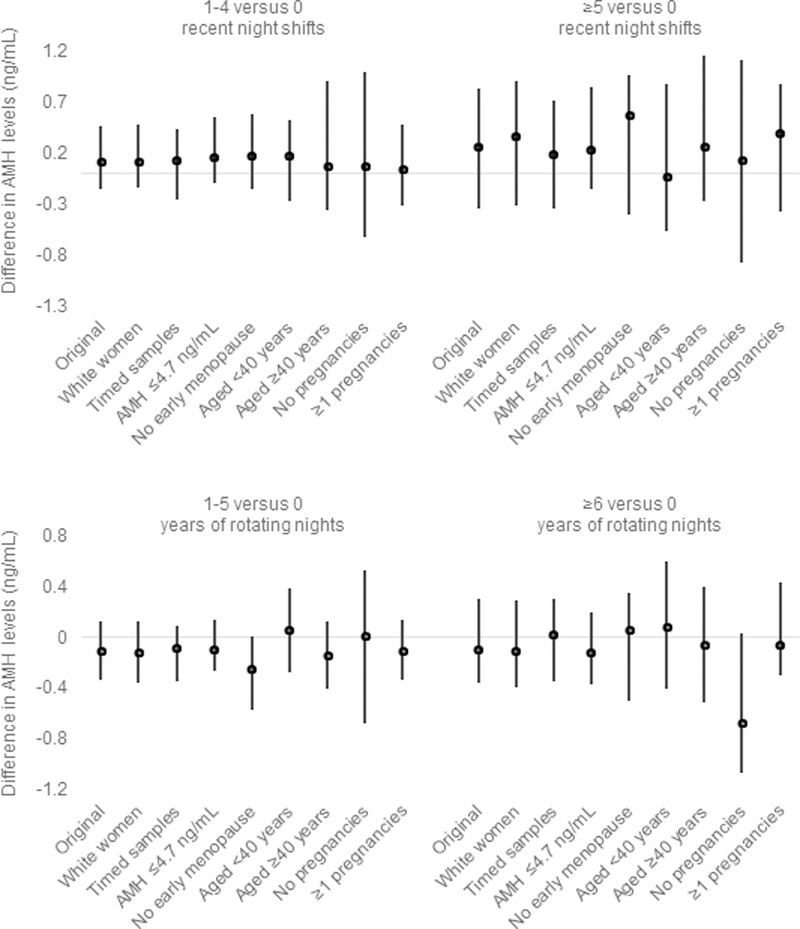
Description:Our objective was to examine associations between night shift work and serum anti-Müllerian hormone (AMH) levels. We analyzed 1,537 blood samples from premenopausal female nurses in the Nurses' Health Study II, assayed for AMH. Rotating or permanent night shifts worked in the two weeks before blood collection and years of rotating night shift work were obtained via questionnaire. We found no associations between recent night shifts or rotating night shift work and AMH. The median difference in AMH was 0.3 (95% CI: -0.4, 0.8) ng/mL for ≥5 versus 0 recent night shifts and -0.1 (95% CI: -0.4, 0.3) ng/mL for ≥6 versus 0 years of rotating night shift work. Although we found no associations between night shift work and AMH, this does not preclude associations between night shift work and fertility operating through other mechanisms.
-
Subjects:
-
Source:Arch Environ Occup Health. :1-8
-
Pubmed ID:30945620
-
Pubmed Central ID:PMC6776712
-
Document Type:
-
Funding:R01 CA178949/CA/NCI NIH HHS/United States ; R01 OH009803/OH/NIOSH CDC HHS/United States ; R01 CA067262/CA/NCI NIH HHS/United States ; UM1 CA176726/CA/NCI NIH HHS/United States ; R01OH009803/ACL/ACL HHS/United States ; CC999999/ImCDC/Intramural CDC HHS/United States ; R01 HD078517/HD/NICHD NIH HHS/United States
-
Collection(s):
-
Main Document Checksum:urn:sha256:3edced8cacc3c5cc278c01804ac8a64bd235d142380ad2405b6cfed8fd8505c6
-
Download URL:
-
File Type:
 [PDF
- 168.50 KB
]
[PDF
- 168.50 KB
]
Supporting Files


File Language:
English
ON THIS PAGE

CDC STACKS serves as an archival repository of CDC-published products including
scientific findings,
journal articles, guidelines, recommendations, or other public health information authored or
co-authored by CDC or funded partners.
As a repository, CDC STACKS retains documents in their original published format to ensure public access to scientific information.
As a repository, CDC STACKS retains documents in their original published format to ensure public access to scientific information.
You May Also Like
COLLECTION
CDC Public Access