


Preventive care services and health behaviors in children with fragile X syndrome
Supporting Files

-
May 03 2019
-
File Language:
English
Details
-
Alternative Title:Disabil Health J
-
Personal Author:
-
Description:Background:
This is the first description of preventive care services specifically received by children and young adults with fragile X syndrome (FXS). We compare these rates to those of other pediatric populations and identify care disparities within our cohort.
Objective:
Describe the frequency of preventive care services and health behaviors by young people with FXS, and identify disparities in care.
Methods:
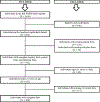
We assessed four preventive care outcomes and the total number of preventive care guidelines met among individuals under 21 years from the ongoing Fragile X Online Registry with Accessible Research Database (N = 406) using data from 2012 to 2015. We used adjusted odds ratios (AORs) from multiple logistic regression models to describe associations between demographic factors and preventive care outcomes.
Results:
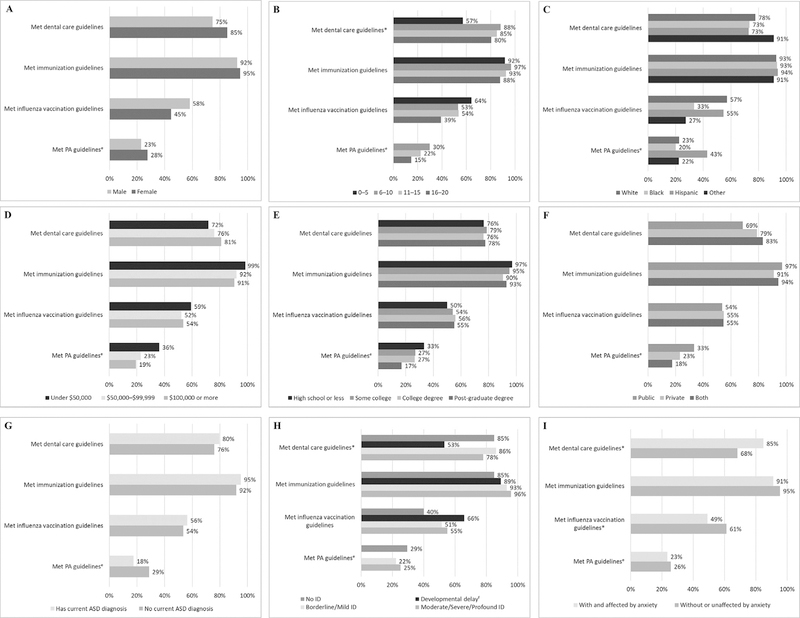
Seventy-five percent of our sample met dental care guidelines, 55.4% met influenza vaccination guidelines, 92.1% met immunization guidelines, and 24.4% met physical activity (PA) guidelines. Compared to children six to 10 years, younger children were less likely to have seen a dentist as recommended (AOR: 0.26) and young adults aged 16–20 were less likely to have received immunizations (AOR: 0.14) or to have engaged in recommended PA (AOR: 0.29). Black participants (AOR: 0.25) were less likely to have received an influenza vaccination than white participants. Individuals with autism (AOR: 0.25) were less likely to have sufficient PA, while individuals with hypersensitivity were more likely to have sufficient PA (AOR: 2.37) than unaffected individuals.
Conclusions:
The proportion of young people with FXS that meet basic recommendations in preventive care guidelines varies according to health condition and demographic characteristics. This proportion could be increased for some groups, particularly in the cases of influenza vaccination and physical activity.
-
Subjects:
-
Source:Disabil Health J. 12(4):564-573
-
Pubmed ID:31118158
-
Pubmed Central ID:PMC6778488
-
Document Type:
-
Funding:U01DD001189/ACL HHS/United States ; U01 DD001189/DD/NCBDD CDC HHS/United States ; U01 DD001190/DD/NCBDD CDC HHS/United States ; U01DD001188/ACL HHS/United States ; U19 DD000753/DD/NCBDD CDC HHS/United States ; U01 DD001188/DD/NCBDD CDC HHS/United States ; CC999999/Intramural CDC HHS/United States ; U01 DD001185/DD/NCBDD CDC HHS/United States ; U01DD001185/ACL HHS/United States ; U01 DD001186/DD/NCBDD CDC HHS/United States ; U01DD001186/ACL HHS/United States ; U01DD001190/ACL HHS/United States
-
Volume:12
-
Issue:4
-
Collection(s):
-
Main Document Checksum:urn:sha256:3deadc8f9b3c9892db6c1f29cb6c960b070958f269ab484be6d07dc61be0cb6d
-
Download URL:
-
File Type:
 [PDF
- 730.32 KB
]
[PDF
- 730.32 KB
]
Supporting Files


File Language:
English
ON THIS PAGE



CDC STACKS serves as an archival repository of CDC-published products including
scientific findings,
journal articles, guidelines, recommendations, or other public health information authored or
co-authored by CDC or funded partners.
As a repository, CDC STACKS retains documents in their original published format to ensure public access to scientific information.
As a repository, CDC STACKS retains documents in their original published format to ensure public access to scientific information.
You May Also Like
COLLECTION
CDC Public Access