



Increasing Childhood Influenza Vaccination
Supporting Files

-
10 2014 ; 10-2014
-
Available in CDC Stacks on October 01, 2015, 12:00 AM
File Language:
English
Details
-
Alternative Title:Am J Prev Med
-
Personal Author:
-
Description:Background
Since the 2008 inception of universal childhood influenza vaccination, national rates have risen more dramatically among younger children than older children and reported rates across racial/ethnic groups are inconsistent. Interventions may be needed to address age and racial disparities to achieve the recommended childhood influenza vaccination target of 70%.
Purpose
To evaluate an intervention to increase childhood influenza vaccination across age and racial groups.
Methods
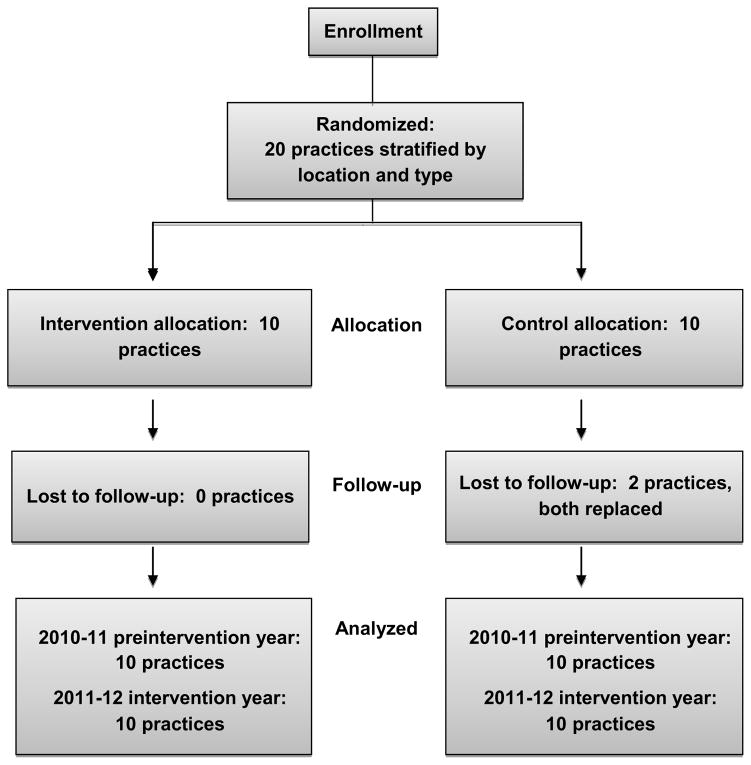
In 2011–2012, 20 primary care practices treating children were randomly assigned to Intervention and Control arms of a cluster randomized controlled trial to increase childhood influenza vaccination uptake using a toolkit and other strategies including early delivery of donated vaccine, in-service staff meetings, and publicity.
Results
The average vaccination differences from pre-intervention to the intervention year were significantly larger in the Intervention arm (n=10 practices) than the Control arm (n=10 practices), for children aged 2–8 years (10.2 percentage points (pct pts) Intervention vs 3.6 pct pts Control) and 9–18 years (11.1 pct pts Intervention vs 4.3 pct pts Control, p<0.05), for non-white children (16.7 pct pts Intervention vs 4.6 pct pts Control, p<0.001), and overall (9.9 pct pts Intervention vs 4.2 pct pts Control, p<0.01). In multi-level modeling that accounted for person- and practice-level variables and the interactions among age, race and intervention, the likelihood of vaccination increased with younger age group (6–23 months), white race, commercial insurance, the practice’s pre-intervention vaccination rate, and being in the Intervention arm. Estimates of the interaction terms indicated that the intervention increased the likelihood of vaccination for non-white children in all age groups and white children aged 9–18 years.
Conclusions
A multi-strategy intervention that includes a practice improvement toolkit can significantly improve influenza vaccination uptake across age and racial groups without targeting specific groups, especially in practices with large percentages of minority children. -
Keywords:
-
Source:Am J Prev Med. 47(4):435-443
-
Pubmed ID:25113138
-
Pubmed Central ID:PMC4208625
-
Document Type:
-
Funding:
-
Volume:47
-
Issue:4
-
Download URL:
-
File Type:
 [PDF - 419.31 KB]
 -
Collection(s):
-
Main Document Checksum:urn:sha256:e8d89b6df5f419dc30360593be9b07859db263d73bde5cfffe0bdf0b96691b40
Supporting Files


File Language:
English
 Was this page helpful?
 Found an issue?



CDC STACKS serves as an archival repository of CDC-published products including
scientific findings, journal articles, guidelines, recommendations, or other public health information authored or
co-authored by CDC or funded partners.
As a repository, CDC STACKS retains documents in their original published format to ensure public access to scientific information.
As a repository, CDC STACKS retains documents in their original published format to ensure public access to scientific information.
You May Also Like
COLLECTION
CDC Public Access