



Timing of State and Territorial COVID-19 Stay-at-Home Orders and Changes in Population Movement — United States, March 1–May 31, 2020
Supporting Files
Public Domain

-
September 04 2020
File Language:
English
Details
-
Journal Article:Morbidity and Mortality Weekly Report (MMWR)
-
Personal Author:Moreland, Amanda ; Herlihy, Christine ; Tynan, Michael A. ; Sunshine, Gregory ; McCord, Russell F. ; Hilton, Charity ; Poovey, Jason ; Werner, Angela K. ; Jones, Christopher D. ; Fulmer, Erika B. ; Gundlapalli, Adi V. ; Strosnider, Heather ; Potvien, Aaron ; García, Macarena C. ; Honeycutt, Sally ; Baldwin, Grant ; Clodfelter, Catherine ; Howard-Williams, Mara ; Jeong, Gi ; Landsman, Lisa ; Shelburne, Julia ; Brown, Amanda ; Cramer, Ryan ; Gilchrist, Siobhan ; Hulkower, Rachel ; Limeres, Alexa ; Popoola, Adebola
-
Corporate Authors:
-
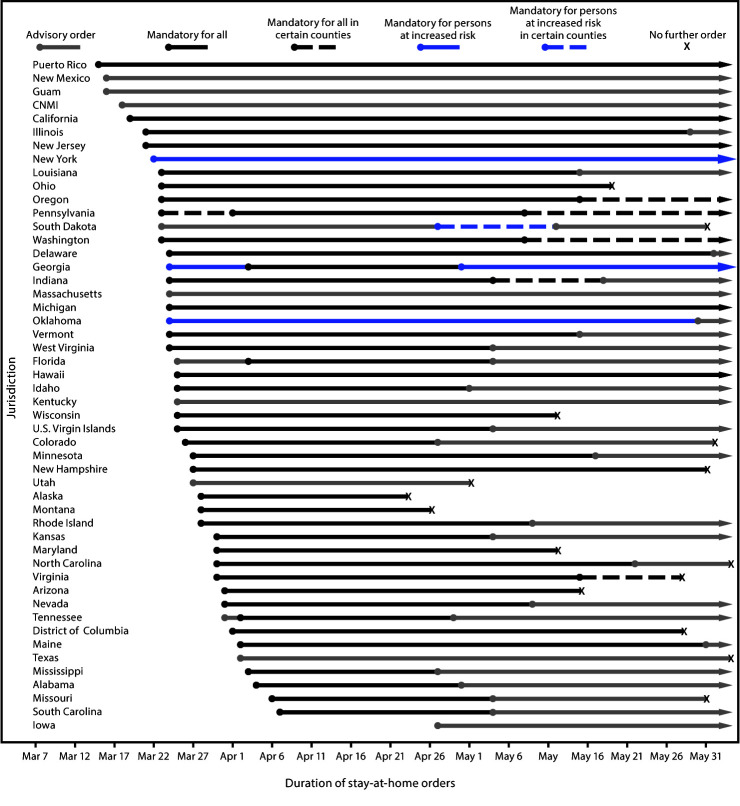
Description:SARS-CoV-2, the Virus that causes coronaVirus disease 2019 (COVID-19), is thought to spread from person to person primarily by the respiratory route and mainly through close contact (1). Community mitigation strategies can lower the risk for disease Transmission by limiting or preventing person-to-person interactions (2). U.S. states and territories began implementing various community mitigation policies in March 2020. One widely implemented strategy was the issuance of orders requiring persons to stay home, resulting in decreased population movement in some jurisdictions (3). Each state or territory has authority to enact its own laws and policies to protect the public's health, and jurisdictions varied widely in the type and timing of orders issued related to stay-at-home requirements. To identify the broader impact of these stay-at-home orders, using publicly accessible, anonymized location data from mobile devices, CDC and the Georgia Tech Research Institute analyzed changes in population movement relative to stay-at-home orders issued during March 1-May 31, 2020, by all 50 states, the District of Columbia, and five U.S. territories.* During this period, 42 states and territories issued mandatory stay-at-home orders. When counties subject to mandatory state- and territory-issued stay-at-home orders were stratified along rural-urban categories, movement decreased significantly relative to the preorder baseline in all strata. Mandatory stay-at-home orders can help reduce activities associated with the spread of COVID-19, including population movement and close person-to-person contact outside the household.
-
Subjects:
-
Source:MMWR Morbidity Mortal Weekly Rep. 69(35):1198-1203
-
Series:
-
ISSN:0149-2195 (print) ; 1545-861X (digital)
-
Pubmed ID:32881851
-
Pubmed Central ID:PMC7470456
-
Document Type:
-
Place as Subject:
-
Pages in Document:6 pdf pages
-
Volume:69
-
Issue:35
-
Download URL:
-
File Type:
 [PDF - 162.38 KB]
 -
Collection(s):
-
Main Document Checksum:urn:sha-512:fb4a459ace942e898555e79aeb5d40cdb2119671897198db6fbce2f7516904eb03426cd481c97ce8ddbb3db065db1df8ca8de72b89a23a69863d8fc9a237ac10
Supporting Files


File Language:
English
 Was this page helpful?
 Found an issue?



CDC STACKS serves as an archival repository of CDC-published products including
scientific findings, journal articles, guidelines, recommendations, or other public health information authored or
co-authored by CDC or funded partners.
As a repository, CDC STACKS retains documents in their original published format to ensure public access to scientific information.
As a repository, CDC STACKS retains documents in their original published format to ensure public access to scientific information.
You May Also Like
COLLECTION
Morbidity and Mortality Weekly Report (MMWR)