


2007–2014
Supporting Files

-
February 01 2018
-
File Language:
English
Details
-
Alternative Title:Public Health Nutr
-
Personal Author:
-
Description:Objective:
Differences in bottled v. tap water intake may provide insights into health disparities, like risk of dental caries and inadequate hydration. We examined differences in plain, tap and bottled water consumption among US adults by sociodemographic characteristics.
Design:
Cross-sectional analysis. We used 24 h dietary recall data to test differences in percentage consuming the water sources and mean intake between groups using Wald tests and multiple logistic and linear regression models.
Setting:
National Health and Nutrition Examination Survey (NHANES), 2007–2014.
Subjects:
A nationally representative sample of 20 676 adults aged ≥20 years.
Results:
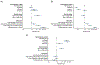
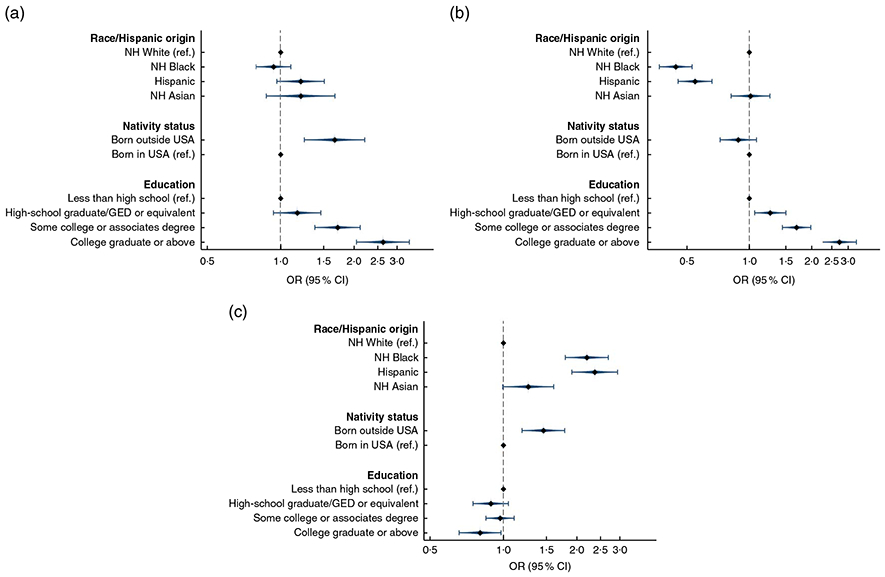
In 2011–2014, 81·4 (se 0·6) % of adults drank plain water (sum of tap and bottled), 55·2 (se 1·4) % drank tap water and 33·4 (se 1·4) % drank bottled water on a given day. Adjusting for covariates, non-Hispanic (NH) Black and Hispanic adults had 0·44 (95% CI 0·37, 0·53) and 0·55 (95% CI 0·45, 0·66) times the odds of consuming tap water, and consumed B = −330 (se 45) ml and B = −180 (se 45) ml less tap water than NH White adults, respectively. NH Black, Hispanic and adults born outside the fifty US states or Washington, DC had 2·20 (95% CI 1·79, 2·69), 2·37 (95% CI 1·91, 2·94) and 1·46 (95% CI 1·19, 1·79) times the odds of consuming bottled water than their NH White and US-born counterparts. In 2007–2010, water filtration was associated with higher odds of drinking plain and tap water.
Conclusions:
While most US adults consumed plain water, the source (i.e. tap or bottled) and amount differed by race/Hispanic origin, nativity status and education. Water filters may increase tap water consumption.
-
Subjects:
-
Source:Public Health Nutr. 21(8):1455-1464
-
Pubmed ID:29388529
-
Pubmed Central ID:PMC7474465
-
Document Type:
-
Funding:
-
Volume:21
-
Issue:8
-
Collection(s):
-
Main Document Checksum:urn:sha256:288c637d62d5683096e936dfce56dd3fb6bfca7473e50ccb5828bb10a8bbbc51
-
Download URL:
-
File Type:
 [PDF
- 428.20 KB
]
[PDF
- 428.20 KB
]
Supporting Files


File Language:
English
ON THIS PAGE

CDC STACKS serves as an archival repository of CDC-published products including
scientific findings,
journal articles, guidelines, recommendations, or other public health information authored or
co-authored by CDC or funded partners.
As a repository, CDC STACKS retains documents in their original published format to ensure public access to scientific information.
As a repository, CDC STACKS retains documents in their original published format to ensure public access to scientific information.
You May Also Like
COLLECTION
CDC Public Access