


Potential Scenarios and Hazards in the Work of the Future: A Systematic Review of the Peer-Reviewed and Gray Literatures
Supporting Files
Public Domain

-
July 28 2020
-
File Language:
English
Details
-
Alternative Title:Ann Work Expo Health
-
Personal Author:
-
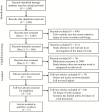
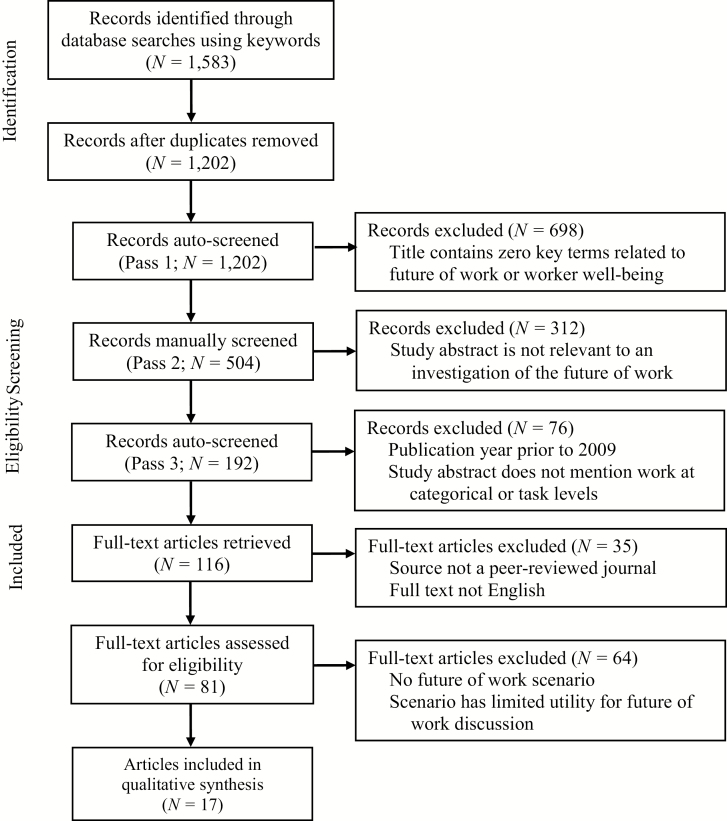
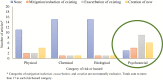
Description:It would be useful for researchers, practitioners, and decision-makers to anticipate the hazards that workers will face in the future. The focus of this study is a systematic review of published information to identify and characterize scenarios and hazards in the future of work. Eleven bibliographic databases were systematically searched for papers and reports published from 1999 to 2019 that described future of work scenarios or identified future work-related hazards. To compile a comprehensive collection of views of the future, supplemental and ad hoc searches were also performed. After screening all search records against a set of predetermined criteria, the review yielded 36 references (17 peer-reviewed, 4 gray, and 15 supplemental) containing scenarios. In these, the future of work was described along multiple conceptual axes (e.g. labor market changes, societal values, and manual versus cognitive work). Technology was identified as the primary driver of the future of work in most scenarios, and there were divergent views in the literature as to whether technology will create more or fewer jobs than it displaces. Workforce demographics, globalization, climate change, economic conditions, and urbanization were also mentioned as influential factors. Other important themes included human enhancement, social isolation, loneliness, worker monitoring, advanced manufacturing, hazardous exposures, sustainability, biotechnology, and synthetic biology. Pandemics have not been widely considered in the future of work literature, but the recent COVID-19 pandemic illustrates that was short-sighted. Pandemics may accelerate future of work trends and merit critical consideration in scenario development. Many scenarios described 'new' or 'exacerbated' psychosocial hazards of work, whereas comparatively fewer discussed physical, chemical, or biological hazards. Various preventive recommendations were identified. In particular, reducing stress associated with precarious work and its requirements of continual skill preparation and training was acknowledged as critical for protecting and promoting the health and well-being of the future workforce. In conclusion, the future of work will be comprised of diverse complex scenarios and a mosaic of old and new hazards. These findings may serve as the basis for considering how to shape the future of work.
-
Subjects:
-
Source:Ann Work Expo Health. 2020;
-
Pubmed ID:32719849
-
Pubmed Central ID:PMC7454321
-
Document Type:
-
Collection(s):
-
Main Document Checksum:urn:sha256:5f732fd6b4bad41feb00f5ce21c9647ab80f56a76d1b42221e4d60cb6284e806
-
Download URL:
-
File Type:
 [PDF
- 687.76 KB
]
[PDF
- 687.76 KB
]
Supporting Files


File Language:
English
ON THIS PAGE


CDC STACKS serves as an archival repository of CDC-published products including
scientific findings,
journal articles, guidelines, recommendations, or other public health information authored or
co-authored by CDC or funded partners.
As a repository, CDC STACKS retains documents in their original published format to ensure public access to scientific information.
As a repository, CDC STACKS retains documents in their original published format to ensure public access to scientific information.
You May Also Like
COLLECTION
CDC Public Access