



The Serological Prevalence of Rabies Virus-Neutralizing Antibodies in the Bat Population on the Caribbean Island of Trinidad
Supporting Files
Public Domain

-
February 05 2020
File Language:
English
Details
-
Alternative Title:Viruses
-
Personal Author:
-
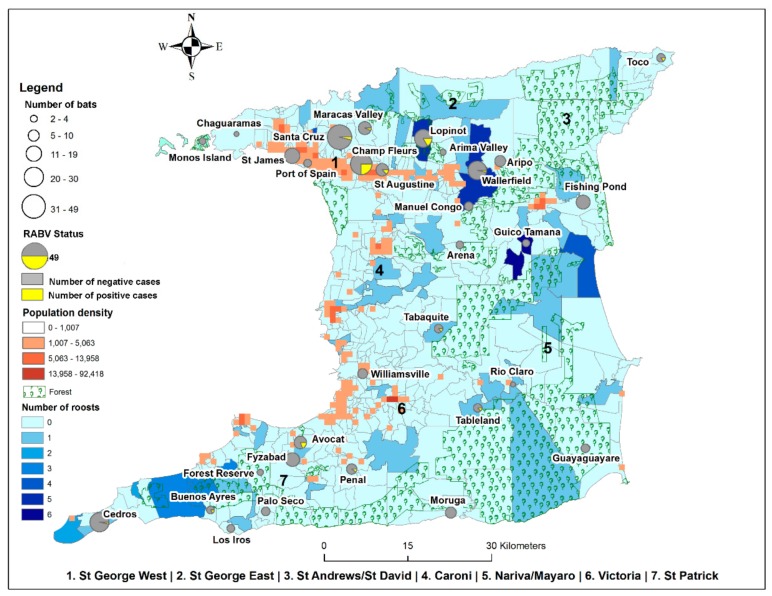
Description:Rabies virus (RABV) is the only lyssavirus known to be present within the Caribbean. The island of Trinidad, is richly diverse in chiropteran fauna and endemic for bat-transmitted rabies with low RABV isolation rates observed in this population. We aimed to determine the seroprevalence of rabies virus neutralizing antibodies (RVNA) in light of spatio-temporal and bat demographic factors to infer the extent of natural exposure to RABV in the Trinidadian bat population. RVNA titers were determined by the RABV micro-neutralization test on 383 bat samples representing 21 species, comprising 30.9% of local bat diversity, from 31 locations across the island over 5 years. RVNA was positively detected in 33 samples (8.6%) representing 6 bat species (mainly frugivorous) with titers ranging from 0.1 to 19 IU/mL (mean 1.66 IU/mL). The analyses based on a multivariable binomial generalised linear mixed-effects model showed that bat age and year of capture were significant predictors of seropositivity. Thus, juvenile bats were more likely to be seropositive when compared to adults (estimate 1.13; | = 0.04) which may suggest early exposure to the RABV with possible implications for viral amplification in this population. Temporal variation in rabies seropositivity, 2012-2014 versus 2015-2017 (estimate 1.07; | = 0.03) may have been related to the prevailing rabies epizootic situation. Regarding other factors investigated, RVNA was found in bats from both rural and non-rural areas, as well as in both hematophagous and non-hematophagous bat species. The most common seropositive species, | is ubiquitous throughout the island which may potentially facilitate human exposure. The findings of this study should be factored into public health assessments on the potential for rabies transmission by non-hematophagous bats in Trinidad.
-
Subjects:
-
Source:Viruses. 2020; 12(2)
-
Pubmed ID:32033370
-
Pubmed Central ID:PMC7077287
-
Document Type:
-
Place as Subject:
-
Volume:12
-
Issue:2
-
Download URL:
-
File Type:
 [PDF - 5.06 MB]
 -
Collection(s):
-
Main Document Checksum:urn:sha256:07e97998cd4eab9360e8d23fe5433c87fe61a49404620e82558e7212df1fe0f5
Supporting Files


File Language:
English
 Was this page helpful?
 Found an issue?

CDC STACKS serves as an archival repository of CDC-published products including
scientific findings, journal articles, guidelines, recommendations, or other public health information authored or
co-authored by CDC or funded partners.
As a repository, CDC STACKS retains documents in their original published format to ensure public access to scientific information.
As a repository, CDC STACKS retains documents in their original published format to ensure public access to scientific information.
You May Also Like
COLLECTION
CDC Public Access