



Weight Change Two Years after the Termination of the Intensive Lifestyle Intervention in the Look AHEAD Study
Supporting Files

-
May 2020
-
Available in CDC Stacks on November 01, 2020, 12:00 AM
File Language:
English
Details
-
Alternative Title:Obesity (Silver Spring)
-
Personal Author:Chao, Ariana M ; Wadden, Thomas A ; Berkowitz, Robert I ; Blackburn, George ; Bolin, Paula ; Clark, Jeanne M ; Coday, Mace ; Curtis, Jeffrey M ; Delahanty, Linda M ; Dutton, Gareth R ; Evans, Mary ; Ewing, Linda J ; Foreyt, John P ; Gay, Linda J ; Gregg, Edward W ; Hazuda, Helen P ; Hill, James O ; Horton, Edward S ; Houston, Denise K ; Jakicic, John M ; Jeffery, Robert W ; Johnson, Karen C ; Kahn, Steven E ; Knowler, William C ; Kure, Anne ; Michalski, Katherine L ; Montez, Maria G ; Neiberg, Rebecca H ; Patricio, Jennifer ; Peters, Anne ; Pi-Sunyer, Xavier ; Pownall, Henry ; Reboussin, David ; Redmon, Bruce ; Rejeski, W Jack ; Steinburg, Helmut ; Walker, Martha ; Williamson, Donald A ; Wing, Rena R ; Wyatt, Holly ; Yanovski, Susan Z ; Zhang, Ping
-
Description:Objective:
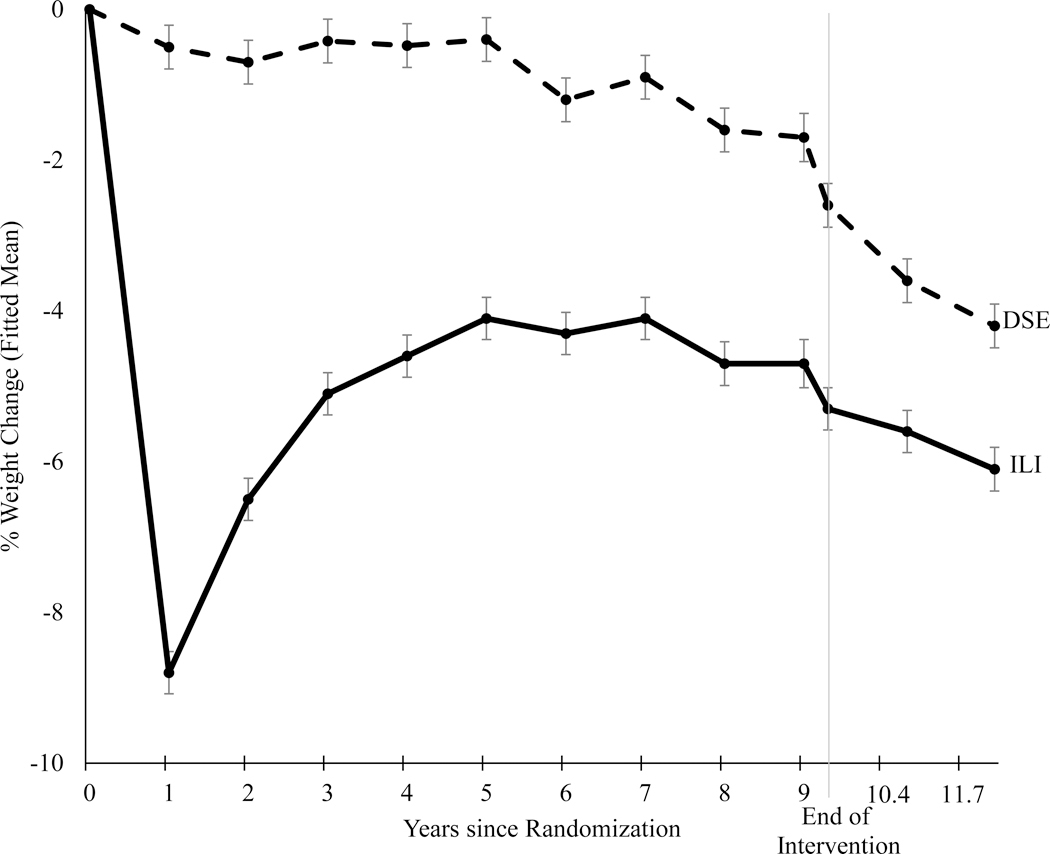
To evaluate weight changes after cessation of the 10-year intensive lifestyle intervention (ILI) in the Look AHEAD (Action for Health in Diabetes) study. We hypothesized that ILI participants would be more likely to gain weight during the 2-year observational period following termination of weight-loss-maintenance counseling than would participants in the Diabetes Support and Education (DSE) control group.
Methods:
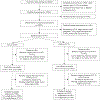
Look AHEAD was an RCT that compared the effects of ILI and DSE on cardiovascular morbidity and mortality in participants with overweight/obesity and type 2 diabetes. Look AHEAD was converted to an observational study in September 2012.
Results:
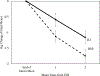
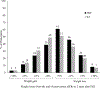
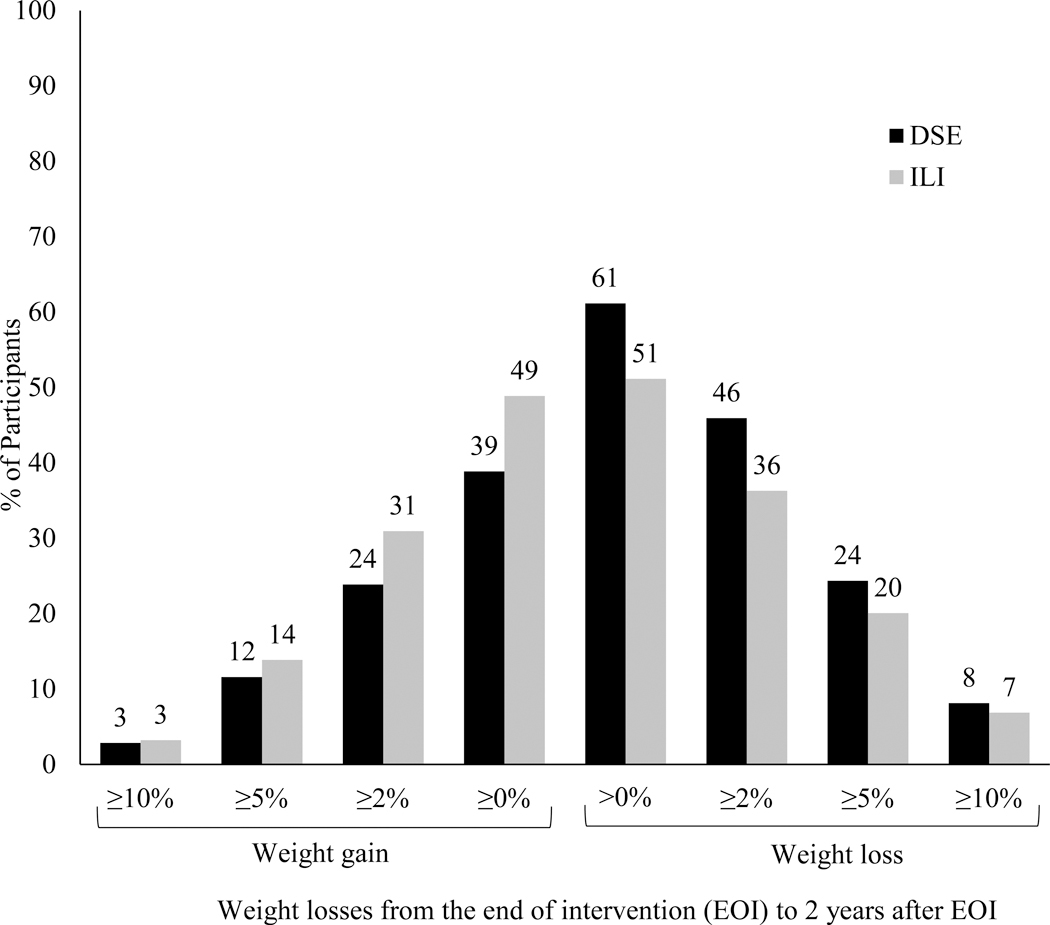
Two years after the EOI, ILI and DSE participants lost a mean±SE of 1.2±0.2 kg and 1.8±0.2 kg, respectively (p=0.003). Thirty-one percent of ILI and 23.9% of DSE participants gained ≥2% (p<0.001) of EOI weight, while 36.3% and 45.9% of the two groups, respectively, lost ≥2% of EOI weight (p=0.001). Two years after the EOI, ILI participants reported greater use of weight-control behaviors than DSE participants.
Conclusions:
Both groups lost weight during the 2-year follow-up period, but more ILI than DSE participants gained ≥2% of EOI weight. Further understanding is needed of factors that affected long-term weight change in both groups.
Clinical trials registration:
NCT00017953 -
Subjects:
-
Source:Obesity (Silver Spring). 28(5):893-901
-
Pubmed ID:32320144
-
Pubmed Central ID:PMC7437140
-
Document Type:
-
Funding:DK57177/DK/NIDDK NIH HHS/United States ; HL/NHLBI NIH HHS/United States ; U01 DK057219/DK/NIDDK NIH HHS/United States ; U01 DK057154/DK/NIDDK NIH HHS/United States ; DK57219/DK/NIDDK NIH HHS/United States ; U01 DK057182/DK/NIDDK NIH HHS/United States ; U01 DK057136/DK/NIDDK NIH HHS/United States ; U01 DK057002/DK/NIDDK NIH HHS/United States ; DK57078/DK/NIDDK NIH HHS/United States ; DK57149/DK/NIDDK NIH HHS/United States ; U01 DK057131/DK/NIDDK NIH HHS/United States ; K23NR017209/NR/NINR NIH HHS/United States ; U01 DK057008/DK/NIDDK NIH HHS/United States ; U01 DK057149/DK/NIDDK NIH HHS/United States ; K23 NR017209/NR/NINR NIH HHS/United States ; DK57131/DK/NIDDK NIH HHS/United States ; MD/NIMHD NIH HHS/United States ; U01 DK057151/DK/NIDDK NIH HHS/United States ; DK57182/DK/NIDDK NIH HHS/United States ; DK57171/DK/NIDDK NIH HHS/United States ; U01 DK057135/DK/NIDDK NIH HHS/United States ; DK57136/DK/NIDDK NIH HHS/United States ; DK57151/DK/NIDDK NIH HHS/United States ; U01 DK056992/DK/NIDDK NIH HHS/United States ; U01 DK057171/DK/NIDDK NIH HHS/United States ; DK57008/DK/NIDDK NIH HHS/United States ; DK57135/DK/NIDDK NIH HHS/United States ; DK57178/DK/NIDDK NIH HHS/United States ; DK56990/DK/NIDDK NIH HHS/United States ; Indian Health Service/International ; P30 DK111022/DK/NIDDK NIH HHS/United States ; U01 DK057177/DK/NIDDK NIH HHS/United States ; Office of Research on Women's Health/International ; U01 DK057078/DK/NIDDK NIH HHS/United States ; DK57154/DK/NIDDK NIH HHS/United States ; U01 DK056990/DK/NIDDK NIH HHS/United States ; U01 DK057178/DK/NIDDK NIH HHS/United States ; DK57002/DK/NIDDK NIH HHS/United States ; DK56992/DK/NIDDK NIH HHS/United States ; P30 DK017047/DK/NIDDK NIH HHS/United States ; CC/CDC HHS/United States
-
Volume:28
-
Issue:5
-
Download URL:
-
File Type:
 [PDF - 1.41 MB]
 -
Collection(s):
-
Main Document Checksum:urn:sha256:580d31518bb52b1446b78e51a1f3a974a9792ed1af58e752d2d2a80d8902df6b
Supporting Files


File Language:
English
 Was this page helpful?
 Found an issue?



CDC STACKS serves as an archival repository of CDC-published products including
scientific findings, journal articles, guidelines, recommendations, or other public health information authored or
co-authored by CDC or funded partners.
As a repository, CDC STACKS retains documents in their original published format to ensure public access to scientific information.
As a repository, CDC STACKS retains documents in their original published format to ensure public access to scientific information.
You May Also Like
COLLECTION
CDC Public Access