



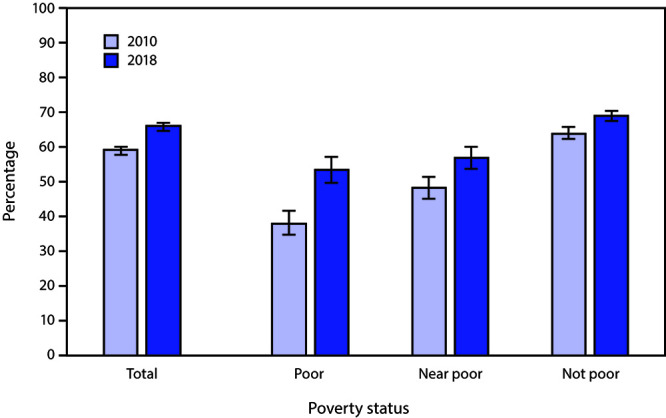
QuickStats: Percentage of Adults Aged 50–75 Years Who Received Colorectal Cancer Screening, by Poverty Status and Year — National Health Interview Survey, United States, 2010 and 2018
Supporting Files
Public Domain

-
July 24 2020
File Language:
English
Details
-
Alternative Title:Percentage of Adults Aged 50–75 Years Who Received Colorectal Cancer Screening, by Poverty Status and Year — National Health Interview Survey, United States, 2010 and 2018
-
Journal Article:Morbidity and Mortality Weekly Report (MMWR)
-
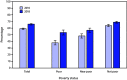
Description:The percentage of adults aged 50–75 years who received colorectal cancer tests or procedures increased from 58.7% in 2010 to 65.5% in 2018. The percentage increased from 2010 to 2018 in all income groups: from 37.9% to 53.1% among poor, 47.9% to 56.7% among near poor, and 63.6% to 68.7% among not poor adults. In both 2010 and 2018, the percentage of adults who received colorectal cancer screening was lowest among poor and highest among not poor adults.
Source: National Health Interview Survey, 2010 and 2018. https://www.cdc.gov/nchs/nhis.htm.
Reported by: Nazik Elgaddal, MS; Yelena Gorina, MPH, MS. -
Subjects:
-
Source:MMWR Morb Mortal Wkly Rep. 69 (29):976
-
Series:
-
ISSN:0149-2195 (print) ; 1545-861X (digital)
-
Document Type:
-
Genre:
-
Place as Subject:
-
CIO:
-
Topic:
-
Volume:69
-
Issue:29
-
Download URL:
-
File Type:
 [PDF - 68.90 KB]
 -
Collection(s):
-
Main Document Checksum:urn:sha-512:ac602cd57522cef72202cc30ffc3bdcbfd4ee9f13152d6f5001ed2cf4de35d529c2bd74e42fa0bc5906eaae6faa8f88f09811a84c0e280a00c7ef9c464fcade9
Supporting Files


File Language:
English
 Was this page helpful?
 Found an issue?

CDC STACKS serves as an archival repository of CDC-published products including
scientific findings, journal articles, guidelines, recommendations, or other public health information authored or
co-authored by CDC or funded partners.
As a repository, CDC STACKS retains documents in their original published format to ensure public access to scientific information.
As a repository, CDC STACKS retains documents in their original published format to ensure public access to scientific information.
You May Also Like