



The role of obesity in the relation between total water intake and urine osmolality in US adults, 2009–20121–3
Supporting Files

-
12 2016
-
Available in CDC Stacks on 2020-07-30T00:00:00Z
File Language:
English
Details
-
Journal Article:Am J Clin Nutr
-
Personal Author:
-
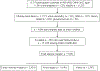
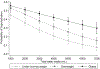
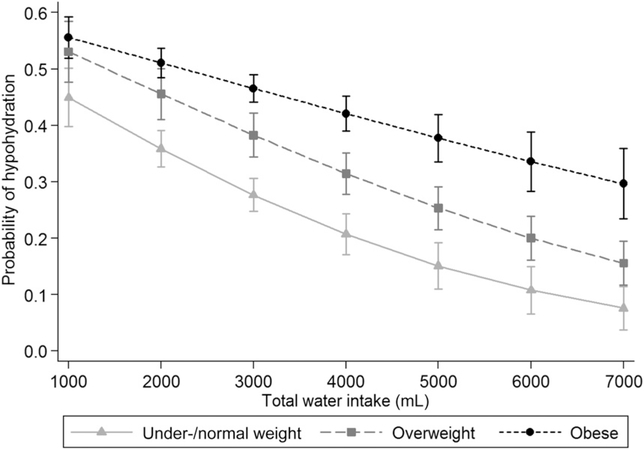
Description:Background ; Adequate water intake is critical to physiologic and cognitive functioning. Although water requirements increase with body size, it remains unclear whether weight status modifies the relation between water intake and hydration status. ; Objective ; We examined how the association between water intake and urine osmolality, which is a hydration biomarker, varied by weight status. ; Design ; NHANES cross-sectional data (2009–2012) were analyzed in 9601 nonpregnant adults aged ≥20 y who did not have kidney failure. Weight status was categorized with the use of body mass index on the basis of measured height and weight (underweight or normal weight, overweight, and obesity). Urine osmolality was determined with the use of freezing-point depression osmometry. Hypohydration was classified according to the following age-dependent formula: ≥831 mOsm/kg – 3.4 × (age − 20 y). Total water intake was determined with the use of a 24-h dietary recall and was dichotomized as adequate or low on the basis of the Institute of Medicine’s adequate intake recommendations for men and women (men: ≥3.7 or <3.7 L; nonlactating women: ≥2.7 or <2.7 L; lactating women: ≥3.8 or <3.8 L for adequate or low intakes, respectively). We tested interactions and conducted linear and log-binomial regressions. ; Results ; Total water intake (P = 0.002), urine osmolality (P < 0.001), and hypohydration prevalence (P < 0.001) all increased with higher weight status. Interactions between weight status and water intake status were significant in linear (P = 0.005) and log-binomial (P = 0.015) models, which were then stratified. The prevalence ratio of hypohydration between subjects with adequate water intake and those with low water intake was 0.56 (95% CI: 0.43, 0.73) in adults who were underweight or normal weight, 0.67 (95% CI: 0.57, 0.79) in adults who were overweight, and 0.78 (95% CI: 0.70, 0.88) in adults who were obese. ; Conclusion ; On a population level, obesity modifies the association between water intake and hydration status.
-
Subjects:
-
Keywords:
-
Source:Am J Clin Nutr. 104(6):1554-1561
-
DOI:
-
Pubmed ID:27935519
-
Pubmed Central ID:PMC7392307
-
Document Type:
-
Funding:
-
Genre:
-
Volume:104
-
Issue:6
-
Download URL:
-
File Type:
 [PDF - 996.02 KB]
 -
Collection(s):
-
Main Document Checksum:urn:sha-512:3e93a9a4dc3c96029d17b8350fc9219de88389077ed520889385fc6994f63bf9d633a1f5cacaa5fb0a0f76ba2d99fd79917aafe3209ebec58226a425b80577e0
Supporting Files


File Language:
English
 Was this page helpful?
 Found an issue?



CDC STACKS serves as an archival repository of CDC-published products including
scientific findings, journal articles, guidelines, recommendations, or other public health information authored or
co-authored by CDC or funded partners.
As a repository, CDC STACKS retains documents in their original published format to ensure public access to scientific information.
As a repository, CDC STACKS retains documents in their original published format to ensure public access to scientific information.
You May Also Like
COLLECTION
CDC Public Access