


Determinants of linear growth faltering among children with moderate-to-severe diarrhea in the Global Enteric Multicenter Study
Supporting Files

-
November 25 2019
-
File Language:
English
Details
-
Alternative Title:BMC Med
-
Personal Author:Brander, Rebecca L. ; Pavlinac, Patricia B. ; Walson, Judd L. ; John-Stewart, Grace C. ; Weaver, Marcia R. ; Faruque, Abu S. G. ; Zaidi, Anita K. M. ; Sur, Dipika ; Sow, Samba O. ; Hossain, M. Jahangir ; Alonso, Pedro L. ; Breiman, Robert F. ; Nasrin, Dilruba ; Nataro, James P. ; Levine, Myron M. ; Kotloff, Karen L.
-
Description:Background
Moderate-to-severe diarrhea (MSD) in the first 2 years of life can impair linear growth. We sought to determine risk factors for linear growth faltering and to build a clinical prediction tool to identify children most likely to experience growth faltering following an episode of MSD.
Methods
Using data from the Global Enteric Multicenter Study of children 0–23 months old presenting with MSD in Africa and Asia, we performed log-binomial regression to determine clinical and sociodemographic factors associated with severe linear growth faltering (loss of ≥ 0.5 length-for-age z-score [LAZ]). Linear regression was used to estimate associations with ΔLAZ. A clinical prediction tool was developed using backward elimination of potential variables, and Akaike Information Criterion to select the best fit model.
Results
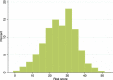
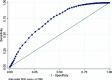
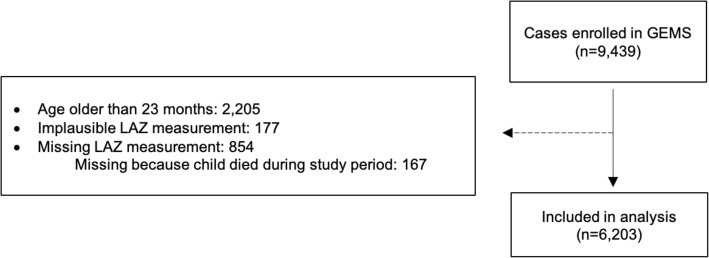
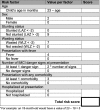
Of the 5902 included children, mean age was 10 months and 43.2% were female. Over the 50–90-day follow-up period, 24.2% of children had severe linear growth faltering and the mean ΔLAZ over follow-up was − 0.17 (standard deviation [SD] 0.54). After adjustment for age, baseline LAZ, and site, several factors were associated with decline in LAZ: young age, acute malnutrition, hospitalization at presentation, non-dysenteric diarrhea, unimproved sanitation, lower wealth, fever, co-morbidity, or an IMCI danger sign. Compared to children 12–23 months old, those 0–6 months were more likely to experience severe linear growth faltering (adjusted prevalence ratio [aPR] 1.97 [95% CI 1.70, 2.28]), as were children 6–12 months of age (aPR 1.72 [95% CI 1.51, 1.95]). A prediction model that included age, wasting, stunting, presentation with fever, and presentation with an IMCI danger sign had an area under the ROC (AUC) of 0.67 (95% CI 0.64, 0.69). Risk scores ranged from 0 to 37, and a cut-off of 21 maximized sensitivity (60.7%) and specificity (63.5%).
Conclusion
Younger age, acute malnutrition, MSD severity, and sociodemographic factors were associated with short-term linear growth deterioration following MSD. Data routinely obtained at MSD may be useful to predict children at risk for growth deterioration who would benefit from interventions.
-
Subjects:
-
Source:BMC Med. 17
-
Pubmed ID:31767012
-
Pubmed Central ID:PMC6878715
-
Document Type:
-
Funding:
-
Place as Subject:
-
Volume:17
-
Collection(s):
-
Main Document Checksum:urn:sha256:35995bd06bbdb5a2c369887dd9e2e9f140f7f14ed37b5d4f4ea742f5ee356c90
-
Download URL:
-
File Type:
 [PDF
- 1.23 MB
]
[PDF
- 1.23 MB
]
Supporting Files


File Language:
English
ON THIS PAGE






CDC STACKS serves as an archival repository of CDC-published products including
scientific findings,
journal articles, guidelines, recommendations, or other public health information authored or
co-authored by CDC or funded partners.
As a repository, CDC STACKS retains documents in their original published format to ensure public access to scientific information.
As a repository, CDC STACKS retains documents in their original published format to ensure public access to scientific information.
You May Also Like
COLLECTION
CDC Public Access