


Investigation of Japanese encephalitis virus as a cause of acute encephalitis in southern Pakistan, April 2015–January 2018
Supporting Files
Public Domain

-
June 12 2020
-
File Language:
English
Details
-
Alternative Title:PLoS One
-
Personal Author:
-
Description:Background
Japanese encephalitis (JE) occurs in fewer than 1% of JE virus (JEV) infections, often with catastrophic sequelae including death and neuropsychiatric disability. JEV transmission in Pakistan was documented in 1980s and 1990s, but recent evidence is lacking. Our objective was to investigate JEV as a cause of acute encephalitis in Pakistan.
Methods
Persons aged ≥1 month with possible JE admitted to two acute care hospitals in Karachi, Pakistan from April 2015 to January 2018 were enrolled. Cerebrospinal fluid (CSF) or serum samples were tested for JEV immunoglobulin M (IgM) using the InBios JE DetectTM assay. Positive or equivocal samples had confirmatory testing using plaque reduction neutralization tests.
Results
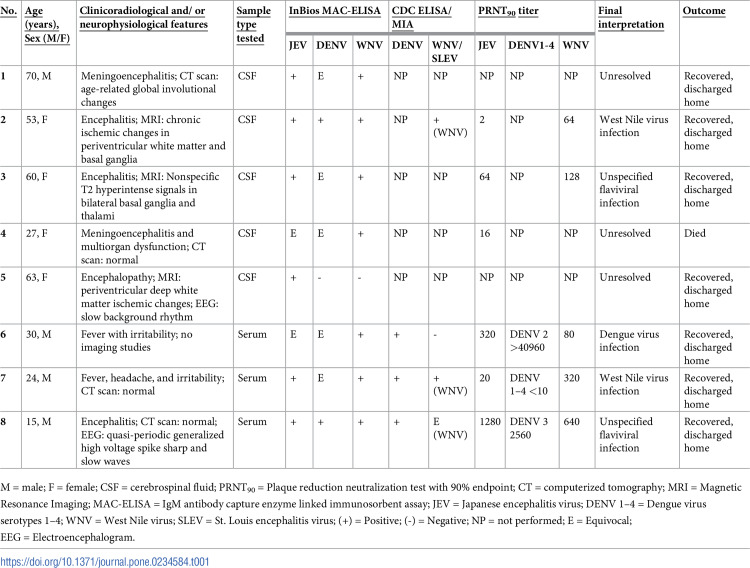
Among 227 patients, testing was performed on CSF in 174 (77%) and on serum in 53 (23%) patients. Six of eight patient samples positive or equivocal for JEV IgM had sufficient volume for confirmatory testing. One patient had evidence of recent West Nile virus (WNV) neurologic infection based on CSF testing. One patient each had recent dengue virus (DENV) infection and WNV infection based on serum results. Recent flavivirus infections were identified in two persons, one each based on CSF and serum results. Specific flaviviruses could not be identified due to serologic cross-reactivity. For the sixth person, JEV neutralizing antibodies were confirmed in CSF but there was insufficient volume for further testing.
Conclusions
Hospital-based JE surveillance in Karachi, Pakistan could not confirm or exclude local JEV transmission. Nonetheless, Pakistan remains at risk for JE due to presence of the mosquito vector, amplifying hosts, and rice irrigation. Laboratory surveillance for JE should continue among persons with acute encephalitis. However, in view of serological cross-reactivity, confirmatory testing of JE IgM positive samples at a reference laboratory is essential.
-
Subjects:
-
Source:PLoS One. 15(6)
-
Pubmed ID:32530966
-
Pubmed Central ID:PMC7292402
-
Document Type:
-
Place as Subject:
-
Volume:15
-
Issue:6
-
Collection(s):
-
Main Document Checksum:urn:sha256:d45688edd3c2b2c37709814b56ba8c4a47b845da1b9db63e06c3e0e82b7778f9
-
Download URL:
-
File Type:
 [PDF
- 387.12 KB
]
[PDF
- 387.12 KB
]
Supporting Files


File Language:
English
ON THIS PAGE

CDC STACKS serves as an archival repository of CDC-published products including
scientific findings,
journal articles, guidelines, recommendations, or other public health information authored or
co-authored by CDC or funded partners.
As a repository, CDC STACKS retains documents in their original published format to ensure public access to scientific information.
As a repository, CDC STACKS retains documents in their original published format to ensure public access to scientific information.
You May Also Like
COLLECTION
CDC Public Access