


Host-Species Transferrin Receptor 1 Orthologs Are Cellular Receptors for Nonpathogenic New World Clade B Arenaviruses
Supporting Files

-
April 03 2009
-
File Language:
English
Details
-
Alternative Title:PLoS Pathog
-
Personal Author:
-
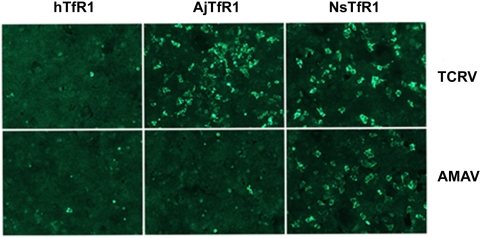
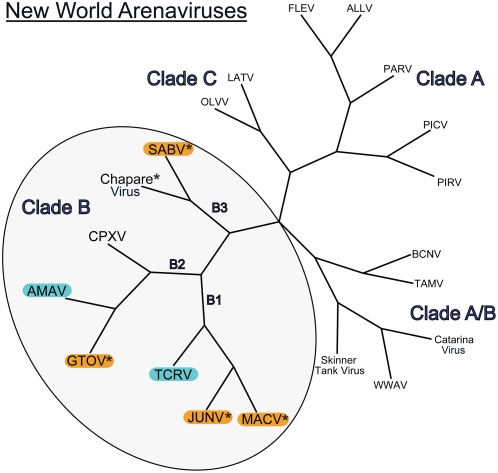
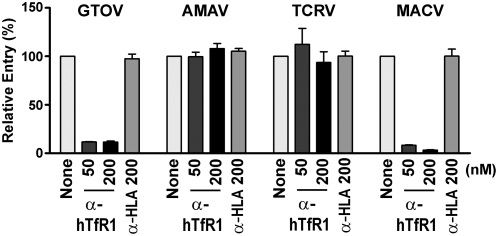
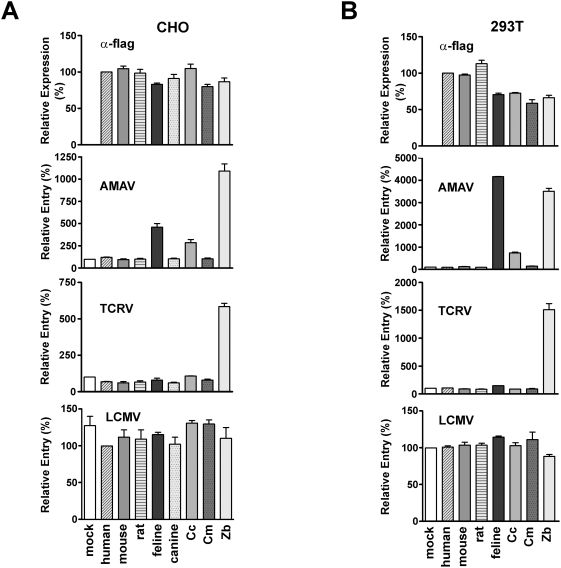
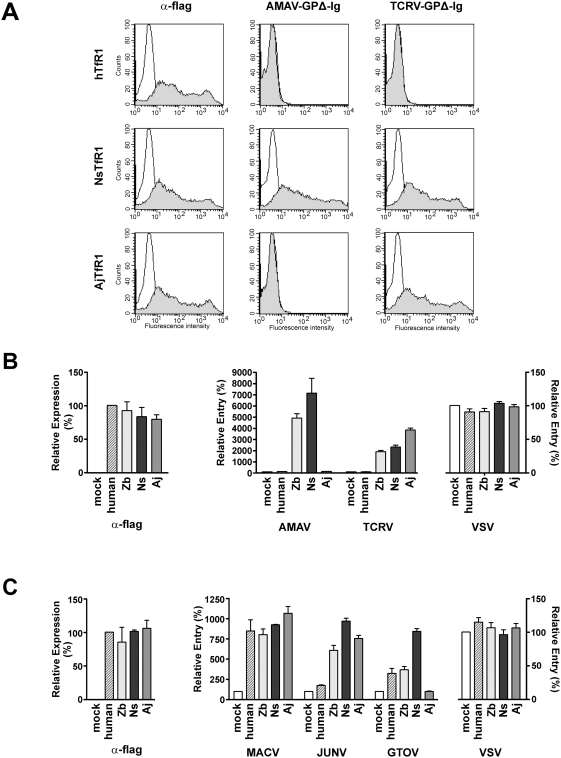
Description:The ability of a New World (NW) clade B arenavirus to enter cells using human transferrin receptor 1 (TfR1) strictly correlates with its ability to cause hemorrhagic fever. Amapari (AMAV) and Tacaribe (TCRV), two nonpathogenic NW clade B arenaviruses that do not use human TfR1, are closely related to the NW arenaviruses that cause hemorrhagic fevers. Here we show that pseudotyped viruses bearing the surface glycoprotein (GP) of AMAV or TCRV can infect cells using the TfR1 orthologs of several mammalian species, including those of their respective natural hosts, the small rodent Neacomys spinosus and the fruit bat Artibeus jamaicensis. Mutation of one residue in human TfR1 makes it a functional receptor for TCRV, and mutation of four residues makes it a functional receptor for AMAV. Our data support an in vivo role for TfR1 in the replication of most, if not all, NW clade B arenaviruses, and suggest that with modest changes in their GPs the nonpathogenic arenaviruses could use human TfR1 and emerge as human pathogens.
-
Subjects:
-
Source:PLoS Pathog. 2009; 5(4)
-
Pubmed ID:19343214
-
Pubmed Central ID:PMC2658809
-
Document Type:
-
Funding:
-
Volume:5
-
Issue:4
-
Collection(s):
-
Main Document Checksum:urn:sha256:1db6293fd1d9399ead656dfec265d9cc9f6f9490fa475427c4ebf009ce90c933
-
Download URL:
-
File Type:
 [PDF
- 892.21 KB
]
[PDF
- 892.21 KB
]
Supporting Files


File Language:
English
ON THIS PAGE



CDC STACKS serves as an archival repository of CDC-published products including
scientific findings,
journal articles, guidelines, recommendations, or other public health information authored or
co-authored by CDC or funded partners.
As a repository, CDC STACKS retains documents in their original published format to ensure public access to scientific information.
As a repository, CDC STACKS retains documents in their original published format to ensure public access to scientific information.
You May Also Like
COLLECTION
CDC Public Access