


Implementation of Case-Based Surveillance and Real-time Polymerase Chain Reaction to Monitor Bacterial Meningitis Pathogens in Chad
Supporting Files
Public Domain

-
October 31 2019
-
File Language:
English
Details
-
Alternative Title:J Infect Dis
-
Personal Author:
-
Description:Background
Meningococcal serogroup A conjugate vaccine (MACV) was introduced in Chad during 2011–2012. Meningitis surveillance has been conducted nationwide since 2003, with case-based surveillance (CBS) in select districts from 2012. In 2016, the MenAfriNet consortium supported Chad to implement CBS in 4 additional districts and real-time polymerase chain reaction (rt-PCR) at the national reference laboratory (NRL) to improve pathogen detection. We describe analysis of bacterial meningitis cases during 3 periods: pre-MACV (2010–2012), pre-MenAfriNet (2013–2015), and post-MenAfriNet (2016–2018).
Methods
National surveillance targeted meningitis cases caused by Neisseria meningitidis, Haemophilus influenzae, and Streptococcus pneumoniae. Cerebrospinal fluid specimens, inoculated trans-isolate media, and/or isolates from suspected meningitis cases were tested via culture, latex, and/or rt-PCR; confirmed bacterial meningitis was defined by a positive result on any test. We calculated proportion of suspected cases with a specimen received by period, and proportion of specimens with a bacterial meningitis pathogen identified, by period, pathogen, and test.
Results
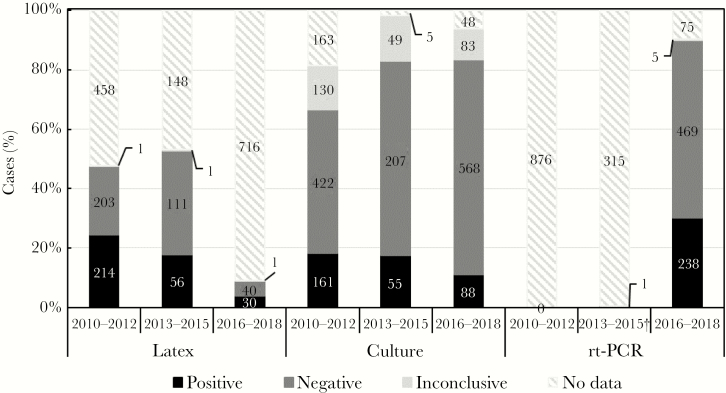
The NRL received specimens for 6.8% (876/12813), 46.4% (316/681), and 79.1% (787/995) of suspected meningitis cases in 2010–2012, 2013–2015, and 2016–2018, respectively, with a bacterial meningitis pathogen detected in 33.6% (294/876), 27.8% (88/316), and 33.2% (261/787) of tested specimens. The number of N. meningitidis serogroup A (NmA) among confirmed bacterial meningitis cases decreased from 254 (86.4%) during 2010–2012 to 2 (2.3%) during 2013–2015, with zero NmA cases detected after 2014. In contrast, proportional and absolute increases were seen between 2010–2012, 2013–2015, and 2016–2018 in cases caused by S. pneumoniae (5.1% [15/294], 65.9% [58/88], and 52.1% [136/261]), NmX (0.7% [2/294], 1.1% [1/88], and 22.2% [58/261]), and Hib (0.3% [1/294], 11.4% [10/88], and 14.9% [39/261]). Of specimens received at the NRL, proportions tested during the 3 periods were 47.7% (418), 53.2% (168), and 9.0% (71) by latex; 81.4% (713), 98.4% (311), and 93.9% (739) by culture; and 0.0% (0), 0.0% (0), and 90.5% (712) by rt-PCR, respectively. During the post-MenAfriNet period (2016–2018), 86.1% (678) of confirmed cases were tested by both culture and rt-PCR, with 12.5% (85) and 32.4% (220) positive by culture and rt-PCR, respectively.
Conclusions
CBS implementation was associated with increased specimen referral. Increased detection of non-NmA cases could reflect changes in incidence or increased sensitivity of case detection with rt-PCR. Continued surveillance with the use of rt-PCR to monitor changing epidemiology could inform the development of effective vaccination strategies.
-
Subjects:
-
Source:J Infect Dis. 2019; 220(Suppl 4):S182-S189
-
Pubmed ID:31671450
-
Pubmed Central ID:PMC6822964
-
Document Type:
-
Name as Subject:
-
Place as Subject:
-
Volume:220
-
Collection(s):
-
Main Document Checksum:urn:sha256:610da5738ee74996fc18f715d05b0e994a2cfbc38256af5d2b663ff24dc0b208
-
Download URL:
-
File Type:
 [PDF
- 813.43 KB
]
[PDF
- 813.43 KB
]
Supporting Files


File Language:
English
ON THIS PAGE


CDC STACKS serves as an archival repository of CDC-published products including
scientific findings,
journal articles, guidelines, recommendations, or other public health information authored or
co-authored by CDC or funded partners.
As a repository, CDC STACKS retains documents in their original published format to ensure public access to scientific information.
As a repository, CDC STACKS retains documents in their original published format to ensure public access to scientific information.
You May Also Like
COLLECTION
CDC Public Access